• Skip to main content
  • Skip to secondary menu
  • Skip to primary sidebar
OrthopaedicPrinciples.com

OrthopaedicPrinciples.com

Integrating Principles and Evidence

Integrating Principles and Evidence

  • Home
  • Editorial Board
  • Our Books
    • Evidence Based Orthopaedic Principles
  • Courses
  • Exams
  • Reviews
  • Live Program
  • Contact

Teres Minor-Why is it Important?

Courtesy: Prof Nabil Ebraheim, University of Toledo, Ohio, USA

GENERAL ANATOMY

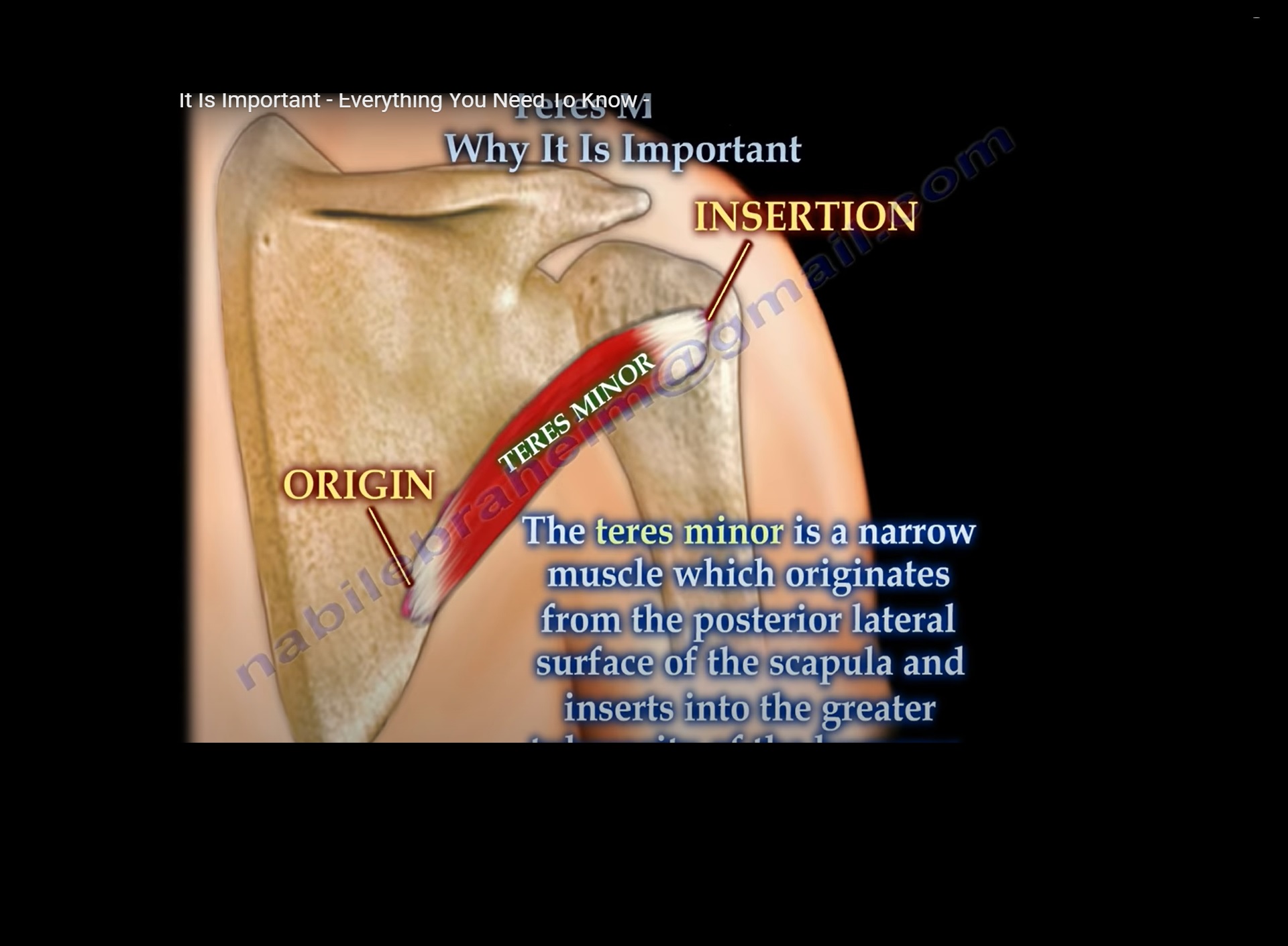
  • The teres minor is a small, narrow muscle of the rotator cuff.

  • It is located on the posterior aspect of the shoulder.

  • Functions primarily as an external rotator of the shoulder and contributes to glenohumeral stability.


TRIANGULAR SPACE

Boundaries

  • Superior: Lower border of the teres minor

  • Inferior: Teres major

  • Lateral: Long head of the triceps brachii

Contents

  • Circumflex scapular artery


QUADRANGULAR SPACE

Boundaries

  • Superior: Teres minor

  • Inferior: Teres major

  • Medial: Long head of the triceps brachii

  • Lateral: Surgical neck of the humerus

Contents

  • Axillary nerve

  • Posterior circumflex humeral artery

Imaging

  • Best visualized on sagittal section magnetic resonance imaging.


INNERVATION

  • Supplied by the posterior branch of the axillary nerve.


FUNCTION

  • External rotation of the shoulder joint.

  • Stabilization of the humeral head within the glenoid during arm movements.


CLINICAL EXAMINATION

Hornblower Test

  • The patient is seated or standing.

  • The examiner positions the shoulder in 90 degrees of abduction in the scapular plane.

  • The elbow is flexed to 90 degrees.

  • The patient is asked to externally rotate the arm against resistance.

Positive Test

  • Weakness or pain during resisted external rotation.

  • Suggests teres minor dysfunction or tear.


SURGICAL IMPORTANCE

  • The teres minor is an important anatomical landmark in the posterior approach to the shoulder joint.

  • Preservation of the muscle and its nerve supply is essential during posterior surgical exposures.


TERES MINOR ATROPHY

Causes

  • Idiopathic muscle atrophy

  • Quadrangular space syndrome, due to compression of the axillary nerve

  • Associated rotator cuff pathology

Clinical Significance

  • Atrophy leads to weakness in external rotation.

  • Often identified incidentally on magnetic resonance imaging.

  • May contribute to posterior shoulder pain and functional impairment.


CLINICAL RELEVANCE

  • The teres minor plays a key role in posterior shoulder stability.

  • Pathology may be overlooked but has significant implications for shoulder function.

  • Knowledge of the surrounding spaces is critical in:

    • Trauma

    • Tumor surgery

    • Nerve compression syndromes

    • Posterior shoulder approaches

Post Views: 2,070

Related Posts

  • Anatomy of the Teres Major

      Anatomy of the Teres Major Muscle Overview The teres major is a thick, powerful…

  • Anatomy Of The Pectoralis Minor Muscle

    Courtesy: Prof Nabil Ebraheim, University of Toledo, Ohio, USA ANATOMY OF PECTORALIS MINOR Pectoralis minor…

  • Sciatica Anatomy

    Courtesy: Prof Nabil Ebraheim University of Toledo, Ohio, USA Anatomy of sciatica The sciatic nerve…

Reader Interactions

Comments

  1. Yogendra S Patel says

    at

    Its very nice and valuable explanation on teres minor bio mechanical importance.i request you to pls give some more information regarding shoulder complex or scapulo-humerl rythme……

    thanks for such kind of vedio

Leave a Reply

Your email address will not be published. Required fields are marked *

Primary Sidebar

Follow Us

instagram slideshare

Categories

  • -Applied Anatomy
  • -Approaches
  • -Basic Sciences
  • -Cartilage & Meniscus
  • -Classifications
  • -Examination
  • -Foot and Ankle
  • -Foot and Ankle Trauma
  • -FRCS(Tr and Orth) tutorials
  • -Gait
  • -Hand and Wrist
  • -Hand and Wrist Trauma
  • -Hand Infections
  • -Hip and Knee
  • -Hip Preservation
  • -Infections
  • -Joint Reconstruction
  • -Knee Arthroplasty
  • -Knee Preservation
  • -Metabolic Disorders
  • -Oncology
  • -OrthoBiologics
  • -OrthoPlastic
  • -Paediatric Orthopaedics
  • -Paediatric Trauma
  • -Patellofemoral Joint
  • -Pelvis
  • -Peripheral Nerves
  • -Principles
  • -Principles of Surgery
  • -Radiology
  • -Rheumatology
  • -Shoulder and Elbow
  • -Shoulder and Elbow Arthroplasty
  • -Spine Deformity
  • -Spine Oncology
  • -Spine Trauma
  • -Spine, Pelvis & Neurology
  • -Sports Ankle and Foot
  • -Sports Elbow
  • -Sports Knee
  • -Sports Medicine
  • -Sports Medicine Hip
  • -Sports Shoulder
  • -Sports Wrist
  • -Statistics
  • -Technical Tip
  • -Technology in Orth
  • -Trauma
  • -Trauma (Upper Limb)
  • -Trauma Life Support
  • -Trauma Reconstruction
  • Book Shelf
  • Book Shelf Medical
  • Careers
  • Case Studies and Free Papers
  • DNB Ortho
  • Evidence Based Orthopaedic Principles
  • Evidence Based Orthopaedics
  • Exam Corner
  • Fellowships
  • Guest Editor
  • Guest Reviews
  • Image Quiz
  • Instructional Course Lectures
  • Journal Club
  • MCQs
  • Meetings and Courses
  • Multimedia
  • News and Blog
  • Plaster Techniques
  • Podcasts
  • Public Health
  • Rehabilitation
  • Research
  • Shorts and Reels
Copyright@orthopaedicprinciples.com. All right rerserved.