
Courtesy – Dr Nabil Ebrahim
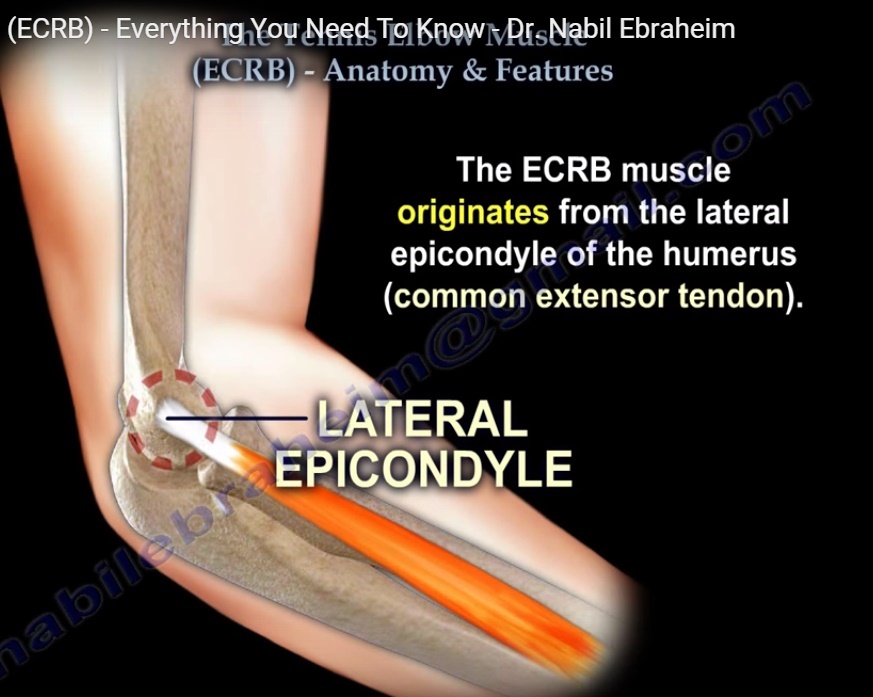
• Most common cause of lateral elbow pain.
• Degenerative tendinopathy involving the extensor carpi radialis brevis (ECRB) tendon.
• Caused by repetitive overuse rather than acute inflammation.
Golfer’s Elbow (Medial Epicondylitis)
• Overuse injury involving the common flexor tendon origin.
• Produces pain over the medial epicondyle.
Anatomy
Bony Anatomy
The elbow consists of:
• Humerus
• Radius
• Ulna
Lateral Side
Common extensor tendon originates from the lateral epicondyle.
Most commonly involved tendon:
• Extensor carpi radialis brevis (ECRB)
Medial Side
Common flexor tendon originates from the medial epicondyle.
Pathophysiology
Repetitive wrist motion produces:
• Microtears within the tendon
• Tendon degeneration
• Fibroblastic proliferation
• Tendinosis
Histology shows:
• Angiofibroblastic hyperplasia
• Collagen disorganization
Risk Factors
Tennis Elbow
• Repetitive wrist extension
• Manual labor
• Racquet sports
• Repetitive gripping
• Twisting activities
Golfer’s Elbow
• Repetitive wrist flexion
• Throwing sports
• Golf
• Heavy lifting
Clinical Features
Tennis Elbow
• Lateral elbow pain
• Tenderness over the lateral epicondyle
• Pain during gripping
• Pain with resisted wrist extension
• Reduced grip strength
Golfer’s Elbow
• Medial elbow pain
• Tenderness over the medial epicondyle
• Pain with resisted wrist flexion
• Symptoms aggravated by wrist movement
Differential Diagnosis
Radial Tunnel Syndrome
Important cause of persistent lateral elbow pain.
Characteristics:
• Pain distal to the lateral epicondyle
• Pain radiates down the forearm
• Due to compression of the posterior interosseous nerve (PIN)
Clinical Pearl
If symptoms fail to improve with treatment for tennis elbow, always consider radial tunnel syndrome.
Posterior Interosseous Nerve
• Branch of the radial nerve.
• Enters the supinator muscle distal to the radial head.
• Compression causes radial tunnel syndrome.
Ultrasound Evaluation
Patient Position
• Elbow semiflexed
• Forearm pronated
Probe Position
• Parallel to the lateral epicondyle
• Over the radial head
Normal Findings
• Smooth homogeneous tendon
• No Doppler vascularity
Abnormal Findings
• Tendon thickening
• Partial tears
• Calcification
• Increased Doppler flow
• Loss of normal fibrillar pattern
Conservative Treatment
Approximately 90% of patients improve within 6 to 12 months.
Treatment Options
• Activity modification
• NSAIDs
• Physiotherapy
• Eccentric strengthening exercises
• Counterforce brace
Injection Therapy
Corticosteroid Injection
• Landmark guided
• Ultrasound guided
Platelet Rich Plasma (PRP)
• Used in chronic tendinopathy
• May be combined with needle fenestration
Ultrasound Guided Injection
Advantages:
• Accurate needle placement
• Visualization of tendon pathology
• Improved safety
Needle Fenestration
Technique:
• Multiple needle punctures through the degenerative tendon.
Purpose:
• Stimulates healing response.
• Increases local vascularity.
Surgical Treatment
Indications
• Persistent symptoms despite prolonged conservative treatment
• Functional limitation
• Failure of nonoperative treatment
Procedure
• Debridement of degenerative tendon
• Tendon repair when necessary
Important Precaution
Avoid injury to the lateral collateral ligament complex.
Damage to this ligament may result in:
• Posterolateral rotatory instability of the elbow
Outcomes
Conservative Treatment
• Approximately 90% success
• Recovery within 6 to 12 months
Surgical Treatment
• Approximately 85 to 90% success
Key Take Home Messages
• Tennis elbow is a degenerative tendinopathy of the ECRB tendon.
• Golfer’s elbow involves the common flexor tendon origin.
• Radial tunnel syndrome is the most important differential diagnosis for lateral elbow pain.
• Ultrasound helps identify tendon tears, calcification, and increased vascularity.
• Eccentric physiotherapy is the cornerstone of treatment.
• Ultrasound guided PRP or corticosteroid injection may be considered in selected patients.
• Surgery is reserved for patients who fail prolonged conservative treatment.
• Protect the lateral collateral ligament during surgery to prevent elbow instability.
Exam Pearls
• ECRB is the tendon most commonly affected in tennis elbow.
• Posterior interosseous nerve compression causes radial tunnel syndrome.
• Radial tunnel pain is located distal to the lateral epicondyle.
• Ultrasound guided injections improve injection accuracy.
• Eccentric exercises remain the most effective physiotherapy modality.
• Injury to the lateral collateral ligament during surgery may cause posterolateral rotatory instability.

Leave a Reply