• Skip to main content
  • Skip to secondary menu
  • Skip to primary sidebar
OrthopaedicPrinciples.com

OrthopaedicPrinciples.com

Integrating Principles and Evidence

Integrating Principles and Evidence

  • Home
  • Editorial Board
  • Our Books
    • Evidence Based Orthopaedic Principles
  • Courses
  • Exams
  • Reviews
  • Live Program
  • Contact

Tendon arrangement in the Ankle Region

Courtesy: Prof Nabil Ebraheim, University of Toledo, Ohio, USA
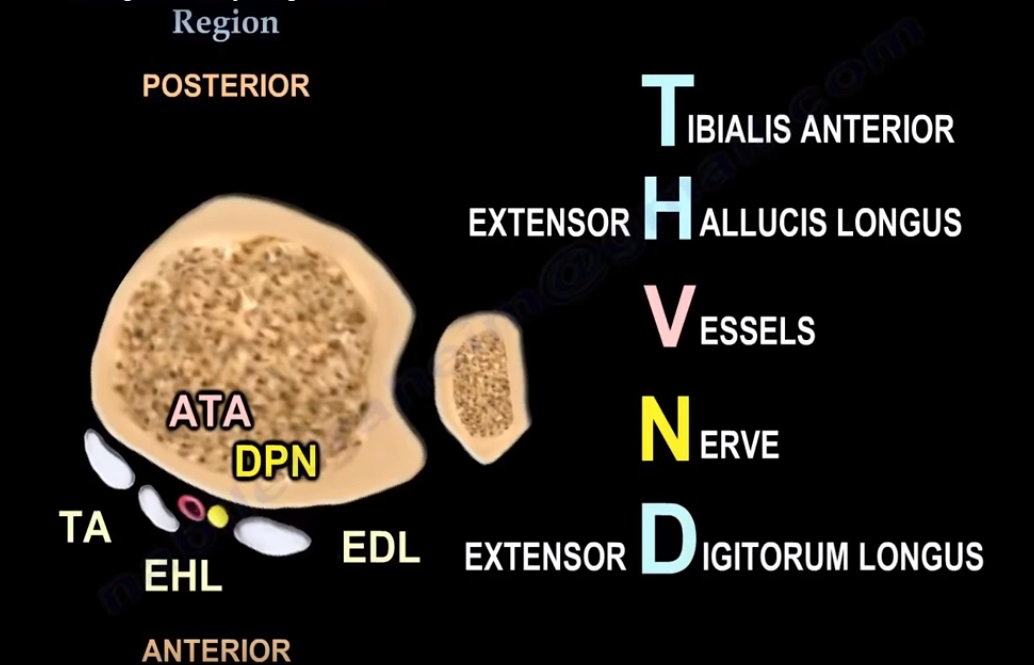
Tendons at the anterior compartment of ankle are Tibialis anterior,Extensor hallucis longus ,Extensor digitorum longus. Also passing through the anterior compartment is the anterior tibial artery and deep peroneal nerve. The superior and inferior extensor retinaculum overlies this area. The mnemonic to remember arrangement of anterior ankle structures: Tom Has a Very Nice Dog. Here T stands for Tibialis anterior,H for EHL,V for vessels,N for nerve and D for EDL.

Medial aspect of ankle has three tendons; Tibialis posterior, Flexor digitorum longus,Flexor hallucis longus. The vessels of this compartment are posterior tibial artery and posterior tibial nerve.To remember the order of structures at medial side of ankle, the mnemonic is Tom, Dick and Harry.T for Tibialis posterior,D for flexor digitorum longus,a and n for artery , nerve and H for the flexor hallucis longus tendon.

Over to the posterior aspect of ankle,there is the Achilles tendon,Sural nerve and Small saphenous vein.Lateral aspect of ankle has two tendons Peroneus brevis and longus both passing behind the fibula.Superior and inferior peroneal retinaculum is in this region.The vessel of this compartment is Sural nerve.
Post Views: 15,345

Related Posts

  • Tendon Transfers in Foot and Ankle

    Courtesy: Prof Nabil Ebraheim, University of Toledo, Ohio, USA

  • Achilles Tendon Ruptures

    Courtesy: International Foot and Ankle Symposium, Chennai

  • Flexor Tendon Anatomy

    Courtesy: Prof Nabil Ebraheim The ability to flex the fingers consists of a system of…

Reader Interactions

Leave a Reply

Your email address will not be published. Required fields are marked *

Primary Sidebar

Follow Us

instagram slideshare

Categories

  • -Applied Anatomy
  • -Approaches
  • -Basic Sciences
  • -Cartilage & Meniscus
  • -Classifications
  • -Examination
  • -Foot and Ankle
  • -Foot and Ankle Trauma
  • -FRCS(Tr and Orth) tutorials
  • -Gait
  • -Hand and Wrist
  • -Hand and Wrist Trauma
  • -Hand Infections
  • -Hip and Knee
  • -Hip Preservation
  • -Infections
  • -Joint Reconstruction
  • -Knee Arthroplasty
  • -Knee Preservation
  • -Metabolic Disorders
  • -Oncology
  • -OrthoBiologics
  • -OrthoPlastic
  • -Paediatric Orthopaedics
  • -Paediatric Trauma
  • -Patellofemoral Joint
  • -Pelvis
  • -Peripheral Nerves
  • -Principles
  • -Principles of Surgery
  • -Radiology
  • -Rheumatology
  • -Shoulder and Elbow
  • -Shoulder and Elbow Arthroplasty
  • -Spine Deformity
  • -Spine Oncology
  • -Spine Trauma
  • -Spine, Pelvis & Neurology
  • -Sports Ankle and Foot
  • -Sports Elbow
  • -Sports Knee
  • -Sports Medicine
  • -Sports Medicine Hip
  • -Sports Shoulder
  • -Sports Wrist
  • -Statistics
  • -Technical Tip
  • -Technology in Orth
  • -Trauma
  • -Trauma (Upper Limb)
  • -Trauma Life Support
  • -Trauma Reconstruction
  • Book Shelf
  • Book Shelf Medical
  • Careers
  • Case Studies and Free Papers
  • DNB Ortho
  • Evidence Based Orthopaedic Principles
  • Evidence Based Orthopaedics
  • Exam Corner
  • Fellowships
  • Guest Editor
  • Guest Reviews
  • Image Quiz
  • Instructional Course Lectures
  • Journal Club
  • MCQs
  • Meetings and Courses
  • Multimedia
  • News and Blog
  • Plaster Techniques
  • Podcasts
  • Public Health
  • Rehabilitation
  • Research
  • Shorts and Reels
Copyright@orthopaedicprinciples.com. All right rerserved.