
Courtesy: Abhay Narvekar, Ashok Shyam,IORG and OrthoTV
ACL Reconstruction Failure and Revision Surgery
Introduction
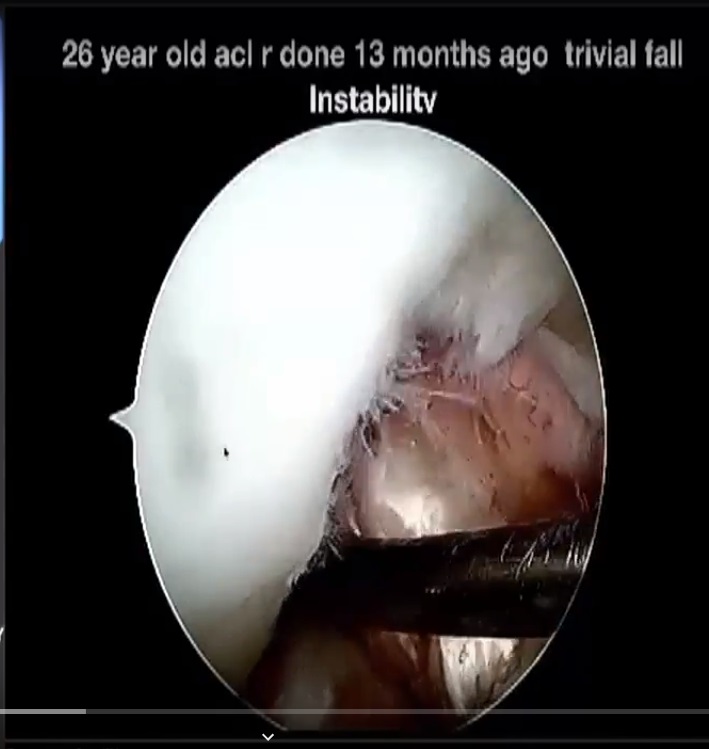
Failure after anterior cruciate ligament (ACL) reconstruction remains a significant challenge in sports medicine and knee surgery.
Reported failure rates range from:
- 10% to 35%
making revision ACL reconstruction a relatively common clinical scenario.
Successful revision surgery requires:
- Identification of the cause of failure
- Careful preoperative planning
- Correction of associated pathology
- Anatomical reconstruction techniques
Causes of ACL Reconstruction Failure
Technical Errors
Technical errors are the:
- Most common cause of ACL graft failure
Common problems include:
- Incorrect tunnel placement
- Non-anatomic graft positioning
- Inadequate fixation
Traumatic Re-Injury
Trauma is the:
- Second most common cause of failure
This typically occurs after:
- Premature return to sports
- New pivoting injury
Biological Causes
Less common biological causes include:
- Poor graft incorporation
- Infection
- Graft stretching or failure to heal
Timing-Based Causes of Failure
Early Failure (< 3 Months)
Common causes include:
- Fixation failure
- Infection
Intermediate Failure (3–24 Months)
This is the:
- Most common time period for graft failure
Causes include:
- Technical errors
- Improper rehabilitation
- Early return to sports
Late Failure (> 24 Months)
Late failures are usually related to:
- New traumatic injury
Non-Anatomic ACL Reconstruction
“High Noon ACL”
A classic example of non-anatomic reconstruction is the:
- Vertical femoral tunnel placed at the 12 o’clock position
Although the graft may appear intact on MRI, it may still be:
- Non-functional
- Rotationally unstable
Consequences of Tunnel Malposition
Femoral Tunnel Too Anterior
- Loss of knee flexion
Femoral Tunnel Too Posterior
- Loss of knee extension
Vertical Graft Placement
- Persistent rotational instability
- Positive pivot shift
Tibial Tunnel Malposition
- Graft impingement
- Restricted motion
Key Principle
An ACL graft must be:
- Anatomically positioned
to restore normal knee biomechanics and rotational stability.
Evaluation of Failed ACL Reconstruction
Clinical Assessment
Evaluation begins with identifying the:
- Primary reason for failure
Important components include assessment of:
- Instability pattern
- Range of motion
- Alignment
- Meniscal status
- Secondary stabilizers
Imaging Assessment
Important imaging considerations include:
- Tunnel position
- Tunnel widening
- Graft integrity
- Alignment abnormalities
- Degenerative changes
Tunnel Angle Assessment
A useful radiographic parameter is the angle between:
- Femoral tunnel
- Blumensaat’s line
An angle less than:
- 33°
suggests a:
- Non-anatomic femoral tunnel
Principles of Revision ACL Reconstruction
Golden Rule
The most important principle in revision ACL surgery is:
- Do not repeat the same mistake
Revision Scenarios
Scenario 1: Good Tunnels with Graft Failure
If tunnel position is satisfactory:
- Existing tunnels may be reused
- Larger grafts may be utilized
- Fixation strength should be improved
Scenario 2: Malpositioned Tunnels
When tunnels are non-anatomic:
- New anatomical tunnels must be created
If overlap occurs:
- Outside-in drilling techniques may help
- Staged surgery may be required
Scenario 3: Tunnel Widening or Bone Loss
Significant tunnel enlargement may require:
Stage 1
- Bone grafting of tunnels
Stage 2
- Delayed ACL reconstruction after graft incorporation
- Typically performed after 4–6 months
Graft Selection in Revision Surgery
Revision surgery generally requires:
- Stronger and larger grafts
Common graft options include:
- Bone-patellar tendon-bone (BTB)
- Hamstring tendon
- Quadriceps tendon
Surgeons should remain versatile with:
- Multiple graft harvesting techniques
Additional Stabilization Procedures
Extra-Articular Procedures
Lateral extra-articular procedures may improve:
- Rotational stability
Common procedures include:
- Iliotibial band lateral tenodesis
These procedures help:
- Protect the ACL graft from excessive rotational forces
Secondary Stabilizer Reconstruction
Associated instability patterns must be corrected, especially involving:
- Posterolateral corner (PLC)
- Anterolateral ligament (ALL)
Failure to address these structures may result in:
- Persistent instability
- Recurrent graft failure
Importance of Alignment
Varus Malalignment
In patients with:
- Varus knee alignment
- Recurrent ACL failure
consideration should be given to:
- High tibial osteotomy (HTO)
with or without ACL revision reconstruction.
When Isolated Revision ACL Should Be Avoided
Simple ACL revision may not be appropriate in patients with:
- Significant osteoarthritis
- Severe malalignment
- Chronic degenerative instability
These patients may benefit more from:
- Corrective osteotomy
- Combined procedures
rather than isolated ACL revision.
Surgical Enhancements in Revision ACL Surgery
Important strategies to improve revision outcomes include:
- Larger graft diameter
- Anatomical tunnel placement
- Stronger fixation
- Double fixation on the tibial side
- Additional rotational stabilization procedures
Rehabilitation After Revision ACL Reconstruction
Rehabilitation following revision surgery is generally:
- More cautious
- Slower than primary ACL reconstruction
Key principles include:
- Gradual range-of-motion recovery
- Controlled strengthening
- Delayed return to pivoting sports
Complications of Revision ACL Reconstruction
Potential complications include:
- Persistent instability
- Arthrofibrosis
- Tunnel convergence
- Infection
- Graft re-rupture
- Progressive osteoarthritis
Important Clinical Pearls
- Technical error is the most common cause of ACL reconstruction failure.
- Vertical graft placement commonly causes rotational instability.
- An intact graft on MRI does not always mean a functional ACL.
- Tunnel position must always be carefully assessed before revision surgery.
- Secondary stabilizers such as the PLC and ALL must not be overlooked.
- Varus alignment significantly increases graft stress.
- Larger grafts and stronger fixation improve revision outcomes.
Final Take-Home Message
ACL reconstruction failure is a complex clinical problem that requires detailed evaluation and individualized management.
Successful revision surgery depends on:
- Identifying the original cause of failure
- Restoring anatomical tunnel placement
- Correcting associated instability and malalignment
- Using strong graft fixation and appropriate rehabilitation
A carefully planned revision procedure can significantly improve knee stability, function, and long-term outcomes.
Leave a Reply