• Skip to main content
  • Skip to secondary menu
  • Skip to primary sidebar
OrthopaedicPrinciples.com

OrthopaedicPrinciples.com

Integrating Principles and Evidence

Integrating Principles and Evidence

  • Home
  • Editorial Board
  • Our Books
    • Evidence Based Orthopaedic Principles
  • Courses
  • Exams
  • Reviews
  • Live Program
  • Contact

Sulcus Sign for Shoulder Instability

Courtesy: Prof Nabil Ebraheim, University of Toledo, Ohio, USA

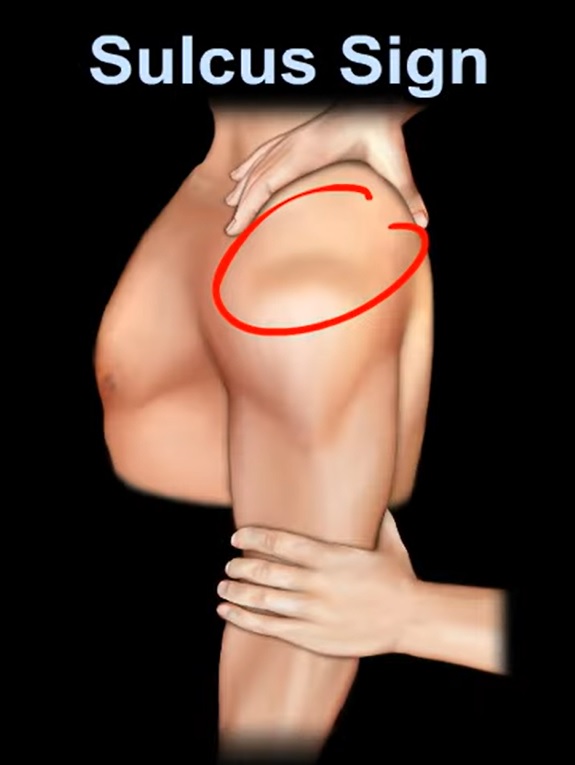
Sulcus Sign

Purpose

The Sulcus sign is a clinical sign suggestive of:

Inferior glenohumeral instability / subluxation

It indicates laxity of the shoulder.

Technique

  1. Patient should be relaxed.
  2. Arm is kept by the side.
  3. Examiner grasps the distal humerus.
  4. Apply gentle downward traction to the arm.
  5. Observe the region below the acromion.

Positive Sulcus Sign

A positive test produces:

A visible groove/depression below the acromion as the humeral head translates inferiorly.

This visible groove is the sulcus.

Interpretation

Positive Sulcus sign – inferior glenohumeral laxity/instability

Exam Pearl

Arm relaxed by side – downward traction – visible subacromial groove = positive Sulcus sign – inferior shoulder instability/laxity.
 

Post Views: 2,723

Related Posts

  • Shoulder instability Examination

    Courtesy: The British Journal of Sports Medicine and Dr. Mark Hutchinson's Knee, Shoulder and Hip/Groin…

  • Shoulder Instability

    Courtesy: Orthopaedic Principles ICL Kochi, Prof Dr Ravi Mittal, MS, FRCS, MRCS, AIIMS, NewDelhi

  • Shoulder Instability Symposium

    Courtesy: Sameer Nadga MD, Virginia Paul Sethi MD, Connecticut Anand Murthi MD, Baltimore

Reader Interactions

Leave a Reply

Your email address will not be published. Required fields are marked *

Primary Sidebar

Follow Us

instagram slideshare

Categories

  • -Applied Anatomy
  • -Approaches
  • -Basic Sciences
  • -Cartilage & Meniscus
  • -Classifications
  • -Examination
  • -Foot and Ankle
  • -Foot and Ankle Trauma
  • -FRCS(Tr and Orth) tutorials
  • -Gait
  • -Hand and Wrist
  • -Hand and Wrist Trauma
  • -Hand Infections
  • -Hip and Knee
  • -Hip Preservation
  • -Infections
  • -Joint Reconstruction
  • -Knee Arthroplasty
  • -Knee Preservation
  • -Metabolic Disorders
  • -Oncology
  • -OrthoBiologics
  • -OrthoPlastic
  • -Paediatric Orthopaedics
  • -Paediatric Trauma
  • -Patellofemoral Joint
  • -Pelvis
  • -Peripheral Nerves
  • -Principles
  • -Principles of Surgery
  • -Radiology
  • -Rheumatology
  • -Shoulder and Elbow
  • -Shoulder and Elbow Arthroplasty
  • -Spine Deformity
  • -Spine Oncology
  • -Spine Trauma
  • -Spine, Pelvis & Neurology
  • -Sports Ankle and Foot
  • -Sports Elbow
  • -Sports Knee
  • -Sports Medicine
  • -Sports Medicine Hip
  • -Sports Shoulder
  • -Sports Wrist
  • -Statistics
  • -Technical Tip
  • -Technology in Orth
  • -Trauma
  • -Trauma (Upper Limb)
  • -Trauma Life Support
  • -Trauma Reconstruction
  • Book Shelf
  • Book Shelf Medical
  • Careers
  • Case Studies and Free Papers
  • DNB Ortho
  • Evidence Based Orthopaedic Principles
  • Evidence Based Orthopaedics
  • Exam Corner
  • Fellowships
  • Guest Editor
  • Guest Reviews
  • Image Quiz
  • Instructional Course Lectures
  • Journal Club
  • MCQs
  • Meetings and Courses
  • MS Ortho
  • Multimedia
  • News and Blog
  • Plaster Techniques
  • Podcasts
  • Public Health
  • Rehabilitation
  • Research
  • Shorts and Reels
Copyright@orthopaedicprinciples.com. All right rerserved.