• Skip to main content
  • Skip to secondary menu
  • Skip to primary sidebar
OrthopaedicPrinciples.com

OrthopaedicPrinciples.com

Integrating Principles and Evidence

Integrating Principles and Evidence

  • Home
  • Editorial Board
  • Our Books
    • Evidence Based Orthopaedic Principles
  • Courses
  • Exams
  • Reviews
  • Live Program
  • Contact

Step-by-Step Approach to Total Hip Replacement

Courtesy: Jibananda Satpathy, MS, MRCS, FACS
Step by step approach to total hip arthroplasty (Posterior approach)

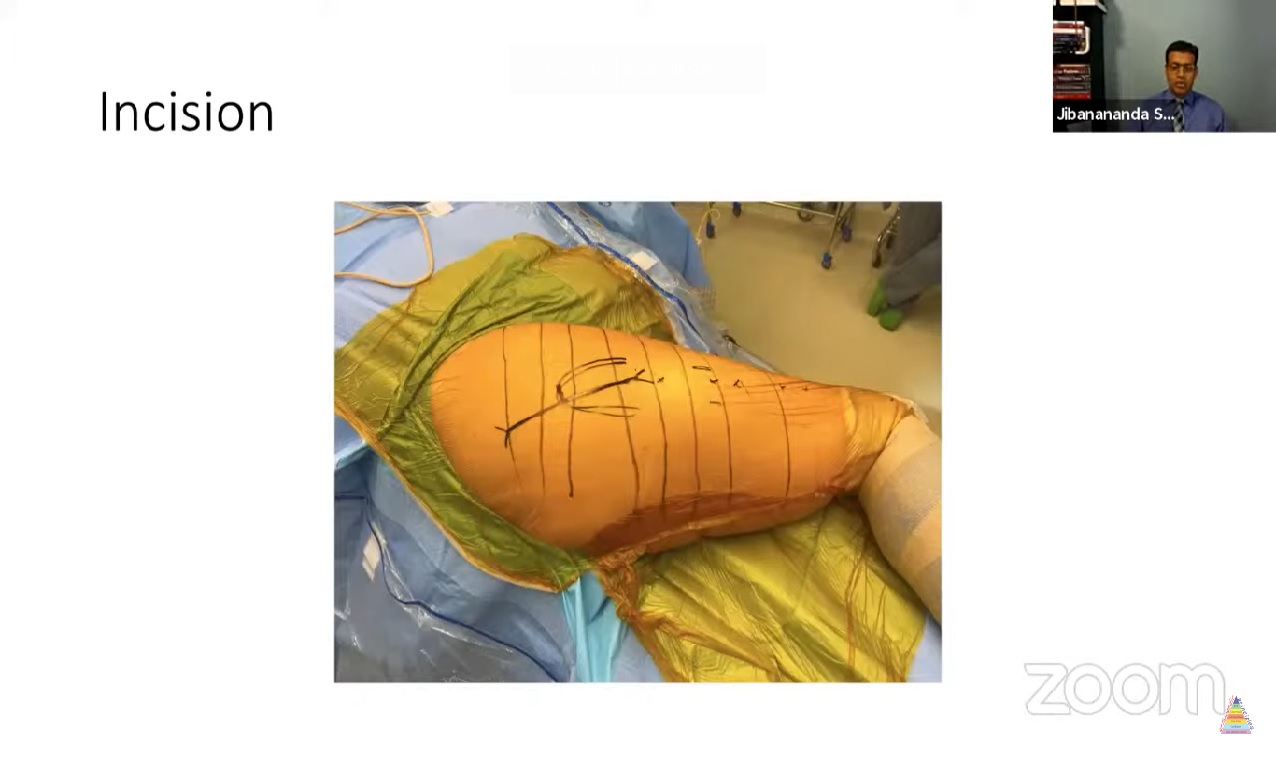
1) Incision

  • Incision size depends on the size of the patient
  • Usually, half of the incision is above and half below the tip of greater trochanter angled down posteriorly

2) Dissection deepened by incising and separating the subcutaneous tissue and fat
3) Ilio tibial band incised and split

  • Splitting started right at the top of the trochanter and below it

4) Splitting gluteus maximus

5) Charnley’s retractor is placed
(Keep in mind the anatomy of sciatic nerve)

6) Retract gluteus medius

7) Cut the external rotators as a flap along with the capsule and gluteus minimus
(be careful of early dividing sciatic nerve)

8) Tag the external rotators using suture threads
(Help to protect sciatic nerve)

9) Dislocating the hip
By flexion adduction and internal rotation of the hip
-never force it
-do all your capsular releases
-make sure no soft tissue is obstructing it
-sometimes anterior capsular release is necessary for dislocation
-low threshold for in situ osteotomy in protrusion hip or ankylosed hip

9) Opening the canal
Open it along the piriform fossa
Be careful with sclerotic bone/ sickle cell /very soft bone

10) Reaming the femur
Ream as few times as possible, couple of sizes up or down the template

11) Neck osteotomy
Right along the top of the reaming hole that was created
Keep the saw away from the GT
Use a thinner blade if possible

12) Removing the head
13) Broaching the femur
Follow the femoral canal
Be careful as we mallet, because at some point the bone may crack

14) Acetabular exposure
Release the anterosuperior capsule to increase the exposure
Good circumferential exposure is critical
Gluteal sling may be released if necessary

15) Reaming the acetabulum
16) Acetabular cup placement
Guide points for correct placement include
-transverse acetabular ligament
-intra acetabular margin
-ischium

17) Placement of screws
Not compulsory
Safe sector can be identified using ASIS, centre of cup and 90 degree posterior to it

18) Check mechanics/trailing
If the neck is impinging on the cup either the stem or the cup is not anteverted enough , we have to change the socket or the stem
If the implants are not impinging and hip is dislocating then it is an external impingement, usually an offset problem (to check for offset look the level of external rotators)

19) Insertion of final implant
Never hit hard, be gentle and never force it in
Post Views: 7,686

Related Posts

  • Step-by-Step Approach to templating in Total Hip Replacement

    Courtesy: Dr Prabhudev Prasad Purudappa, Assistant Professor, Boston University School of Medicine, Attending Orthopaedic Surgeon,…

  • Total Hip Replacement

    Courtesy: RCSI

  • Step-by-Step Approach to Direct Anterior Total Hip Replacement

    Courtesy: PrabhuDev Prasad Purudappa, Assistant Professor, Boston University School of Medicine, Boston, MA

Reader Interactions

Leave a Reply

Your email address will not be published. Required fields are marked *

Primary Sidebar

Follow Us

instagram slideshare

Categories

  • -Applied Anatomy
  • -Approaches
  • -Basic Sciences
  • -Cartilage & Meniscus
  • -Classifications
  • -Examination
  • -Foot and Ankle
  • -Foot and Ankle Trauma
  • -FRCS(Tr and Orth) tutorials
  • -Gait
  • -Hand and Wrist
  • -Hand and Wrist Trauma
  • -Hand Infections
  • -Hip and Knee
  • -Hip Preservation
  • -Infections
  • -Joint Reconstruction
  • -Knee Arthroplasty
  • -Knee Preservation
  • -Metabolic Disorders
  • -Oncology
  • -OrthoBiologics
  • -OrthoPlastic
  • -Paediatric Orthopaedics
  • -Paediatric Trauma
  • -Patellofemoral Joint
  • -Pelvis
  • -Peripheral Nerves
  • -Principles
  • -Principles of Surgery
  • -Radiology
  • -Rheumatology
  • -Shoulder and Elbow
  • -Shoulder and Elbow Arthroplasty
  • -Spine Deformity
  • -Spine Oncology
  • -Spine Trauma
  • -Spine, Pelvis & Neurology
  • -Sports Ankle and Foot
  • -Sports Elbow
  • -Sports Knee
  • -Sports Medicine
  • -Sports Medicine Hip
  • -Sports Shoulder
  • -Sports Wrist
  • -Statistics
  • -Technical Tip
  • -Technology in Orth
  • -Trauma
  • -Trauma (Upper Limb)
  • -Trauma Life Support
  • -Trauma Reconstruction
  • Book Shelf
  • Book Shelf Medical
  • Careers
  • Case Studies and Free Papers
  • DNB Ortho
  • Evidence Based Orthopaedic Principles
  • Evidence Based Orthopaedics
  • Exam Corner
  • Fellowships
  • Guest Editor
  • Guest Reviews
  • Image Quiz
  • Instructional Course Lectures
  • Journal Club
  • MCQs
  • Meetings and Courses
  • Multimedia
  • News and Blog
  • Plaster Techniques
  • Podcasts
  • Public Health
  • Rehabilitation
  • Research
  • Shorts and Reels
Copyright@orthopaedicprinciples.com. All right rerserved.