• Skip to main content
  • Skip to secondary menu
  • Skip to primary sidebar
OrthopaedicPrinciples.com

OrthopaedicPrinciples.com

Integrating Principles and Evidence

Integrating Principles and Evidence

  • Home
  • Editorial Board
  • Our Books
    • Evidence Based Orthopaedic Principles
  • Courses
  • Exams
  • Reviews
  • Live Program
  • Contact

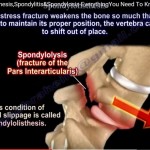
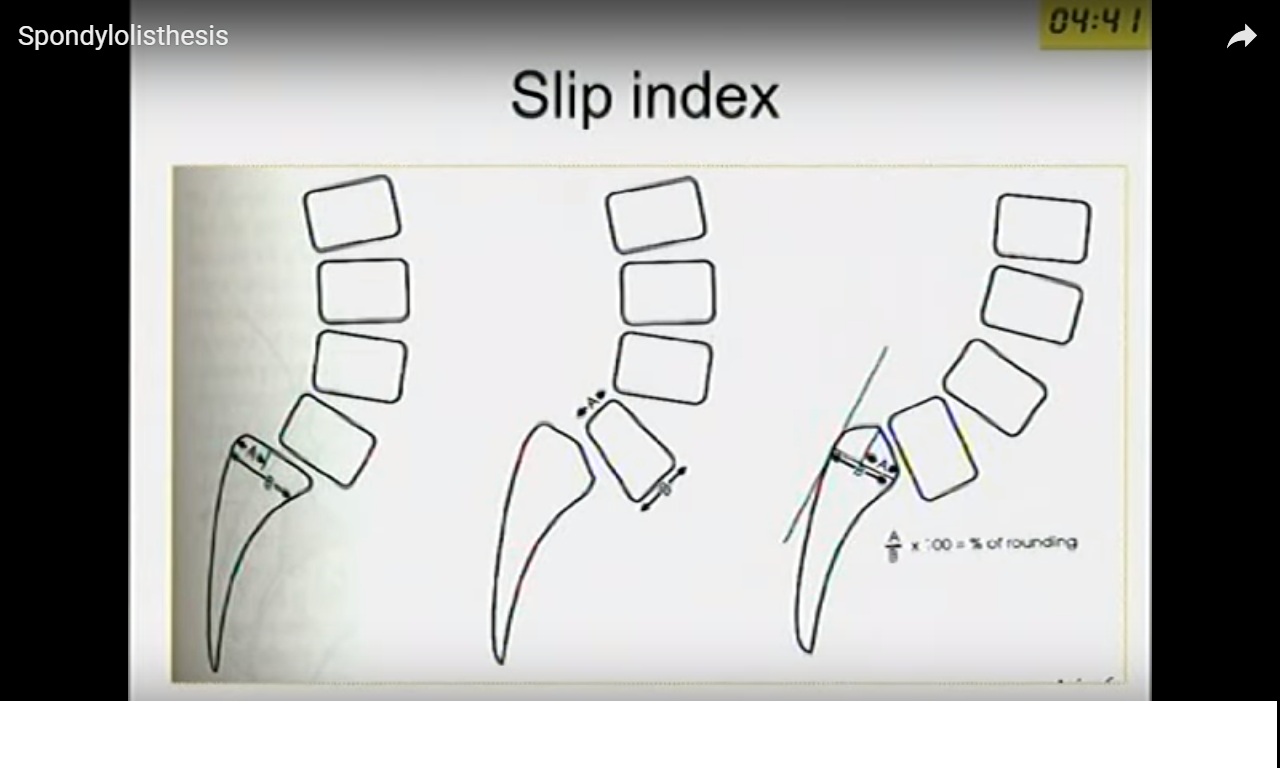
Spondylolisthesis

Courtesy: Orthopaedic Principles ICL Kochi by Dr Hitesh Gopalan

Radiological Findings of Spondylolisthesis

• Spinous Process Sign of Bryk and Rosenkranz
In spondylolisthesis due to spondylolysis (True): The step will be at a level higher than the slippage.
In pseudospondylolisthesis due to degenerative disease, the step will be at a level below the slippage.
• Beheaded Scottish Terrier Sign:
Nose: Transverse process
Eye : Pedicle
Ears: Superior articular process
Forelimbs: Inferior articular process
Neck: Pars interarticularis. In the oblique view, the Scottish Terrier dog is formed by the above anatomical structures. In case of pars defect, it appears that the neck of the dog is broken and hence it is called Beheaded Scottish Terrier Sign.

• In 20% of patients the lytic defect is unilateral and associated with reactive sclerosis of the opposite pedicle, lamina or both.
• Napoleon Hat Sign: In high-grade slips with severe angulation of the L5 vertebra, an end on projection of the L5 vertebra, which resembles a hat, is seen on AP view.
• Ferguson’s view is a true AP view of the lumbosacral junction with 30 degree cephalad orientation.

•
Post Views: 5,949

Related Posts

  • Spondylolysis, Spondylolisthesis

    Courtesy: Prof Nabile Ebraheim, University of Toledo, Ohio, USA

  • Spondylolysis, Spondylolisthesis

    Courtesy: Prof Nabile Ebraheim, University of Toledo, Ohio, USA

  • Spondylolysis, Spondylolisthesis

    Courtesy: Prof Nabile Ebraheim, University of Toledo, Ohio, USA

Reader Interactions

Leave a Reply

Your email address will not be published. Required fields are marked *

Primary Sidebar

Follow Us

instagram slideshare

Categories

  • -Applied Anatomy
  • -Approaches
  • -Basic Sciences
  • -Cartilage & Meniscus
  • -Classifications
  • -Examination
  • -Foot and Ankle
  • -Foot and Ankle Trauma
  • -FRCS(Tr and Orth) tutorials
  • -Gait
  • -Hand and Wrist
  • -Hand and Wrist Trauma
  • -Hand Infections
  • -Hip and Knee
  • -Hip Preservation
  • -Infections
  • -Joint Reconstruction
  • -Knee Arthroplasty
  • -Knee Preservation
  • -Metabolic Disorders
  • -Oncology
  • -OrthoBiologics
  • -OrthoPlastic
  • -Paediatric Orthopaedics
  • -Paediatric Trauma
  • -Patellofemoral Joint
  • -Pelvis
  • -Peripheral Nerves
  • -Principles
  • -Principles of Surgery
  • -Radiology
  • -Rheumatology
  • -Shoulder and Elbow
  • -Shoulder and Elbow Arthroplasty
  • -Spine Deformity
  • -Spine Oncology
  • -Spine Trauma
  • -Spine, Pelvis & Neurology
  • -Sports Ankle and Foot
  • -Sports Elbow
  • -Sports Knee
  • -Sports Medicine
  • -Sports Medicine Hip
  • -Sports Shoulder
  • -Sports Wrist
  • -Statistics
  • -Technical Tip
  • -Technology in Orth
  • -Trauma
  • -Trauma (Upper Limb)
  • -Trauma Life Support
  • -Trauma Reconstruction
  • Book Shelf
  • Book Shelf Medical
  • Careers
  • Case Studies and Free Papers
  • DNB Ortho
  • Evidence Based Orthopaedic Principles
  • Evidence Based Orthopaedics
  • Exam Corner
  • Fellowships
  • Guest Editor
  • Guest Reviews
  • Image Quiz
  • Instructional Course Lectures
  • Journal Club
  • MCQs
  • Meetings and Courses
  • Multimedia
  • News and Blog
  • Plaster Techniques
  • Podcasts
  • Public Health
  • Rehabilitation
  • Research
  • Shorts and Reels
Copyright@orthopaedicprinciples.com. All right rerserved.