
Courtesy: Prof Nabil Ebraheim, University of Toledo, Ohio, USA
ASIA Impairment Scale in Spinal Cord Injury
Topic Overview
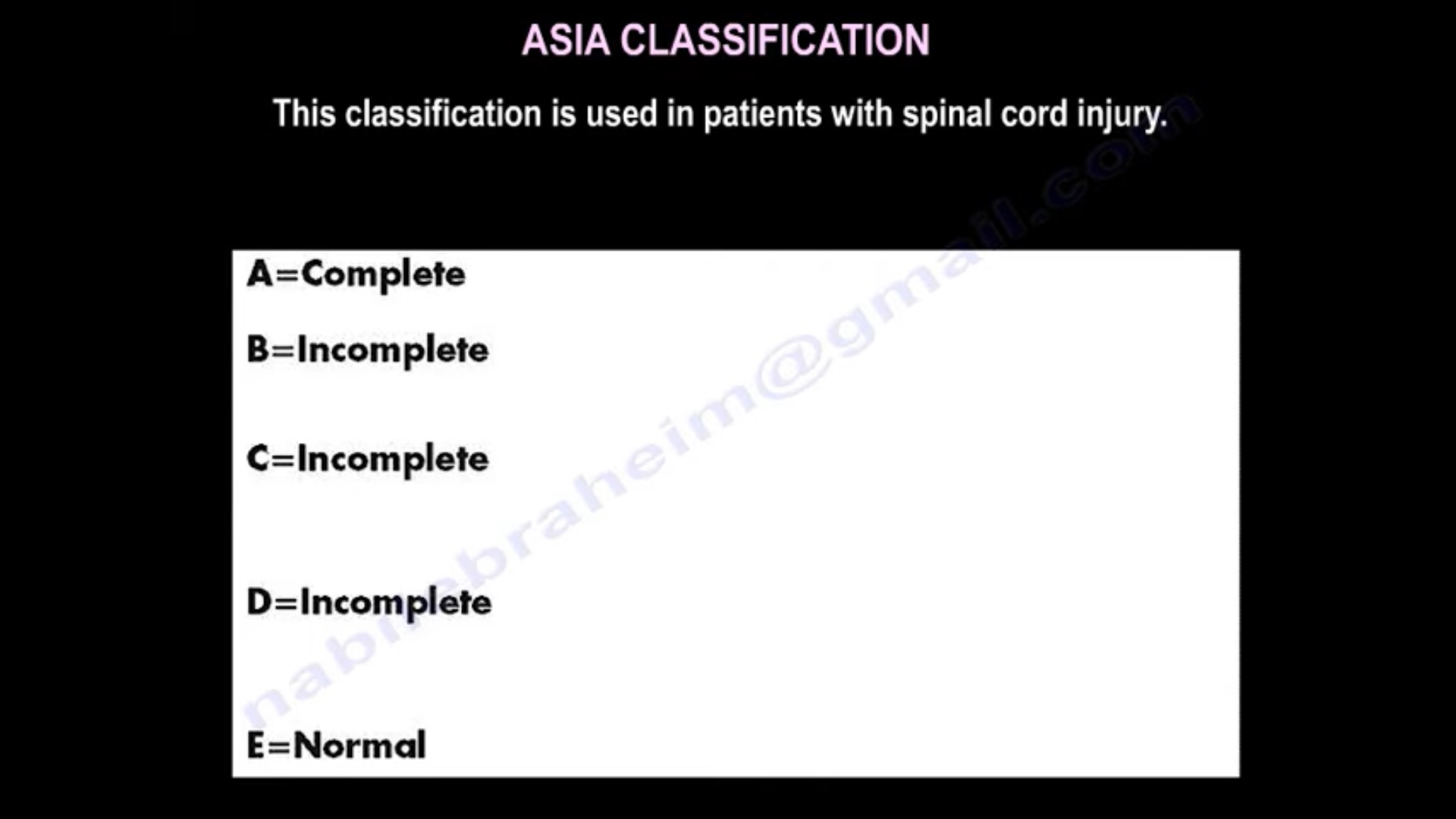
The ASIA (American Spinal Injury Association) Impairment Scale is a standardized neurological classification used to assess and categorize the severity of motor and sensory deficits in patients sustaining spinal cord injuries (SCI). It grades injuries from Grade A (complete injury) to Grade E (normal function).
Classification & Detailed Definitions
- ASIA Grade A (Complete Injury):
- Absence of all motor and sensory function preserved in the sacral segments (S4\S5).
- Clinically signifies complete loss of neural transmission across the zone of injury.
- ASIA Grade B (Incomplete Injury – Sensory Incomplete):
- Sensory function is preserved, but no motor function is preserved below the neurological level.
- Preservation extends through the sacral segments (S4\S5) demonstrating sacral sparing.
- ASIA Grade C (Incomplete Injury – Motor Incomplete, Non-Functional):
- Motor function is preserved below the neurological level.
- Muscle Grading Threshold: More than half of the key muscle functions below the single neurological level have a muscle grade of < 3/5.
- Clinical Meaning: Muscle activation is present but weak; the patient cannot perform active movement against gravity (cannot lift arms or legs off the bed against gravity).
- ASIA Grade D (Incomplete Injury – Motor Incomplete, Functional):
- Motor function is preserved below the neurological level.
- Muscle Grading Threshold: At least half (half or more) of the key muscle functions below the single neurological level have a muscle grade of 3/5
- Clinical Meaning: Functional muscle strength is preserved, allowing movement against gravity.
- ASIA Grade E (Normal):
- Fully intact motor and sensory function throughout all tested segments.
Grade Comparison
| ASIA Grade | Category | Sensory Function Below Level | Motor Function Below Level | Key Muscle Strength Threshold |
| Grade A | Complete | Absent | Absent | No motor function (0/5) |
| Grade B | Incomplete | Preserved (including S4\S5) | Absent | No motor function (0/5) |
| Grade C | Incomplete | Preserved | Preserved | > 50% of muscles are <3/5 (cannot overcome gravity) |
| Grade D | Incomplete | Preserved | Preserved | > 50%of muscles are >3/5 (active against gravity) |
| Grade E | Normal | Intact | Intact | Normal power (5/5) and sensation |
Practical Clinical Implications
- Differentiating Complete from Incomplete (A vs. B): Assessment of deep anal sensation and voluntary anal contraction (sacral sparing at S4\S5) is the critical clinical divider between complete (Grade A) and incomplete (Grade B) injuries.
- Differentiating Grade C from Grade D: The dividing factor relies entirely on the grade 3 cutoff (anti-gravity power) across more than half of the key muscle groups below the neurological level of injury.
Key Take-Home Points
- ASIA A indicates complete neurological loss, whereas ASIA E represents complete neurological recovery/normal status.
- ASIA B denotes sensory preservation (including sacral sparing) without motor recovery below the level of injury.
Exam Pearls
- Grade A: No sensory or motor function in S4\S5
- Grade B: Sensory preserved, Motor absent (S4\S5 sensory intact).
- Grade C vs. D Rule:
- {Grade C} = > 50% {of key muscles } < 3/5 (Sub-gravity power).
- {Grade D} => 50%{ of key muscles }>3/5 (Anti-gravity power).
- Grade E: Motor and sensory functions are normal.


Leave a Reply