• Skip to main content
  • Skip to secondary menu
  • Skip to primary sidebar
OrthopaedicPrinciples.com

OrthopaedicPrinciples.com

Integrating Principles and Evidence

Integrating Principles and Evidence

  • Home
  • Editorial Board
  • Our Books
    • Evidence Based Orthopaedic Principles
  • Courses
  • Exams
  • Reviews
  • Live Program
  • Contact

Spinal Accessory to Suprascapular Nerve Transfer for Brachial plexus injury

Posterior Approach – Spinal Accessory to Suprascapular Nerve Transfer
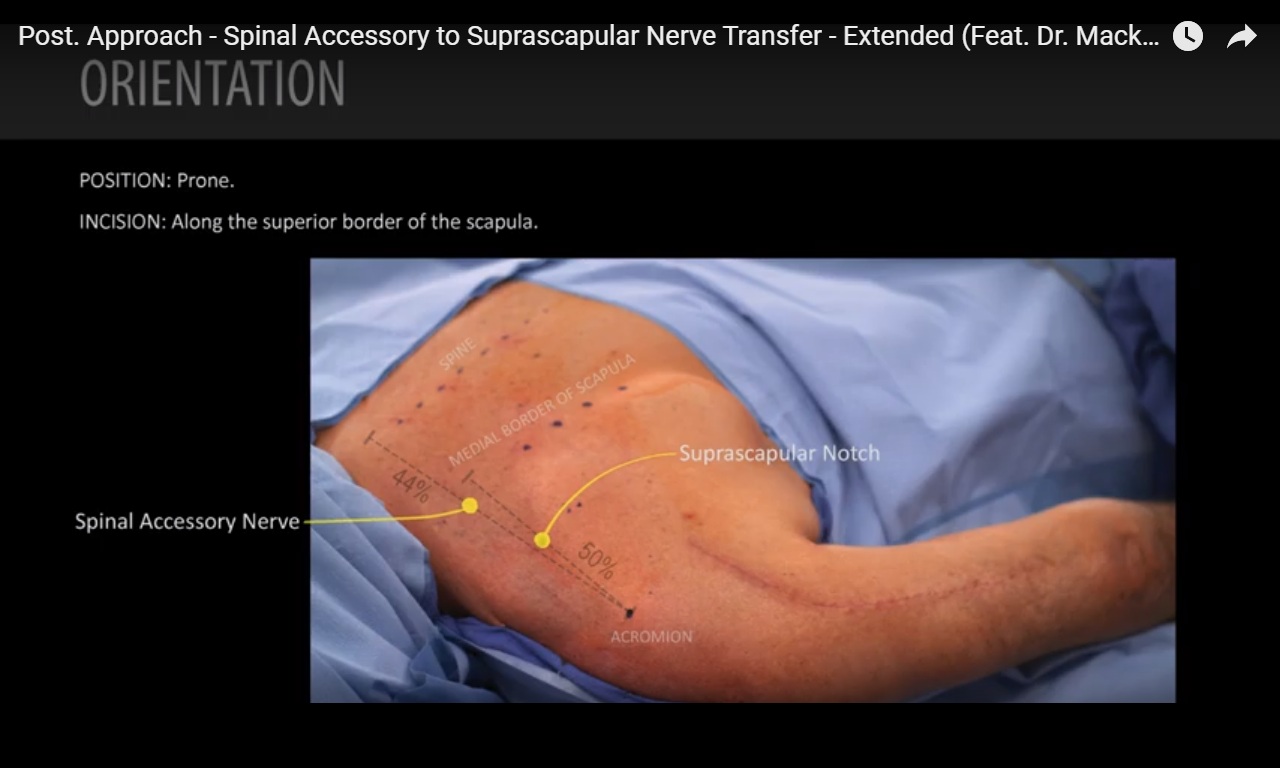

Reconstructing shoulder function following a nerve injury is a challenge due to its dynamic movement originating from several muscles. The supra/infraspinatus muscles are critical for shoulder function in that they initiate abduction of the arm, external rotation, and stabilization of the shoulder joint. In upper brachial plexus injuries, it is common to find a deficit in the suprascapular nerve associated with the axillary and musculocutaneous nerves due to their C5,6 root origins. These patients present with no shoulder function or elbow flexion. Reconstruction includes nerve transfers to innervate the axillary and suprascapular nerves for shoulder function. An available donor nerve for restoring the suprascapular nerve includes the spinal accessory nerve from a posterior or anterior approach. The posterior approach utilizes the distal branches of the accessory nerve that innervates the inferior segments of the trapezius. This video portrays that posterior approach. In this case, a 49-year-old male presented post-Schwannoma resection from the upper brachial plexus with a shoulder and elbow flexion deficit. To reconstruct shoulder function, a spinal accessory to suprascapular nerve transfer was elected with a medial triceps to axillary nerve transfer. To reconstruct elbow flexion, a double fascicular nerve transfer was elected. This video details the posterior approach to reconstructing the suprascapular nerve using the spinal accessory nerve.

Table of Contents (Extended)
Table of Contents (Standard)
00:25 Pre-operative Discussion on Anatomical Landmarks
00:54 Incision / Exposure
01:36 Developing a Superficial Plane to the Trapezius
02:34 Dissection through the Trapezius
03:05 Identifying the Fascial Plane and Fat Deep to the Trapezius
03:50 Identifying and Exposing the Spinal Accessory Nerve
05:04 Dissection through the Trapezius towards the Suprascapular Notch
05:32 Palpating the Suprascapular Notch for Orientation
06:01 Identifying and Exposing the Suprascapular Ligament
06:44 Releasing the Suprascapular Ligament
07:26 Identifying the Suprascapular Nerve
08:17 Proximal Dissection of the Suprascapular Nerve
08:40 Dividing the Suprascapular Nerve Proximally
09:16 Distal Dissection of the Spinal Accessory Nerve
11:37 Dividing the Spinal Accessory Nerve Distally
12:20 Spinal Accessory to Suprascapular Nerve Transfer

Authors: Susan E. Mackinnon, Andrew Yee

Affiliation:
Washington University School of Medicine
Division of Plastic Reconstructive Surgery
Department of Surgery
Saint Louis, MO
Peripheral Nerve Surgery:
Home

Post Views: 4,869

Related Posts

  • Spinal Accessory to Suprascapular Nerve Transfer

    Affiliation: Washington University School of Medicine Division of Plastic Reconstructive Surgery Department of Surgery Saint…

  • Suprascapular Nerve Anatomy

    Courtesy: Prof Nabile Ebraheim Professor of Orthopaedic Surgery University of Toledo Ohio United States. Suprascapular…

  • Spinal Accessory to Suprascapular Nerve Transfer

    Affiliation: Washington University School of Medicine Division of Plastic Reconstructive Surgery Department of Surgery Saint…

Reader Interactions

Leave a Reply

Your email address will not be published. Required fields are marked *

Primary Sidebar

Follow Us

instagram slideshare

Categories

  • -Applied Anatomy
  • -Approaches
  • -Basic Sciences
  • -Cartilage & Meniscus
  • -Classifications
  • -Examination
  • -Foot and Ankle
  • -Foot and Ankle Trauma
  • -FRCS(Tr and Orth) tutorials
  • -Gait
  • -Hand and Wrist
  • -Hand and Wrist Trauma
  • -Hand Infections
  • -Hip and Knee
  • -Hip Preservation
  • -Infections
  • -Joint Reconstruction
  • -Knee Arthroplasty
  • -Knee Preservation
  • -Metabolic Disorders
  • -Oncology
  • -OrthoBiologics
  • -OrthoPlastic
  • -Paediatric Orthopaedics
  • -Paediatric Trauma
  • -Patellofemoral Joint
  • -Pelvis
  • -Peripheral Nerves
  • -Principles
  • -Principles of Surgery
  • -Radiology
  • -Rheumatology
  • -Shoulder and Elbow
  • -Shoulder and Elbow Arthroplasty
  • -Spine Deformity
  • -Spine Oncology
  • -Spine Trauma
  • -Spine, Pelvis & Neurology
  • -Sports Ankle and Foot
  • -Sports Elbow
  • -Sports Knee
  • -Sports Medicine
  • -Sports Medicine Hip
  • -Sports Shoulder
  • -Sports Wrist
  • -Statistics
  • -Technical Tip
  • -Technology in Orth
  • -Trauma
  • -Trauma (Upper Limb)
  • -Trauma Life Support
  • -Trauma Reconstruction
  • Book Shelf
  • Book Shelf Medical
  • Careers
  • Case Studies and Free Papers
  • DNB Ortho
  • Evidence Based Orthopaedic Principles
  • Evidence Based Orthopaedics
  • Exam Corner
  • Fellowships
  • Guest Editor
  • Guest Reviews
  • Image Quiz
  • Instructional Course Lectures
  • Journal Club
  • MCQs
  • Meetings and Courses
  • Multimedia
  • News and Blog
  • Plaster Techniques
  • Podcasts
  • Public Health
  • Rehabilitation
  • Research
  • Shorts and Reels
Copyright@orthopaedicprinciples.com. All right rerserved.