• Skip to main content
  • Skip to secondary menu
  • Skip to primary sidebar
OrthopaedicPrinciples.com

OrthopaedicPrinciples.com

Integrating Principles and Evidence

Integrating Principles and Evidence

  • Home
  • Editorial Board
  • Our Books
    • Evidence Based Orthopaedic Principles
  • Courses
  • Exams
  • Reviews
  • Live Program
  • Contact

Shoulder Dislocations

Courtesy: Prof Nabil Ebraheim, University of Toledo, Ohio, USA

Shoulder dislocation refers to dislocation of Glenohumeral joint.
It is the most commonly dislocated joint in the human body.

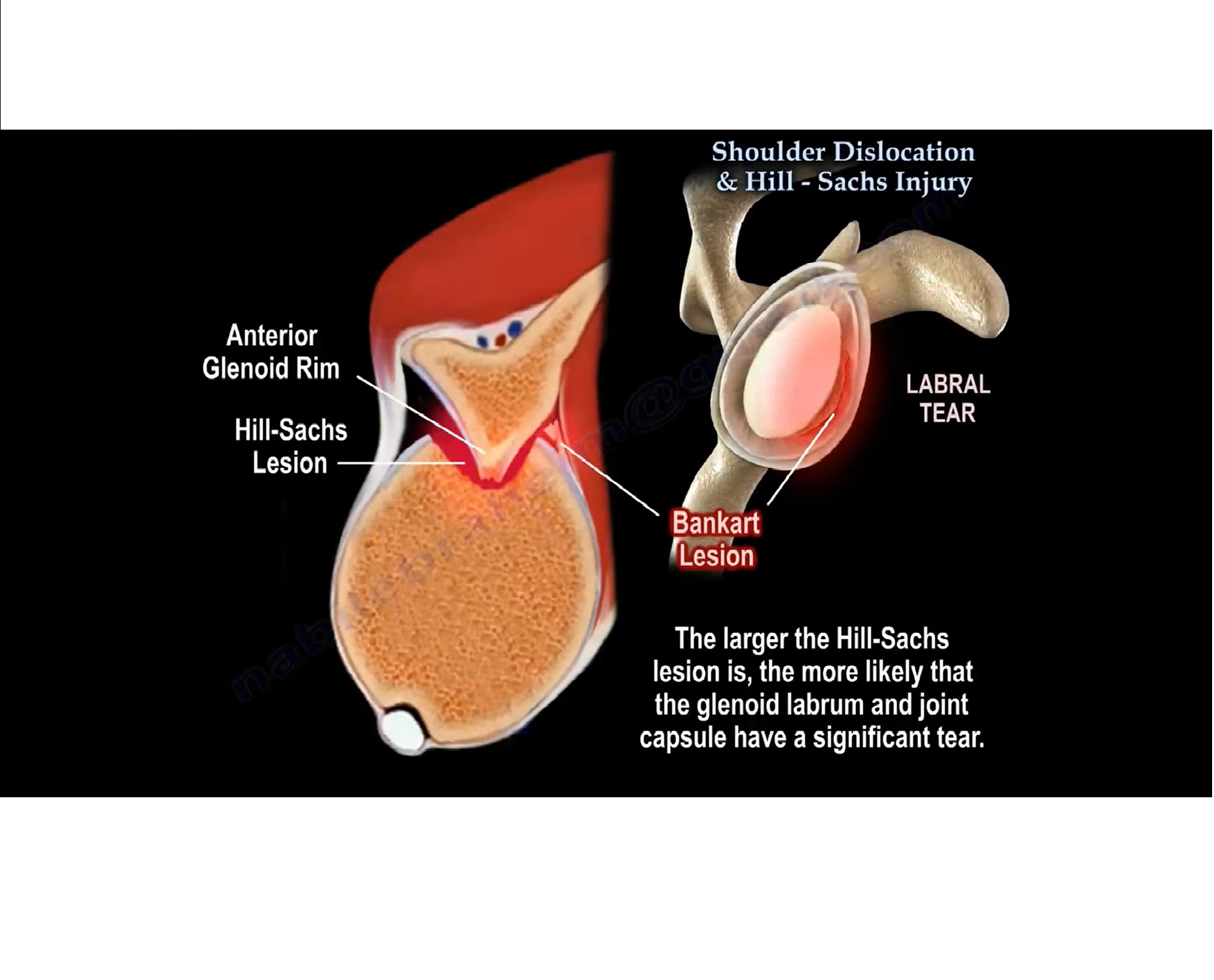
Eg: When shoulder dislocates anteriorly –the anteroinferior part of the labrum gets injured-BANKART LESION


  • The labrum reinforces the glenoid cavity and acts like a guard between the joint capsule and shoulder joint .
  • The axillary nerve is the most commonly injured nerve during the shoulder dislocation.
  • Injury to the axillary nerve results in numbness and parasthesia around the shoulder joint-REGIMENTAL BADGE SIGN
    and weakness during abduction of the shoulder joint.
  • Elderly patient+ weakness in abduction of shoulder joint = rotator cuff tear
    Young patient + weakness in abduction of shoulder joint= axillary nerve palsy.

Types of Shoulder Dislocation

• Anterior dislocation ( most common type about 95%)
• Posterior dislocation ( rare type about 5%)

Anterior Dislocation

  • Mechanism of Injury: Indirect force acting on the shoulder joint with a combination of abduction ,extension and external rotation.
    (the arm will be positioned away from the body with backward rotation.)
  • Injuries associated with Anterior Dislocation :
    • Bankart lesion – Tear of the anteroinferior part of labrum .
    It is associated with a high recurrence rate of dislocation in young patients


  • It can be of 2 types –fibrous /bony
    • Greater tuberosity fracture
    • Hill-Sachs lesion- The head of humerus may get impacted against antero-inferior edge of glenoid cavity
    causing an indentation on the head of humerus called Hill Sachs lesion

Treatment
• Immediate reduction followed by Immobilisation of shoulder joint – Usually for 7-10 days.
• Surgery is the mode of treatment in patients with recurrent shoulder dislocations.

Posterior Dislocation

  • Mechanism of Injury: Associated with high voltage electric shock ,seizures and it is often missed on X-rays
    ( The shoulder gets locked in internal rotation and there will be lack of external rotation of shoulder when compared to the normal side)

Injuries associated with posterior dislocation

• Reverse Bankart lesion
• Lesser tuberosity fracture humerus
• Reverse Hill-Sachs lesion.

Axillary view of shoulder joint is the best to diagnose posterior dislocation.
Post Views: 1,585

Related Posts

  • Locked Posterior Dislocations of Shoulder

    Courtesy: Enio Siberio, Shoulder Surgeon, Recife, Brazil

  • Review of Upper Extremity and Shoulder Trauma

    Courtesy: Dr Amr Abdelgawad, Maimonaodes Medical Centre, NY, USA

  • Management of AC Joint Dislocations

    Courtesy: Dr Arpit Jariwala, FRCS Orth, MCh, MRCS Ed, MS, MD

Reader Interactions

Leave a Reply

Your email address will not be published. Required fields are marked *

Primary Sidebar

Follow Us

instagram slideshare

Categories

  • -Applied Anatomy
  • -Approaches
  • -Basic Sciences
  • -Cartilage & Meniscus
  • -Classifications
  • -Examination
  • -Foot and Ankle
  • -Foot and Ankle Trauma
  • -FRCS(Tr and Orth) tutorials
  • -Gait
  • -Hand and Wrist
  • -Hand and Wrist Trauma
  • -Hand Infections
  • -Hip and Knee
  • -Hip Preservation
  • -Infections
  • -Joint Reconstruction
  • -Knee Arthroplasty
  • -Knee Preservation
  • -Metabolic Disorders
  • -Oncology
  • -OrthoBiologics
  • -OrthoPlastic
  • -Paediatric Orthopaedics
  • -Paediatric Trauma
  • -Patellofemoral Joint
  • -Pelvis
  • -Peripheral Nerves
  • -Principles
  • -Principles of Surgery
  • -Radiology
  • -Rheumatology
  • -Shoulder and Elbow
  • -Shoulder and Elbow Arthroplasty
  • -Spine Deformity
  • -Spine Oncology
  • -Spine Trauma
  • -Spine, Pelvis & Neurology
  • -Sports Ankle and Foot
  • -Sports Elbow
  • -Sports Knee
  • -Sports Medicine
  • -Sports Medicine Hip
  • -Sports Shoulder
  • -Sports Wrist
  • -Statistics
  • -Technical Tip
  • -Technology in Orth
  • -Trauma
  • -Trauma (Upper Limb)
  • -Trauma Life Support
  • -Trauma Reconstruction
  • Book Shelf
  • Book Shelf Medical
  • Careers
  • Case Studies and Free Papers
  • DNB Ortho
  • Evidence Based Orthopaedic Principles
  • Evidence Based Orthopaedics
  • Exam Corner
  • Fellowships
  • Guest Editor
  • Guest Reviews
  • Image Quiz
  • Instructional Course Lectures
  • Journal Club
  • MCQs
  • Meetings and Courses
  • Multimedia
  • News and Blog
  • Plaster Techniques
  • Podcasts
  • Public Health
  • Rehabilitation
  • Research
  • Shorts and Reels
Copyright@orthopaedicprinciples.com. All right rerserved.