
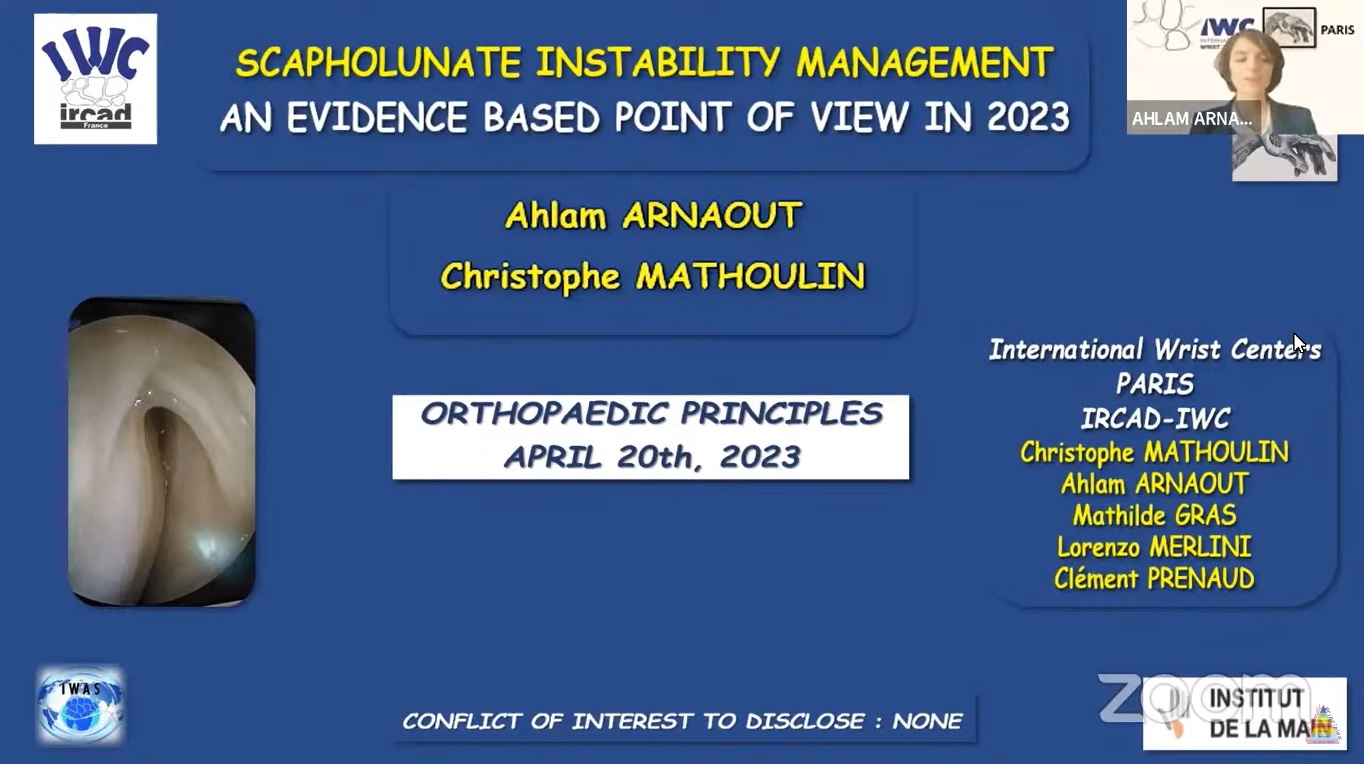
Courtesy: Dr. Ahlam Arnaout, MD, Paris France
Key Insight
Despite extensive research, there is no universally accepted optimal treatment, reflecting the complexity of wrist biomechanics
Historical Understanding of SLI
Focus on Scapholunate Interosseous Ligament (SLIL)
The SLIL was traditionally considered the primary stabilizer.
Components of SLIL
- Dorsal portion — Strongest, main stabilizer
- Volar portion — Weaker, elastic
- Intermediate portion — Fibrocartilaginous, minimal role
Natural Progression of Untreated Injury
- Scapholunate dissociation
- DISI deformity
- SLAC wrist arthritis
Early Surgical Approaches
1. Direct Ligament Repair
Techniques
- Open repair
- Transosseous sutures
- Anchor fixation
Limitations
- Large surgical exposure
- Vascular disruption
- Anchor-related complications
- Poor long-term outcomes
2. Tendon Reconstruction
Common Techniques
- Three-ligament tenodesis
- Brunelli procedure
- Dorsal capsulodesis
Indications
- Irreparable SL ligament
- Reducible gap
- No arthritis
Outcomes
- Good pain relief
- Variable functional results
- Limited long-term stability
Key Limitation
Tendons may not replicate:
- Ligament biomechanics
- Proprioceptive function
Modern Concept: Scapholunate Complex
Key Principle
Stability depends on the entire scapholunate complex, not just the SL ligament
Components
Intrinsic Structure
- Scapholunate interosseous ligament
Extrinsic Ligaments
- Dorsal intercarpal ligament (DIC)
- Dorsal capsulo-scapholunate septum (DCSS)
- Radioscaphocapitate ligament
- Long and short radiolunate ligaments
- Scaphotrapeziotrapezoid ligament
Key Stabilizers
Dorsal Capsulo-Scapholunate Septum (DCSS)
Role
- Secondary stabilizer
- Contains:
- Blood supply
- Mechanoreceptors
Clinical Significance
- Injury — Dynamic instability, even with intact SL ligament
Dorsal Intercarpal Ligament (DIC)
Role
- Major stabilizer of SL complex
Key Finding
- Sectioning DIC — significant instability
Role of Proprioception
Concept
Wrist stability involves sensorimotor control
Structures Containing Mechanoreceptors
- DCSS
- Dorsal capsule
- Extrinsic ligaments
Dynamic Stabilizers
- Flexor carpi radialis (FCR)
- Forearm muscle reflexes
- Posterior interosseous nerve
Modern Classification
Gold Standard
Arthroscopic classification
Geissler Classification
- Four stages based on arthroscopy
EWAS Classification (0–4)
Represents:
- Dynamic instability
- Partial tear
- Complete tear
- Static instability
Current Treatment Philosophy
Modern Principle
Treat scapholunate instability, not just the ligament
Structures to Address
- Dorsal SL ligament
- DCSS
- DIC
- Extrinsic ligament complex
Role of Wrist Arthroscopy
Why It Is Gold Standard
- Dynamic assessment
- Accurate staging
- Guides treatment
- Minimizes tissue damage
Modern Surgical Techniques
1. Open Reconstruction
ANAFAB Technique
- Hybrid synthetic tendon reconstruction
Targets
- SL ligament
- DCSS
- Extrinsic ligaments
Limitations
- Extensive dissection
- Limited long-term data
2. Arthroscopic Reconstruction Techniques
PCO Box Technique
- Reconstructs dorsal + volar SL ligaments
Corella Technique
- Fully arthroscopic
- Recreates SL ligaments
Does not address extrinsic ligaments
Smiley Suture Button
- Reconstructs:
- DCSS
- SL ligament
- Extrinsic stabilizers
3. Internal Brace (Gomez Technique)
Key Features
- Arthroscopic
- No tendon graft
- Internal stabilization
Options
Option A
- Stable bones
- Reconstructs SL + DCSS
Option B
- Unstable scaphoid
- Adds DIC + STT ligament
Option C
- Advanced instability
- Reconstructs all stabilizers
4. Arthroscopic Dorsal Capsuloligamentous Repair (ADCLR)
Concept
- Capsule acts as plate
- Ligament acts as bone
Indications
- Dynamic instability
- Partial tears
- Reducible cases
Procedure
- Arthroscopic evaluation
- Assess DCSS
- Midcarpal instability testing
- Suture capsule to ligament
Structures Addressed
- Dorsal SL ligament
- DCSS
- Partial extrinsic support
Outcomes
- ~800 cases reported
- Good:
- Pain relief
- ROM
- Grip strength
Return to Activity
- Work: ~9 weeks
- Athletes: return to same level
Postoperative Protocol
- Immobilization: 6 weeks
- With K-wires: 8 weeks
- Rehab focuses on:
- Proprioception
- FCR strengthening
Avoid early aggressive stretching
Evidence-Based Treatment Algorithm (2023)
Stage 1 (Dynamic)
- Immobilization (6 weeks)
Stage 2–3 (Partial)
- ADCLR
- Arthroscopic pinning
Stage 3C (Complete)
- Large ADCLR
- Reconstruction
Stage 4 (Advanced)
- Arthroscopic/open reconstruction
- Salvage procedures
Special Scenario: Distal Radius Fracture + SL Widening
Early Stage (<3)
- Treat fracture only
SL gap may heal
Advanced Stage
- Arthroscopic stabilization required
Advantages of Arthroscopic Surgery
- Minimal soft tissue damage
- Preserves vascularity
- Preserves proprioception
- Less stiffness
Future Directions
Ideal Procedure Should
- Be arthroscopic
- Address:
- DCSS
- SL ligament
- DIC
- Preserve biomechanics and proprioception
Current Reality
No single technique meets all criteria yet
Key Take-Home Messages
- SLI involves the entire scapholunate complex, not just SL ligament
- Arthroscopy is the gold standard for diagnosis and management
- Modern treatment focuses on:
- Biomechanics
- Proprioception
- Multi-structure reconstruction
- ADCLR is highly promising for early instability

Leave a Reply