• Skip to main content
  • Skip to secondary menu
  • Skip to primary sidebar
OrthopaedicPrinciples.com

OrthopaedicPrinciples.com

Integrating Principles and Evidence

Integrating Principles and Evidence

  • Home
  • Editorial Board
  • Our Books
    • Evidence Based Orthopaedic Principles
  • Courses
  • Exams
  • Reviews
  • Live Program
  • Contact

Salter Harris Epiphyseal Injury Classification

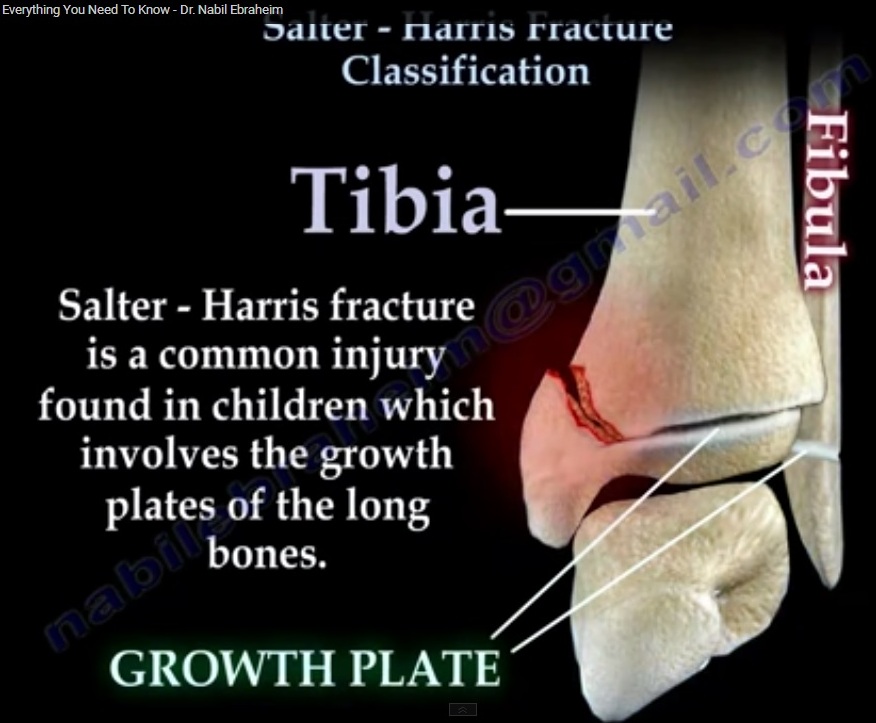
Salter – Harris Fracture Classification

Salter-Harris fracture is a common injury found in children which involves the growth plates of the long bones. Approximately 15-30% of all childhood fractures are growth plate fractures and are common in the lower leg bones (tibia and fibula). It is important to detect these fractures as they may affect the growth of the bone if not treated properly.

There are generally five types of Salter-Harris fractures. The higher the type number, the more complications associated with the fracture and worse prognosis.

Type I:

•5% of fractures are type I.
•It may be difficult to diagnose and sometimes diagnosis is clinical.
•It occurs through the weak zone of provisional calcification.
•It is known by fast healing and rare complications.
•Unless there is obvious displacement it may be hard to diagnose.

Type II

•75% of fractures are type II.
•Fracture of the physis (growth plate) and metaphysis.
•The corner of the metaphysis separates (Thurston-Holland sign).
•Fragment usually stays with the epiphysis while the rest of the metaphysis will displace.
•Healing is fast and growth is usually OK
•Distal femur fracture may result in growth deformity.

Type III
•10% of fractures are type III.
•Fracture of the growth plate and epiphysis.
•Split of the epiphysis
•Fracture extends into the articular surface of the bone.
•Requires reduction of the joint
•In distal femur fractures it may result in growth deformity.

Type IV
•10% of fractures are type IV
•Fracture passes through the epiphysis, physis (growth plate) and the metaphysis
•Can cause complications such as growth disturbance and angular deformity.

Type V
•Uncommon, about 5%
•Compression or crush injury of the growth plate
•No associated fracture of the epiphysis or metaphysis
•Initial diagnosis may be difficult
•The highest incidence of growth deformity and disturbance.
30Salter Harris Epiphyseal Injury ClassificationJ

Post Views: 9,701

Related Posts

  • Nerve Injury Classification

    Courtesy : Professor Nabile Ebraheim, Department of Orthopaedics and Trauma, University of Toledo, United States.

  • 1 minute masterclass: Nerve injury classification

    Courtesy: Dominic Power, Consultant Hand Surgeon, Birmingham, UK

  • Salter Harris Classification of Epiphyseal Injuries

    Courtesy: Prof Nabil Ebraheim, University of Toledo, Ohio, USA GROWTH PLATE ANATOMY AND ITS FUNCTIONS…

Reader Interactions

Comments

  1. shabe bharathan says

    at

    good video…..informative…

Leave a Reply

Your email address will not be published. Required fields are marked *

Primary Sidebar

Follow Us

instagram slideshare

Categories

  • -Applied Anatomy
  • -Approaches
  • -Basic Sciences
  • -Cartilage & Meniscus
  • -Classifications
  • -Examination
  • -Foot and Ankle
  • -Foot and Ankle Trauma
  • -FRCS(Tr and Orth) tutorials
  • -Gait
  • -Hand and Wrist
  • -Hand and Wrist Trauma
  • -Hand Infections
  • -Hip and Knee
  • -Hip Preservation
  • -Infections
  • -Joint Reconstruction
  • -Knee Arthroplasty
  • -Knee Preservation
  • -Metabolic Disorders
  • -Oncology
  • -OrthoBiologics
  • -OrthoPlastic
  • -Paediatric Orthopaedics
  • -Paediatric Trauma
  • -Patellofemoral Joint
  • -Pelvis
  • -Peripheral Nerves
  • -Principles
  • -Principles of Surgery
  • -Radiology
  • -Rheumatology
  • -Shoulder and Elbow
  • -Shoulder and Elbow Arthroplasty
  • -Spine Deformity
  • -Spine Oncology
  • -Spine Trauma
  • -Spine, Pelvis & Neurology
  • -Sports Ankle and Foot
  • -Sports Elbow
  • -Sports Knee
  • -Sports Medicine
  • -Sports Medicine Hip
  • -Sports Shoulder
  • -Sports Wrist
  • -Statistics
  • -Technical Tip
  • -Technology in Orth
  • -Trauma
  • -Trauma (Upper Limb)
  • -Trauma Life Support
  • -Trauma Reconstruction
  • Book Shelf
  • Book Shelf Medical
  • Careers
  • Case Studies and Free Papers
  • DNB Ortho
  • Evidence Based Orthopaedic Principles
  • Evidence Based Orthopaedics
  • Exam Corner
  • Fellowships
  • Guest Editor
  • Guest Reviews
  • Image Quiz
  • Instructional Course Lectures
  • Journal Club
  • MCQs
  • Meetings and Courses
  • Multimedia
  • News and Blog
  • Plaster Techniques
  • Podcasts
  • Public Health
  • Rehabilitation
  • Research
  • Shorts and Reels
Copyright@orthopaedicprinciples.com. All right rerserved.