
Courtesy: Saurabh Aggarwal, Princess Royal University Hospital, London, UK
Definition
-
Rheumatoid arthritis is a chronic systemic inflammatory disease characterized by symmetrical inflammatory polyarthritis.
-
It predominantly affects the small joints of the hands, feet, and wrists.
-
Symptoms persist for more than 6 weeks and are associated with characteristic laboratory abnormalities.
Pathogenesis
-
The disease begins with antigen-mediated activation of T lymphocytes.
-
This initiates a cascade involving activation of endothelial cells and inflammatory mediators.
-
Matrix metalloproteinases cause excessive collagen degradation and cartilage matrix destruction.
-
The synovium transforms into an invasive pannus, composed of synoviocytes, T lymphocytes, and macrophages.
-
Inflamed synovium with vascular proliferation invades adjacent cartilage and bone.
-
This process leads to:
-
Progressive cartilage destruction
-
Activation of osteoclasts
-
Periarticular bony erosions
-
Juxta-articular osteopenia
-
Clinical Features
-
Insidious onset of symptoms.
-
Joint pain, swelling, and stiffness, particularly morning stiffness lasting more than 1 hour.
-
Symmetrical involvement is typical.
-
Commonly affected joints include:
-
Metacarpophalangeal joints
-
Proximal interphalangeal joints
-
Interphalangeal joints of the thumb
-
Wrist joints
-
Metatarsophalangeal joints of the toes
-
Physical Examination Findings
General Joint Findings
-
Pain and localized tenderness
-
Swelling and synovial thickening
-
Restriction of joint movement
Hand Deformities
-
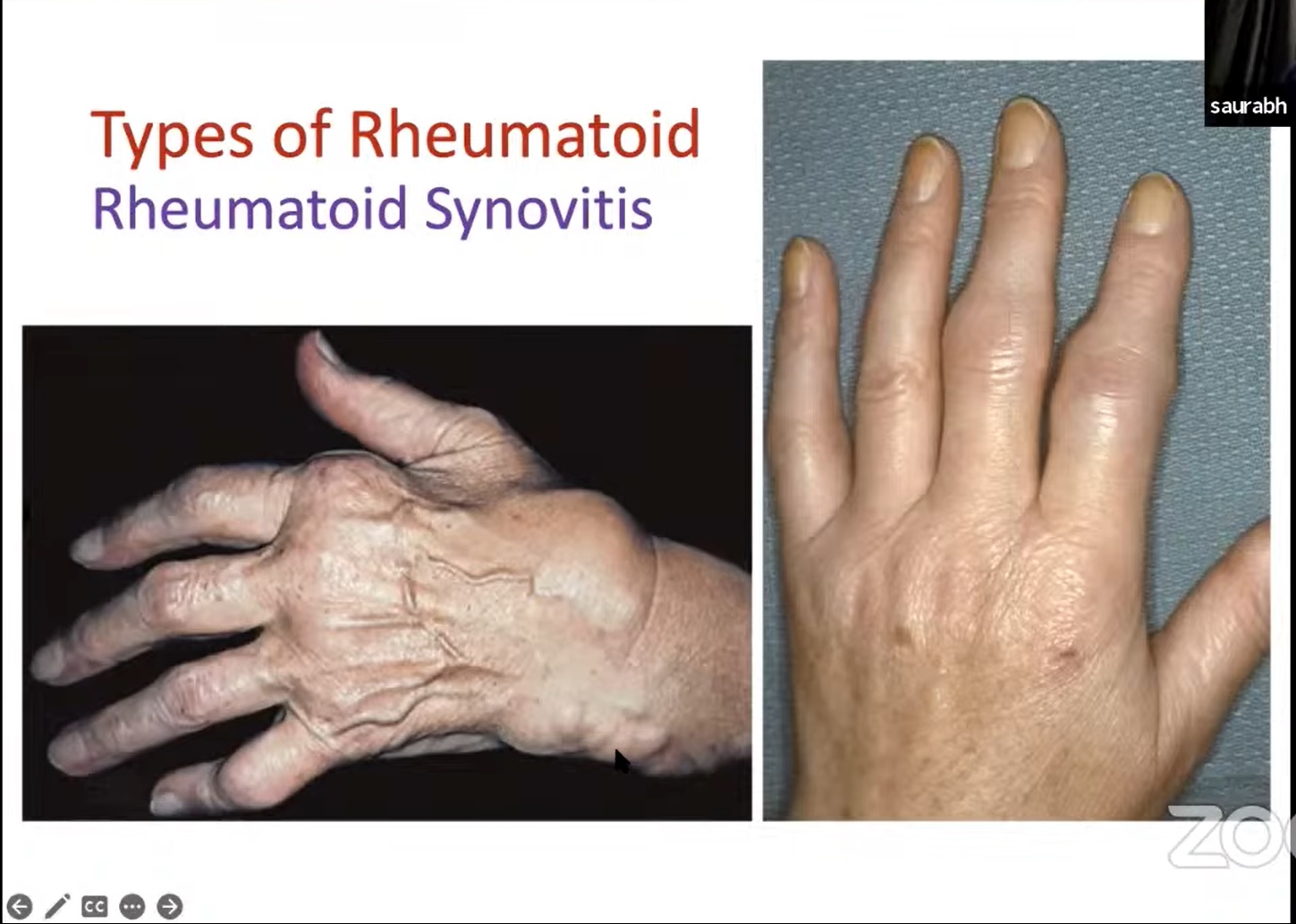
Ulnar deviation (ulnar drift) of fingers
-
Swan-neck deformity
-
Boutonnière deformity
-
Z-deformity of the thumb
-
Bowstring sign
-
Digital infarcts
-
Rheumatoid nodules
Elbow
-
Subcutaneous rheumatoid nodules
-
Loss of extension
-
Ulnar nerve compression neuropathy
Shoulder
-
Adhesive capsulitis (frozen shoulder)
Foot and Ankle
-
Synovitis of metatarsophalangeal joints
-
Cock-up deformities of toes
-
Flattening of foot arches
-
Retrocalcaneal bursitis
-
Tarsal tunnel syndrome
Knee
-
Synovial thickening
-
Joint effusion
-
Restricted range of motion
-
Ligamentous laxity leading to deformity
Axial Skeleton
-
Cervical spine involvement
-
Atlantoaxial subluxation
Other Joints
-
Cricoarytenoid joint
-
Temporomandibular joint
-
Sternoclavicular joint
-
Manubriosternal joint
Radiographic Features
Early Changes
-
Soft tissue swelling
-
Juxta-articular osteopenia
Late Changes
-
Joint space narrowing
-
Marginal bony erosions
-
Reduced intercarpal and radiocarpal joint spaces
-
Carpal crowding and ankylosis
-
Destruction of intercarpal articulations
-
Marked subluxation of metacarpophalangeal joints
-
Reduced joint space at carpometacarpal, metacarpophalangeal, and proximal interphalangeal joints
-
Erosions of cartilage and bone are cardinal features of rheumatoid arthritis but are not diagnostic by themselves.
Extra-Articular Manifestations
-
Generalized osteopenia or osteoporosis
-
Muscle wasting and weakness
-
Rheumatoid nodules
-
Skin ulcers
-
Ocular involvement
-
Pulmonary disease
-
Cardiac involvement
-
Renal disease
-
Hematologic abnormalities
-
Nervous system involvement
Laboratory Findings
-
Anemia of chronic inflammation
-
Thrombocytosis
-
Mild leukocytosis
-
Positive rheumatoid factor
-
Anti-citrullinated protein antibodies
-
Elevated acute phase reactants:
-
Erythrocyte sedimentation rate
-
C-reactive protein
-
Assessment of Disease Activity
-
Disease Activity Score using 28 joints with erythrocyte sedimentation rate or C-reactive protein
-
Simplified Disease Activity Index
-
Clinical Disease Activity Index
Poor Prognostic Factors
-
Early functional impairment as assessed by validated scoring systems
-
Presence of extra-articular disease
-
High titers of rheumatoid factor or anti-citrullinated protein antibodies
-
Elevated erythrocyte sedimentation rate at diagnosis
-
Male gender
-
Presence of rheumatoid nodules
-
Radiographic evidence of bony erosions
Pre-Treatment Evaluation
-
Baseline investigations:
-
Complete blood count
-
Serum creatinine
-
Liver function tests
-
Erythrocyte sedimentation rate
-
C-reactive protein
-
-
Screening for hepatitis B and C prior to initiating disease-modifying therapy
-
Ophthalmologic examination before initiating hydroxychloroquine
-
Screening for latent tuberculosis using Mantoux test or interferon-gamma release assay before starting biologic or Janus kinase inhibitor therapy
Medical Management
-
Nonsteroidal anti-inflammatory drugs for symptomatic relief
-
Corticosteroids for short-term disease control
-
Conventional synthetic disease-modifying antirheumatic drugs
-
Biologic disease-modifying antirheumatic drugs
-
Targeted synthetic disease-modifying antirheumatic drugs
Surgical Management
Surgery is considered for pain relief, deformity correction, and functional restoration.
Common procedures include:
-
Decompression of entrapped nerves
-
Reconstructive joint procedures, including arthroplasty
-
Corrective metatarsal arthrotomies
-
Cervical spine stabilization
-
Tendon release and tendon transfer procedures
-
Arthrodesis, particularly of the ankle joint
Leave a Reply