
Courtesy: Dr S Macdonald, Ashok Shyam TV, Ortho
Why This Matters
-
Incidence of infection after TKA: ~1% to 2.5%.
-
Devastating complication:
-
Severe patient morbidity.
-
Surgeon burden.
-
High healthcare cost.
-
-
Prevention requires a multifactorial strategy:
-
Patient factors
-
Intraoperative factors
-
Postoperative factors
-
1 Patient-Related Risk Factors
Some modifiable, some not.
Gender
-
Large registry data (e.g., Finnish arthroplasty registry ~43,000 TKAs):
-
Slightly higher infection in males (~1%) vs females (~0.7%).
-
-
Not clinically modifiable.
Diagnosis
-
Osteoarthritis: ~0.7% infection risk.
-
Rheumatoid arthritis: approximately double the risk.
Management in Rheumatoid Arthritis
NSAIDs
-
Stop ~7–10 days preoperatively.
Steroids
-
Perioperative stress dosing recommended.
-
Common protocol: 3 doses of 25 mg IV steroid.
Methotrexate
-
Historically stopped.
-
Recent data suggests continuation may not increase infection risk.
-
Practice varies.
Leflunomide
-
Should be stopped (increased infection risk).
TNF-alpha blockers
-
Evidence suggests may not significantly increase infection risk.
-
Coordinate with rheumatologist.
Practical strategy:
-
Collaborate with rheumatology.
-
Temporarily hold immunosuppressive drugs where safe.
Diabetes
-
Poor glycemic control – higher infection risk.
-
Elevated HbA1c strongly associated with increased infection.
Recommendation:
-
Screen preoperatively.
-
Optimize glucose control before surgery.
Obesity
-
Associated with:
-
Prolonged wound drainage.
-
Higher superficial complications.
-
-
Deep infection risk likely increased.
-
BMI trends:
-
Obesity prevalence rising globally.
-
Increasing number of patients with BMI >40.
-
Reality:
-
Weight loss before surgery is difficult.
-
Counseling important but limited impact in practice.
2 Intraoperative Factors
These are largely under surgeon control.
Antibiotic Prophylaxis
-
Standard of care.
-
First-line: Cefazolin (if no allergy).
-
Adjust for MRSA risk or allergies.
Operating Room Environment
Air Quality
-
High air exchange turnover essential.
-
Laminar flow beneficial but not universally available.
-
UV light rarely used routinely.
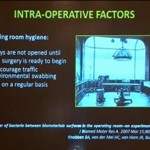
OR Traffic
-
Increased traffic – higher contamination.
-
Minimize personnel and door openings.
Sterile Technique
-
Change gloves before handling implants.
-
Avoid breaks in sterility.
-
Maintain discipline in the OR.
Surgical Time
-
Longer operative time – increased infection risk.
-
Efficient, well-planned surgery reduces risk.
Antibiotic Cement
Controversial but strongly supported by registry data.
Large registry findings (Norwegian, Finnish, etc.):
-
IV antibiotics alone:
-
~1% infection rate.
-
-
IV + antibiotic-loaded cement:
-
Reduced to ~0.6–0.7%.
-
Findings:
-
Lower septic and aseptic loosening rates.
-
Gentamicin-containing cement performs best.
-
No strong evidence of increased resistant organisms.
Takeaway:
-
Antibiotic cement significantly reduces infection risk.
-
Especially useful in primary TKA.
3 Postoperative Factors
Drain Use
-
No convincing evidence either way.
-
Surgeon preference.
DVT Prophylaxis
-
Necessary.
-
Avoid starting anticoagulation preoperatively.
Wound Complications
Critical point:
-
Hematoma
-
Persistent drainage
-
Skin necrosis
-
Superficial infection
These do NOT resolve spontaneously.
They must be:
-
Identified early.
-
Managed aggressively.
Failure to intervene early -deep periprosthetic infection.
Dental Prophylaxis
-
Controversial topic.
-
No strong evidence for routine long-term prophylaxis.
-
Follow updated guidelines.
Key Infection Prevention Principles
- Optimize the patient.
- Use perioperative IV antibiotics.
- Consider routine antibiotic cement.
- Minimize OR traffic.
- Maintain strict sterile discipline.
- Keep operative time efficient.
- Aggressively manage wound issues.
Final Message
Infection prevention in TKA is not one intervention—it is a layered defense strategy:
-
Patient optimization
-
Intraoperative discipline
-
Postoperative vigilance
No single step eliminates infection risk.
A multifaceted, systematic approach offers the best protection.

Leave a Reply