
Courtesy: Prof Abhijeet Wahegaonkar, Sancheti Hospital, Pune, India
PIP Joint Fracture-Dislocations
Definition
- Injury involving dislocation of the proximal interphalangeal (PIP) joint with an associated fracture
- Most commonly involves the base of the middle phalanx articular surface
Importance
- Commonly missed injury
- Delayed or inadequate treatment can lead to:
- Stiffness
- Instability
- Post-traumatic arthritis
- Loss of function
Anatomy
The PIP joint is a hinge joint.
Stability Provided By
- Bony congruity
- Volar plate
- Collateral ligaments
- Central slip and extensor mechanism
Mechanism of Injury
Usually caused by:
- Axial loading
- Hyperextension
- Rotational force
Types of PIP Fracture-Dislocations
1. Dorsal Fracture-Dislocation
Most common type
Mechanism:
- Hyperextension injury
Pathology:
- Volar lip fracture of middle phalanx
- Middle phalanx displaces dorsally
2. Volar Fracture-Dislocation
Less common
Associated injury:
- Central slip injury
3. Lateral Dislocation
Mechanism:
- Collateral ligament injury
Classification by Articular Involvement
<30% Articular Surface
- Usually stable
30–50% Articular Surface
- Tenuous stability
>50% Articular Surface
- Usually unstable
Clinical Features
- Pain
- Swelling
- Deformity
- Restricted movement
- Tenderness around PIP joint
Chronic cases may present with:
- Stiffness
- Functional limitation
Imaging
Required Views
- AP view
- Lateral view
- Oblique view
Assess On Imaging
- Direction of dislocation
- Fragment size
- Percentage of articular involvement
- Joint congruity
- Persistent subluxation
Important Radiological Concept
Joint Congruity is Critical
Look for:
- Smooth gliding articulation
- Absence of hinging
- No persistent subluxation
Persistent hinging or subluxation indicates instability.
Treatment Goals
- Restore congruent reduction
- Maintain stability
- Allow early mobilization
- Prevent stiffness and arthritis
Treatment
Stable Injuries
Non-operative Management
- Extension block splinting
- Buddy taping in selected simple injuries
- Early supervised range of motion exercises
Dorsal Fracture-Dislocation
Common Treatment Options
1. Extension Block Splinting
- Prevents hyperextension
- Maintains stable reduction
2. Extension Block Pinning
- Used for unstable injuries
3. Open Reduction and Internal Fixation (ORIF)
Indication:
- Large fracture fragments
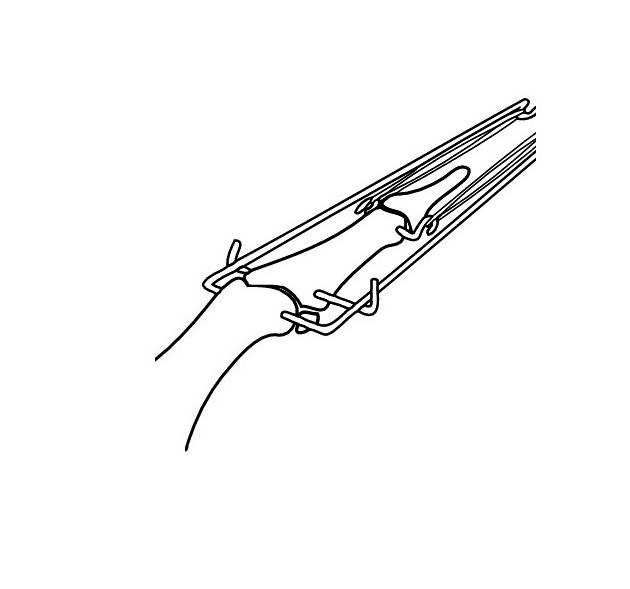
4. Dynamic External Fixation
Indications:
- Comminuted fractures
- Unstable injuries
Advantages:
- Uses ligamentotaxis
- Allows early motion
5. Volar Plate Arthroplasty
Used in:
- Selected chronic injuries
6. Hemi-Hamate Arthroplasty
Used for:
- Severe chronic injuries
- Salvage situations
- Extensive volar lip loss
Volar Fracture-Dislocation
Treatment Principles
- Usually immobilized in extension
- Large fragments may require fixation
- Always assess for central slip injury
Dynamic External Fixation
Advantages
- Maintains reduction through ligamentotaxis
- Allows early controlled motion
- Useful for unstable and comminuted fractures
Complications
- Joint stiffness
- Residual instability
- Recurrent subluxation
- Post-traumatic arthritis
- Flexion deformity
- Extension lag
- Reduced grip strength
Key Clinical Pearls
- Dorsal fracture-dislocation is more common than volar fracture-dislocation
- <30% articular involvement is usually stable
-
50% articular involvement is usually unstable
- Early mobilization after stable reduction is essential
- Smooth gliding congruent reduction is more important than perfect radiographic appearance
- Missed injuries lead to poor long-term functional outcome
Post Views: 4,798
Related Posts
- Managing Delayed presentation of PIP joint Dislocations
Courtesy: Hemant Patankar, Ashok Shyam, IORG and OrthoTV
- PIP Dorsal Fracture Dislocation
Courtesy: Prof Nabile Ebraheim, University of Toledo, Ohio, United States
Leave a Reply