
Courtesy: Dr Rishi Dhir, Consultant Orthopaedic Surgeon, UK
Introduction
This video lecture provides a comprehensive overview of peripheral nerve injuries, with emphasis on:
-
Basic nerve anatomy
-
Mechanisms and causes of nerve injury
-
Clinically relevant classification systems
-
Nerve conduction studies and EMG
-
Practical exam scenarios and real-world clinical decision-making
1. Overview of Nerve Anatomy
Components of the Nervous System
-
Central Nervous System (CNS)
-
Brain, brainstem, and spinal cord
-
-
Peripheral Nervous System (PNS)
-
Transmits sensory and motor signals between the body and CNS
-
-
Autonomic Nervous System (ANS)
-
Controls involuntary functions
-
Includes sympathetic and parasympathetic systems
-
Structure of a Neuron
Each neuron consists of:
-
Axon – conducts electrical impulses
-
Myelin sheath – fatty insulating layer produced by Schwann cells, increases conduction velocity
-
Cell body – contains nucleus and controls neuronal function
-
Dendrites – receive incoming signals
-
Synaptic terminal – transmits signals to muscles or other neurons
Supporting Structures of Peripheral Nerves
-
Glial cells – provide support and nutrition
-
Connective tissue layers:
-
Endoneurium – surrounds individual axons
-
Perineurium – surrounds fascicles; forms the blood–nerve barrier
-
Epineurium – surrounds entire nerve, providing mechanical protection
-
The perineurium is critical for maintaining the blood–nerve barrier and regulating nutrient exchange.
2. Causes of Nerve Injury
A useful mnemonic to recall common causes is “DATING ME”:
-
D – Diabetes (diabetic neuropathy)
-
A – Autoimmune (e.g., Guillain–Barré syndrome)
-
T – Trauma (fractures, lacerations)
-
I – Inflammatory (vasculitis)
-
N – Neoplasms (tumor compression)
-
G – General systemic disorders (malnutrition, metabolic disease)
-
M – Motor neuron diseases (e.g., ALS)
-
E – Electrical or thermal injuries (burns, electrocution)
3. Classification of Nerve Injuries
Seddon Classification (1943)
-
Neuropraxia
-
Temporary conduction block
-
No structural damage
-
Common in compression injuries (e.g., carpal tunnel syndrome)
-
-
Axonotmesis
-
Axonal disruption with intact connective tissue
-
Good potential for recovery
-
-
Neurotmesis
-
Complete disruption of nerve and sheath
-
Requires surgical repair
-
Sunderland Classification (1951)
-
Grade 1 – Neuropraxia
-
Grade 2 – Axon damage, intact endoneurium
-
Grade 3 – Axon damage with disrupted endoneurium
-
Grade 4 – Axon damage with disrupted perineurium
-
Grade 5 – Complete nerve transection (neurotmesis)
Birch & Bonney Classification (Clinically Oriented)
-
Conduction block – equivalent to neuropraxia
-
Degenerative lesion – includes axonotmesis and neurotmesis
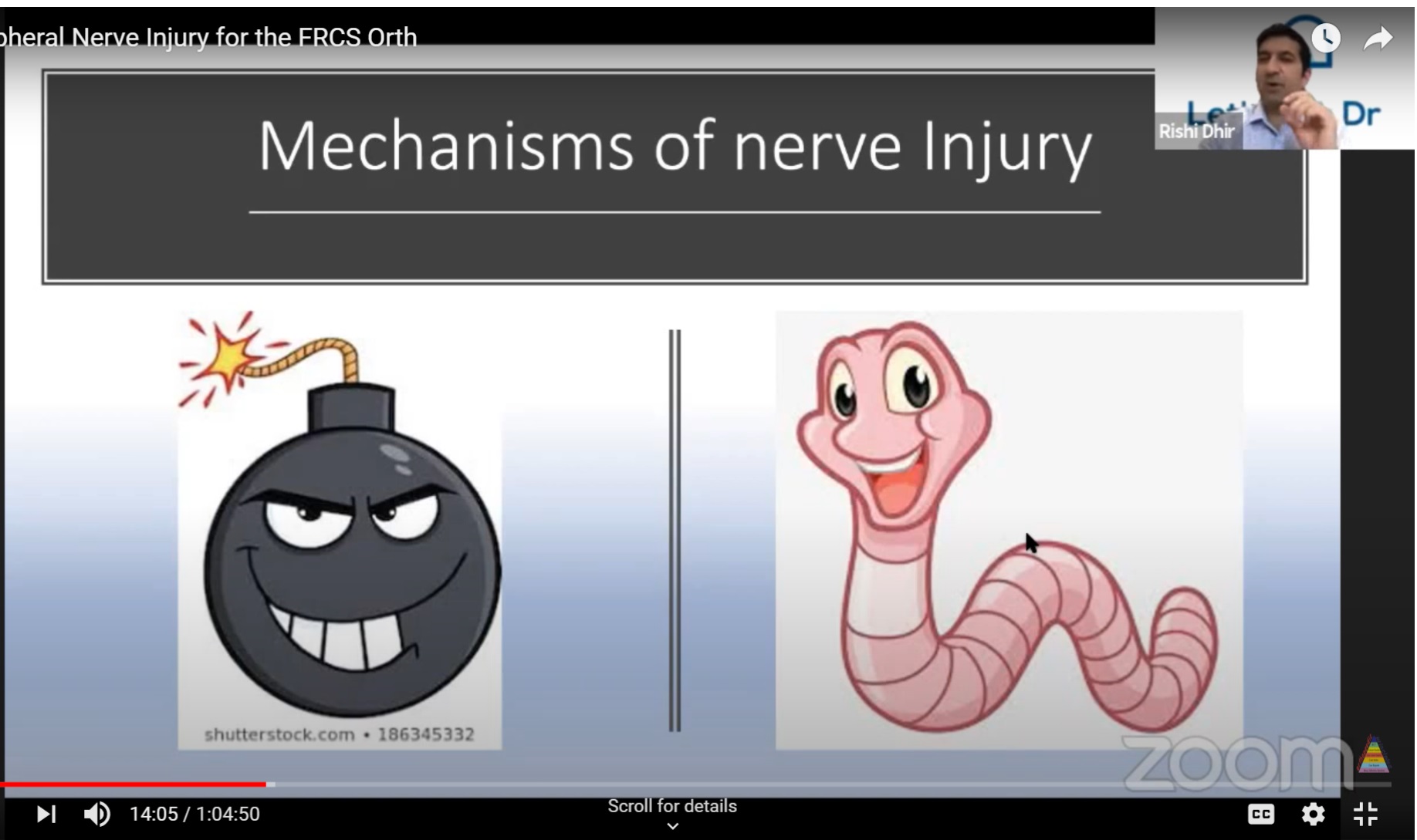
4. Mechanisms of Nerve Injury & Healing
Mechanisms
-
Compression injuries – reversible conduction block
-
Stretch injuries – damage to connective tissue layers with scarring
-
Lacerations – severe injuries requiring surgical repair
Wallerian Degeneration
-
Occurs in axonotmesis and neurotmesis
-
Distal axonal segment degenerates due to loss of nutrient supply
-
Cleared by macrophages, leaving Schwann cells behind
Nerve Regeneration
-
Schwann cells align to form Bands of Büngner
-
Release neurotrophic factors guiding axonal growth
-
Axonal growth rate ? 1 mm/day
-
Cell body response includes:
-
Nuclear displacement
-
Increased mitochondrial activity
-
Phenotypic shift toward regeneration
-
5. Conduction Block & Blood–Nerve Barrier
-
The blood–nerve barrier lies between perineurium and endoneurium
-
Compression leads to:
-
Microvascular compromise
-
Edema and inflammatory cell infiltration
-
Protein leakage ? vicious cycle of swelling
-
-
Prolonged compression may progress to Wallerian degeneration
6. Clinical Examination & Diagnostic Tools
Clinical Assessment
-
Detailed history (motor vs sensory symptoms)
-
Focused physical examination
Special Tests
-
Tinel’s sign
-
Phalen’s test (for carpal tunnel syndrome)
Nerve Conduction Studies (NCS)
-
Measure:
-
Latency
-
Amplitude
-
Conduction velocity
-
-
Not reliable in isolation
-
Must be compared with the contralateral side
-
Not performed in the first 6 weeks after injury
Key Findings
-
Prolonged latency
-
Reduced amplitude
-
Slowed conduction velocity
Examples
-
Carpal tunnel syndrome ? slowed conduction at wrist
-
Cubital tunnel syndrome ? slowed conduction at elbow
Electromyography (EMG)
-
Resting EMG should be electrically silent
-
Denervation shows:
-
Fibrillation potentials
-
Positive sharp waves
-
-
Reinnervation shows:
-
Polyphasic motor units
-
Increasing amplitude with recovery
-
7. Tinel’s Sign & Its Variants
-
Advancing Tinel’s sign
-
Indicates active nerve regeneration
-
-
Pseudo-Tinel’s sign
-
Seen in chronic compressive neuropathies
-
Due to myelin damage, not regeneration
-
8. Treatment Principles
Based on Severity
-
Neuropraxia
-
Observation and physiotherapy
-
-
Axonotmesis
-
Monitoring; surgery if no recovery
-
-
Neurotmesis
-
Surgical repair mandatory
-
9. Surgical Management: Ladder of Reconstruction
-
Neurolysis
-
Direct nerve repair (low tension)
-
Nerve grafting (auto/allograft)
-
Nerve transfer
-
Tendon transfer
-
Free muscle transfer
Tendon Transfers
-
Used when nerve recovery is not possible
-
Key principles:
-
Adequate tendon excursion
-
Synergistic muscle action
-
Patient motivation and rehabilitation compliance
-
10. Timing of Surgical Exploration
-
Consider surgery if:
-
No clinical or electrophysiological recovery by 6 weeks to 3 months
-
Persistent pain, compression, or expanding hematoma
-
No advancing Tinel’s sign or EMG evidence of reinnervation
-
11. Clinical Applications
Carpal Tunnel Syndrome (CTS)
-
Risk factors: pregnancy, hypothyroidism, manual labor
-
Examination:
-
Tinel’s sign
-
Phalen’s test
-
Durkan’s test
-
-
Important to rule out proximal pathology (cervical spine)
Radial Nerve Injury
-
Common after trauma (e.g., motorbike accidents)
-
Features:
-
Wrist drop
-
Dorsal hand sensory loss
-
-
Management prioritizes fracture stabilization
-
Many injuries recover spontaneously
Ulnar Nerve Injury
-
Features:
-
Clawing of fingers
-
Intrinsic muscle wasting
-
Reduced grip strength
-
-
Requires thorough hand and neurological assessment
12. Summary: Practical Clinical Approach
-
Use triple assessment:
-
Clinical
-
Radiological
-
Neurophysiological
-
-
NCS and EMG support—but do not replace—clinical judgment
-
Management decisions depend on:
-
Severity of injury
-
Presence of fractures or compression
-
Evidence of recovery
-
Leave a Reply