
Courtesy: Prof Nabil Ebraheim, University of Toledo, Ohio, USA
Perilunate and Lunate Dislocation
Carpal Bone Arrangement
Normal proximal-to-distal relationship:
- Scaphoid
- Lunate
- Triquetrum
- Capitate
Carpal bones are stabilized by strong interconnecting ligaments.
Types of Perilunate Injuries
Lesser Arc Injury
- Purely ligamentous injury
Greater Arc Injury
- Combination of ligamentous and bony injury
Common patterns:
- Trans-radial styloid perilunate injury
- Trans-scaphoid perilunate injury
- Pure ligamentous perilunate injury
- Combined ligamentous + bony injury
- Chauffeur fracture (radial styloid fracture)
- Trans-scaphoid perilunate fracture-dislocation
Mayfield Stages of Perilunate Instability
Stage 1
Scapholunate Ligament Injury
- Initial disruption occurs at scapholunate ligament
Stage 2
Capitolunate Injury
- Injury progresses through capitolunate articulation
Stage 3
Lunotriquetral Injury
- Disruption of lunotriquetral ligament and joint
Stage 4
Lunate Dislocation
- Failure of dorsal radiocarpal ligament
- Lunate rotates and dislocates volarly
- Produces classic:
- “Spilled teacup sign”
Lunate Dislocation
Key Features
- Lunate displaced volarly
- Loses normal articulation with radius
- Remaining carpus remains aligned with radius
Clinical Importance
May compress median nerve causing:
- Acute carpal tunnel syndrome
- Numbness in radial three-and-a-half digits
Radiographic Diagnosis
Important Radiological Signs
1. Gilula Lines
- Smooth carpal arcs should remain continuous
2. Terry Thomas Sign
- Increased scapholunate gap
- Indicates scapholunate dissociation
3. Piece of Pie Sign
- Triangular appearance of dislocated lunate on AP view
4. Spilled Teacup Sign
- Volarly tilted lunate on lateral view
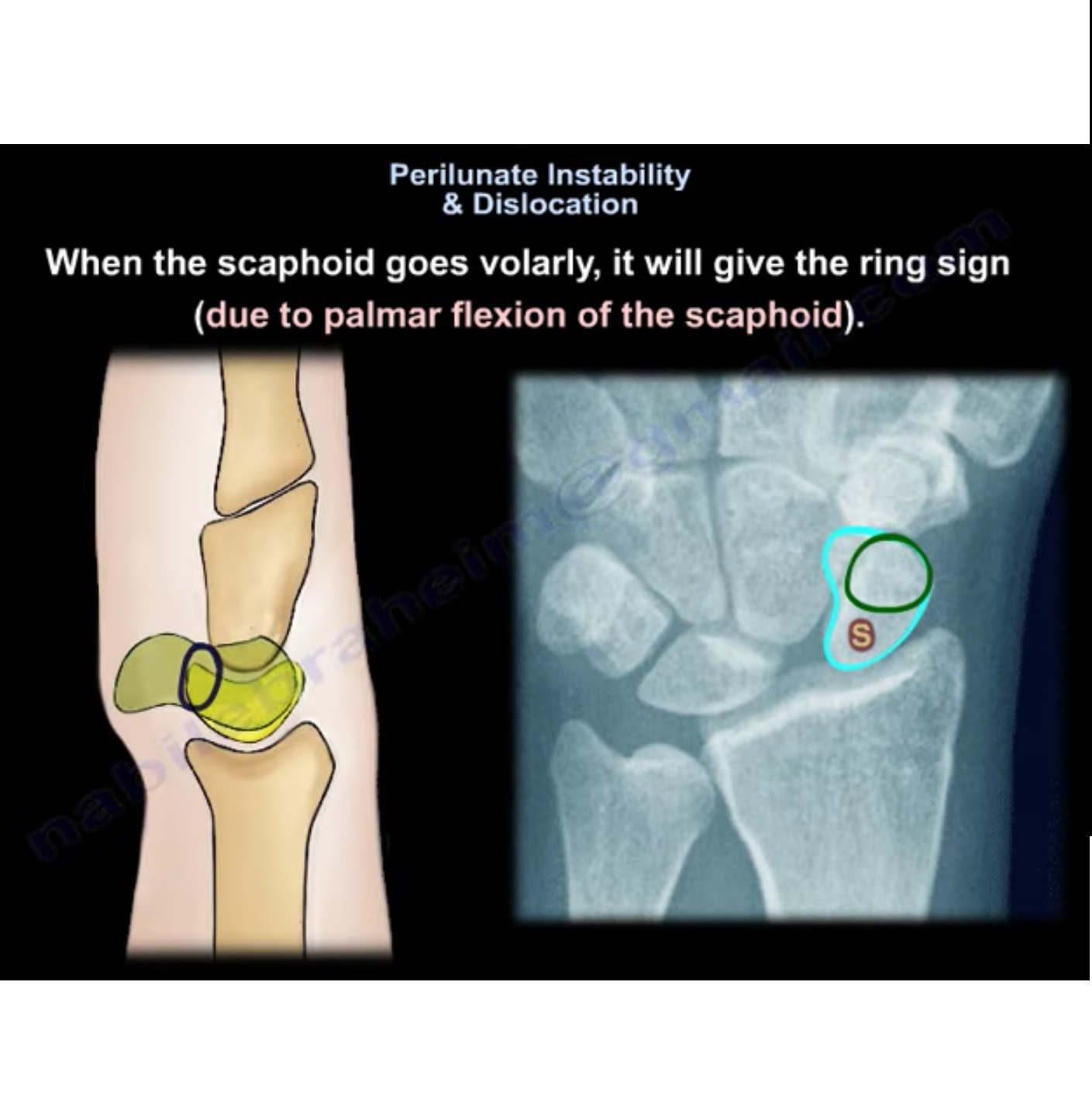
5. Ring Sign
- Indicates volar flexion of scaphoid
Carpal Alignment
Check collinearity of:
- Radius
- Lunate
- Capitate
Loss of alignment suggests perilunate instability.
Important Angles
Scapholunate (SL) Angle
Normal:
- Approximately 30–60°
- Average around 47°
Abnormal:
-
60° suggests scapholunate dissociation
DISI and VISI
DISI
(Dorsal Intercalated Segment Instability)
Mechanism:
- Scapholunate ligament disrupted
- Scaphoid flexes volarly
- Lunate follows triquetrum dorsally
Findings:
- Lunate dorsiflexed
- Increased SL angle
VISI
(Volar Intercalated Segment Instability)
Mechanism:
- Lunotriquetral ligament disrupted
- Lunate follows scaphoid volarly
Findings:
- Lunate volar flexion
Pathomechanics
Normal tendencies:
- Scaphoid tends to flex volarly
- Triquetrum tends to dorsiflex
Ligament disruption determines direction of lunate instability.
Treatment
Acute Injuries (<8 weeks)
Initial Management
- Urgent closed reduction
- Relieves median nerve compression
Definitive Treatment
- Open ligament repair
- Approaches:
- Dorsal
- Combined dorsal + volar
Additional Procedure
- Carpal tunnel release if median nerve symptoms persist
Chronic Injuries (>8 weeks)
Usually due to:
- Missed diagnosis
- Untreated instability
Surgical Option
Proximal Row Carpectomy
Removal of:
- Scaphoid
- Lunate
- Triquetrum
Important:
- Preserve radiocapitate ligament
- Prevents carpal collapse
Key Clinical Pearls
- Perilunate injuries are commonly missed
- Median nerve compression is an emergency
- “Spilled teacup sign” indicates lunate dislocation
- Terry Thomas sign indicates scapholunate dissociation
- DISI:
- Scapholunate ligament injury
- Lunate dorsiflexed
- VISI:
- Lunotriquetral ligament injury
- Lunate volar flexed
- Chronic missed injuries may require proximal row carpectomy


Leave a Reply