• Skip to main content
  • Skip to secondary menu
  • Skip to primary sidebar
OrthopaedicPrinciples.com

OrthopaedicPrinciples.com

Integrating Principles and Evidence

Integrating Principles and Evidence

  • Home
  • Editorial Board
  • Our Books
    • Evidence Based Orthopaedic Principles
  • Courses
  • Exams
  • Reviews
  • Live Program
  • Contact

Osteopoikilosis

OSTEOPOIKILOSIS (OSTEOPATHIA CONDENSANS DISSEMINATE; SPOTTED BONES)

  • Autosomal dominant inheritance, with loss of function mutation in LEMD3 gene.
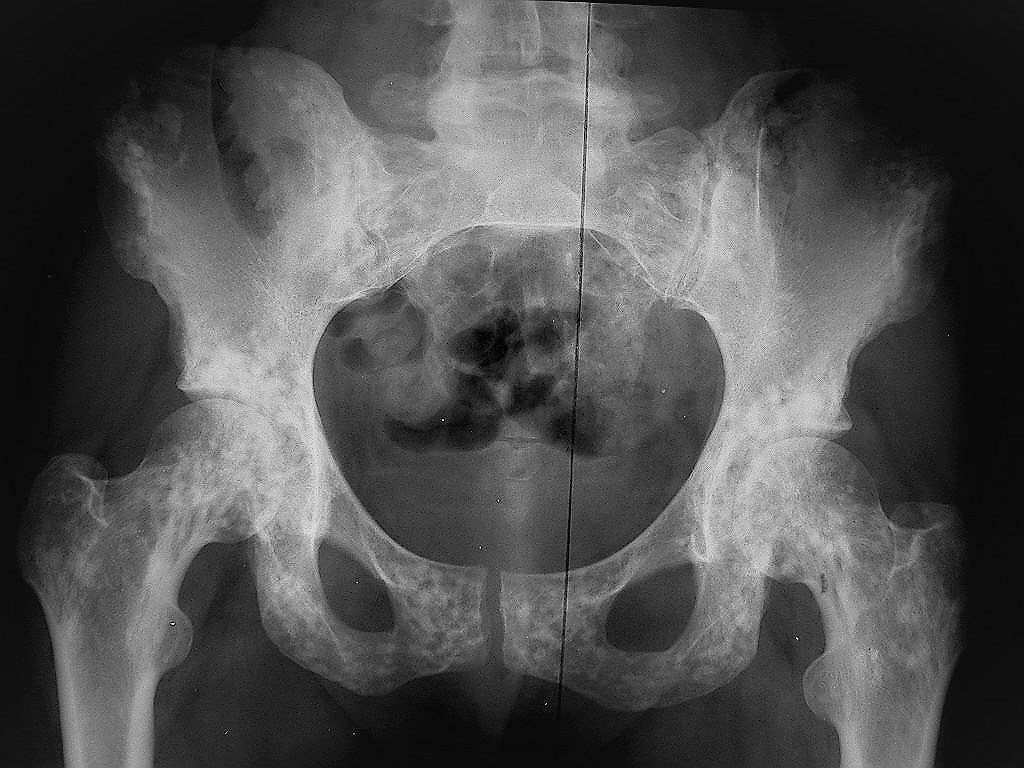
  • Osteopoikilosis is the presence of multiple bone islands(enostosis)
  • Commonly found in association with osteopathia striata and Melorrheostosis, and some times considered to be a part of a spectrum of disease called, Mixed sclerosing Bone Dysplasia
  • White spots are seen in the skin in (disseminated lenticular dermato­fibrosis)- Buschke-Ollendorf syndrome along with osteopoikilosis
  • Round, oval or lanceolate sclerotic lesions with their long axes parallel to the long axis of the bone. Often in the epiphysis and adjacent metaphysis
  • Lesions may involve any bone except the skull, ribs, and vertebrae
  • They usually line up along the trabeculae in a lanceolate fashion. In non trabecular areas they assume a more or less spherical shape.
  • Bony lesions of osteopoikilosis are stable over time and do not accumulate radionucleotide on bone scanning
  • There is no risk for malignant transformation, and hence no surgical intervention is required in typical presentations.

Osteopoikilosis is one of the “Do not touch” lesions as they are benign and no invasive investigation or procedure is necessary
Post Views: 1,642

Related Posts

  • Benign Bone Tumours

    Courtesy: Dr Renjit Kumar J, Orthopaedic Principles ICL Kochi

  • Benign Bone Forming Tumours

    Courtesy: Dr James Wittig, Orthopaedic Oncologist, Sarcoma Surgeon wwww.tumorsurgery.org Books by Dr James Wittig:-

  • Malignant Bone #Tumours in Children

    Courtesy: Prof Lynn Staheli, www.global-help.org

Reader Interactions

Leave a Reply

Your email address will not be published. Required fields are marked *

Primary Sidebar

Follow Us

instagram slideshare

Categories

  • -Applied Anatomy
  • -Approaches
  • -Basic Sciences
  • -Cartilage & Meniscus
  • -Classifications
  • -Examination
  • -Foot and Ankle
  • -Foot and Ankle Trauma
  • -FRCS(Tr and Orth) tutorials
  • -Gait
  • -Hand and Wrist
  • -Hand and Wrist Trauma
  • -Hand Infections
  • -Hip and Knee
  • -Hip Preservation
  • -Infections
  • -Joint Reconstruction
  • -Knee Arthroplasty
  • -Knee Preservation
  • -Metabolic Disorders
  • -Oncology
  • -OrthoBiologics
  • -OrthoPlastic
  • -Paediatric Orthopaedics
  • -Paediatric Trauma
  • -Patellofemoral Joint
  • -Pelvis
  • -Peripheral Nerves
  • -Principles
  • -Principles of Surgery
  • -Radiology
  • -Rheumatology
  • -Shoulder and Elbow
  • -Shoulder and Elbow Arthroplasty
  • -Spine Deformity
  • -Spine Oncology
  • -Spine Trauma
  • -Spine, Pelvis & Neurology
  • -Sports Ankle and Foot
  • -Sports Elbow
  • -Sports Knee
  • -Sports Medicine
  • -Sports Medicine Hip
  • -Sports Shoulder
  • -Sports Wrist
  • -Statistics
  • -Technical Tip
  • -Technology in Orth
  • -Trauma
  • -Trauma (Upper Limb)
  • -Trauma Life Support
  • -Trauma Reconstruction
  • Book Shelf
  • Book Shelf Medical
  • Careers
  • Case Studies and Free Papers
  • DNB Ortho
  • Evidence Based Orthopaedic Principles
  • Evidence Based Orthopaedics
  • Exam Corner
  • Fellowships
  • Guest Editor
  • Guest Reviews
  • Image Quiz
  • Instructional Course Lectures
  • Journal Club
  • MCQs
  • Meetings and Courses
  • Multimedia
  • News and Blog
  • Plaster Techniques
  • Podcasts
  • Public Health
  • Rehabilitation
  • Research
  • Shorts and Reels
Copyright@orthopaedicprinciples.com. All right rerserved.