
Courtesy Dr Takuro Wada , Dr Ashok Shyam, Ortho TV
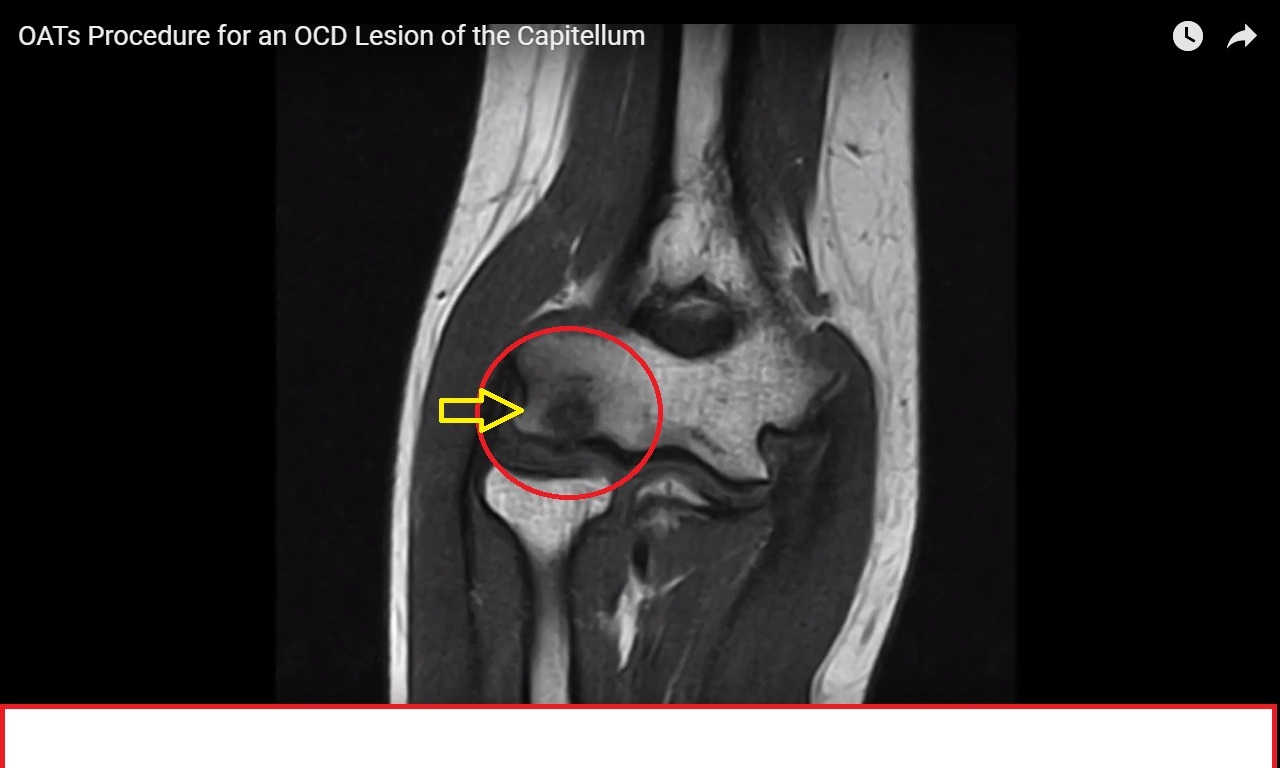
Osteochondritis Dissecans of the Capitellum
Introduction
Osteochondritis dissecans (OCD) of the capitellum is a condition affecting the:
- Articular cartilage
- Subchondral bone
of the capitellum in the elbow.
It is most commonly seen in:
- Adolescent throwing athletes
particularly those involved in repetitive overhead sports.
Early diagnosis is important because delayed treatment may lead to:
- Loose bodies
- Persistent pain
- Elbow stiffness
- Degenerative changes
Epidemiology
Commonly Affected Population
OCD of the capitellum is frequently seen in:
- Adolescent baseball players
- Overhead throwing athletes
- Gymnasts
Prevalence
The prevalence is estimated at approximately:
- 1–3% in adolescent baseball players
Risk Factors
Important risk factors include:
- Early sports specialization
- Repetitive throwing
- High training volume
- Repetitive valgus loading of the elbow
Biomechanics
Throwing Mechanics
The injury typically develops during the:
- Late cocking phase
- Acceleration phase
of throwing.
Pathomechanics
These phases generate:
- Compressive forces
- Shear stress
across the radiocapitellar joint.
Repetitive loading may result in:
- Subchondral injury
- Cartilage damage
- Vascular compromise
Pathophysiology
Early Stage
Initial changes include:
- Separation of cartilage from underlying bone
Progressive Disease
Progression leads to:
- Delayed ossification
- Subchondral bone changes
- Fragment instability
Advanced Disease
Advanced lesions may develop:
- Osteonecrosis
- Loose body formation
- Articular collapse
These changes increase the risk of long-term degenerative arthritis.
Clinical Presentation
Symptoms
Patients commonly present with:
- Lateral elbow pain
- Reduced athletic performance
- Mechanical symptoms
Mechanical Symptoms
Advanced lesions may cause:
- Catching
- Locking
- Clicking
due to unstable fragments or loose bodies.
Physical Examination
Findings may include:
- Tenderness over the radiocapitellar joint
- Reduced range of motion
- Loss of extension
- Pain with valgus loading
Imaging
Plain Radiographs
Standard radiographs may demonstrate:
- Capitellar flattening
- Subchondral lucency
- Fragmentation
- Loose bodies
Important View
A:
- 45° flexion AP view
is particularly useful for identifying capitellar lesions.
MRI
MRI is valuable for assessing:
- Lesion stability
- Cartilage integrity
- Subchondral bone viability
MRI also helps guide treatment decisions.
Classification
Lesions are broadly categorized as:
- Stable
- Unstable
This distinction strongly influences management.
Conservative Management
Indications
Non-operative treatment is appropriate for:
- Early-stage lesions
- Stable lesions
- Patients with open physes
Treatment Components
Conservative treatment includes:
- Activity restriction
- Cessation of throwing
- Physiotherapy
- Gradual return to sport
Duration
Rest from aggravating activity is typically recommended for:
- Approximately 3–6 months
Surgical Management
Indications
Surgery is indicated for:
- Unstable lesions
- Loose bodies
- Persistent symptoms
- Failed conservative treatment
- Advanced OCD lesions
Arthroscopic Debridement
Arthroscopic procedures may include:
- Debridement
- Loose body removal
- Microfracture
These procedures help improve symptoms and motion.
Osteochondral Autograft Transplantation
Indications
Used for:
- Larger lesions
- Significant articular defects
Principle
Healthy osteochondral grafts are transferred to restore:
- Articular congruity
- Joint surface integrity
Outcomes
Prognosis
Outcomes are generally favorable with appropriate treatment.
Studies report:
- More than 90% good outcomes
Return to Sports
Most athletes can successfully:
- Return to sport
- Resume throwing activities
especially with early diagnosis and treatment.
Complications
Potential complications include:
- Persistent pain
- Elbow stiffness
- Loose bodies
- Degenerative arthritis
- Incomplete return to sport
Delayed diagnosis increases complication risk.
Prevention
Preventive strategies include:
- Limiting excessive throwing
- Avoiding year-round overhead sports
- Proper pitching mechanics
- Adequate rest periods
Early recognition of symptoms is essential.
Key Clinical Pearls
- OCD of the capitellum commonly affects adolescent throwing athletes.
- Repetitive valgus and compressive forces contribute to injury.
- Lateral elbow pain in young athletes should raise suspicion.
- The 45° flexion AP radiograph is particularly useful.
- MRI is important for assessing lesion stability.
- Stable lesions may heal with rest and activity modification.
- Unstable or advanced lesions usually require surgery.
- Early diagnosis improves outcomes and return-to-sport rates.
Final Take-Home Message
Osteochondritis dissecans of the capitellum is an important cause of lateral elbow pain in young throwing athletes.
The condition results from repetitive radiocapitellar stress leading to:
- Cartilage injury
- Subchondral bone damage
Early identification and appropriate management are essential to prevent progression and preserve long-term elbow function.
Stable lesions often respond well to conservative treatment, whereas unstable or advanced lesions generally require surgical intervention.
Related Posts
- Osteochondritis Dissecans Knee
Courtesy: Mininder Kocher, Ashok SHyam, IORG, OrthoTV
 Osteochondritis Dissecans of the Knee Joint
Courtesy: Peter Fabricant, Hospital for Special Surgery; Ashok Shyam, IORG and OrthoTV
 MRI in Osteochondritis Dissecans
Courtesy: Robert LaPrade MD, Complex Knee Surgeon Steadman-Philippon Clinic, Vail, Colarado, USA http://drrobertlaprademd.com/ Address: 181…
Leave a Reply