
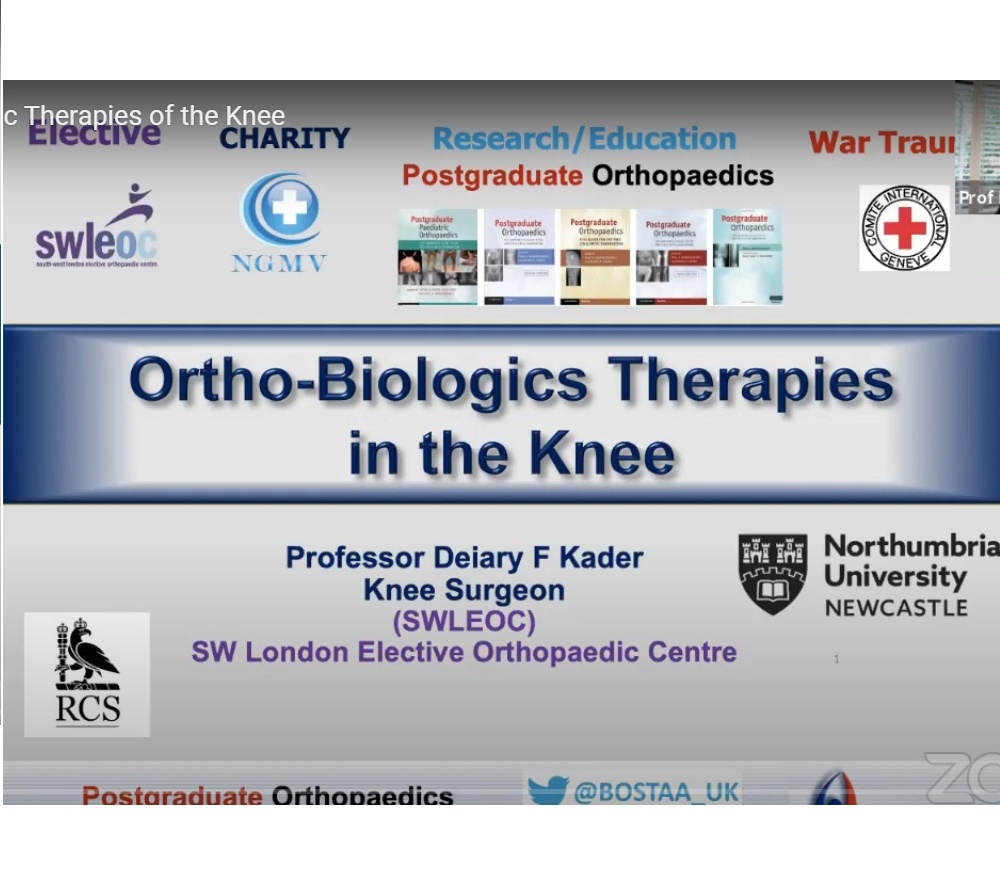
Courtesy: Prof Deiary Kader, London, UK
Focus of lecture:
-
- Hyaluronic acid (viscosupplementation)
- Platelet-rich plasma (PRP)
- Cell-based therapy (stem cells / mesenchymal cells)
Concept of Biological Regeneration
Natural Regeneration
- Human body possesses innate regenerative capacity.
- Example:
- Approximately 3 million red blood cells replaced every second.
- Stem or progenitor cells may contribute to:
- Tissue repair
- Regeneration of tendons and soft tissues.
Example:
- Studies show hamstring tendon regeneration in ~70% of patients after harvest for ACL reconstruction.
Commercialization of Orthobiologics
Growth of the Industry
- Increasing commercial promotion of:
- PRP
- Stem cell therapy
- Biologic injections
Claims include treatment of:
- Hair loss
- Diabetes
- Neurological diseases
- Arthritis
- Sports injuries
Concerns:
- Lack of regulation
- Limited scientific evidence
- High cost to patients.
Hyaluronic Acid (Viscosupplementation)
Background
- Hyaluronic acid injections commonly used for knee osteoarthritis.
- Numerous commercial preparations exist.
Key Principle
- Hyaluronic acid products are not identical.
- Differences include:
- Molecular weight
- Preparation technique
- Injection protocol.
Evidence from Literature
Cochrane Review (2006)
- Demonstrated some effectiveness.
- However, effect size was small, limiting strong recommendations.
Meta-analysis (54 RCTs)
- Benefit seen:
- Onset: ~4 weeks
- Peak: ~8 weeks.
Additional Meta-analyses
Findings vary:
Some show:
- Minimal clinical benefit.
Others report:
- Moderate improvement in symptoms.
Guideline Recommendations
- National Institute for Health and Care Excellence (NICE)
? Does not recommend routine use. - Osteoarthritis Research Society International
? Does not strongly support use. - American Academy of Orthopaedic Surgeons
? Previously recommended against routine use.
Clinical Takeaway
- Hyaluronic acid may provide short-term symptom relief.
- Most useful in:
- Early osteoarthritis
Typical duration of effect:
- 2–3 months
Effect decreases with:
- Advanced joint degeneration.
Platelet-Rich Plasma (PRP)
Composition
PRP contains:
- Platelets
- Growth factors
- Cytokines
- Clotting factors
- Prostaglandins
- Electrolytes (e.g., calcium, potassium)
More than 1100 proteins have been identified.
Types of PRP
PRP preparations vary widely:
- Leukocyte-rich PRP
- Leukocyte-poor PRP
- Different centrifugation protocols:
- Soft spin
- Hard spin
Leukocyte-rich PRP:
- Produces stronger inflammatory response.
Evidence in Knee Osteoarthritis
Systematic Reviews
Some studies show:
- Small clinical benefit
Other RCTs report:
- PRP superior to hyaluronic acid.
However, some meta-analyses demonstrate:
- No significant benefit.
PRP in Tendinopathy
Patellar Tendinopathy
Studies comparing PRP with:
- Dry needling
- Shockwave therapy
- Physiotherapy
Result:
- Well-conducted studies generally show no clear benefit.
Limitations of PRP Research
Major problem:
- Lack of standardization
Currently:
- More than 40 commercial PRP preparation systems exist.
Variability occurs in:
- Platelet concentration
- Growth factor content
- Leukocyte count
- Preparation protocol.
Even factors such as:
- Time of day
- Patient characteristics
can affect PRP composition.
Stem Cell and Cell-Based Therapies
Definition of Stem Cells
According to the National Institutes of Health:
Stem cells are cells that:
- Can self-renew
- Are undifferentiated
- Can differentiate into specialized cells.
Types of Stem Cells
Embryonic Stem Cells
- Pluripotent
- Can differentiate into any tissue type.
Adult (Somatic) Stem Cells
- Multipotent
- Found in various tissues.
Induced Pluripotent Stem Cells
- Adult cells genetically reprogrammed to become pluripotent.
Discovery awarded the Nobel Prize in Physiology or Medicine.
Mesenchymal Stem Cells (MSC)
Originally described by Arnold Caplan.
However:
- Later recognized that these are not true stem cells.
Caplan proposed a new name:
- Medicinal signaling cells
Reason:
- Their main role appears to be cell signaling, not direct regeneration.
Mechanism of Action of MSCs
MSCs may act by:
Paracrine Effects
- Secretion of cytokines
- Release of growth factors.
Immunomodulation
- Regulation of immune response.
Trophic Effects
- Promotion of local tissue repair.
Anti-inflammatory Effects
- Reduction of joint inflammation.
Source of MSCs
Common sources:
- Bone marrow
- Adipose tissue
- Perivascular cells (pericytes)
Pericytes:
- Located around blood vessels.
- Activated during injury.
Stem Cells in Knee Conditions
ACL Injuries
- High-quality studies show no significant benefit.
Meniscal Injuries
Some case series suggest:
- Increase in meniscal volume on MRI.
However:
- Measurement reliability is questionable.
Tendinopathy
Small studies show:
- Possible benefit.
Evidence remains low quality.
Knee Osteoarthritis
Evidence includes:
- Case series showing cartilage improvement.
- Randomized trials showing no difference compared to saline injection.
Overall conclusion:
- Evidence remains insufficient.
Limitations of Stem Cell Therapy
Major issues include:
- Lack of standardized protocols
- Unknown composition of injections
- Uncertain mechanism of action
- Poor quality clinical trials
- High risk of bias.
Placebo Effect
Important consideration in orthopaedics.
Studies show:
- Up to 50% of treatment effect may be placebo.
This applies to:
- Injections
- Some surgical interventions.
Future Directions
Potential future therapies include:
Exosomes
- Small extracellular vesicles released by cells.
Characteristics:
- Size: 30–100 nm
- Carry signaling molecules.
Potential uses:
- Targeted regenerative therapy
- Cell-to-cell signaling.
Exosomes may allow:
- Delivery of regenerative factors directly to tissues.
Key Conclusions
- Orthobiologic therapy has significant potential but limited evidence.
- Hyaluronic acid may help early osteoarthritis for short duration.
- PRP evidence is mixed and inconsistent.
- Mesenchymal cells are not true stem cells.
- Current studies lack:
- Standardization
- High-quality methodology.
Overall message:
Too much hope, but currently limited scientific evidence
Leave a Reply