
Courtesy: Dr Bill Walter, Dr Ashok Shyam, Ortho TV
Enabling Technologies in Joint Arthroplasty: Robotics, Navigation, and Health Systems
Panel Landscape and Current Practice Patterns
-
Preoperative Imaging Protocols:
-
Routine mechanical workups utilize full-length standing scanograms or long-leg films alongside orthogonal knee series.
-
Image-based systems mandate thin-slice CT scans for virtual 3D surface mapping.
-
Imageless platforms rely on direct intraoperative anatomical landmark registration without preoperative cross-sectional imaging radiation or cost.
-
-
Adoption Divergence (Knee vs. Hip Arthroplasty):
-
Knee Arthroplasty: High penetration among tertiary specialists (ranging from 50% to 100% robotic or navigated cases).
-
Hip Arthroplasty: Significantly lower adoption, with many high-volume surgeons operating entirely manually.
-
Registry & Market Reality (India vs. Australia): While the Australian Orthopaedic Association National Joint Replacement Registry (AOANJRR) demonstrates technology-assisted knee procedures surpassing manual techniques (with manual cases falling below 50%), audience polling across broader Indian orthopedic cohorts reveals over 90% of knee procedures and roughly 95% of hip procedures are still performed manually.
-
-
Barriers to Technology Uptake in Hips:
-
Direct Visualization: Surgeons directly reference local anatomical landmarks in the hip (e.g., transverse acetabular ligament, native version, bony teardrop), whereas knee alignment relies on distant hip and ankle centers that are obscured during surgery.
-
Clinical Satisfaction Gap: Primary total hip arthroplasty (THA) historically achieves greater than 90% to 95% patient satisfaction with manual jigs, whereas 15% to 20% of manual total knee arthroplasty (TKA) patients report residual stiffness, pain, or dissatisfaction.
-
Software and Platform Lag: Commercial orthopedic platforms historically launched and prioritized knee applications before introducing hip modules.
-
Approach Constraints: Certain robotic hip platforms were originally tailored to specific approaches (such as the direct anterior approach), limiting adoption by posterior or lateral approach surgeons.
-
Registration Complexity: Pelvic array fixation requires separate pin sites that carry unique technical challenges compared to femoral and tibial tracker placement.
-
-
Socioeconomic Determinants:
-
Private insurance and Third-Party Administrator (TPA) mediclaim policies in India frequently deny coverage for robotic consumables or software surcharges, forcing a reversion to manual instrumentation based solely on patient socioeconomic constraints.
-
Technical Foundations: Precision, Jigs, and Outlier Reduction
-
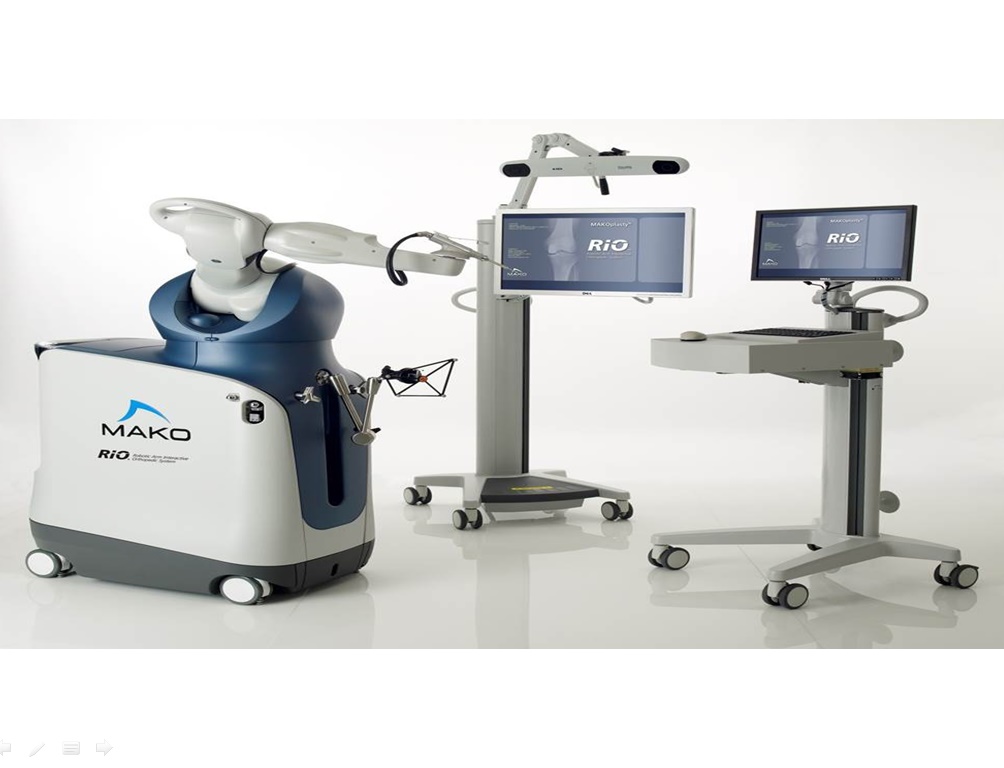
The Scope of Robotics: The robotic arm functions strictly as an execution tool for planar resections and haptic-guided bone preparation; 80% to 90% of arthroplasty remains surgical craft (soft-tissue exposure, handling the capsule, osteophyte removal, gap assessment, and cementation).
-
Elimination of Mechanical Jigs:
-
Conventional intramedullary femoral rods and extramedullary tibial jigs are vulnerable to wide medullary canals, femoral bowing, and extra-articular deformities.
-
Enabling technologies consistently compress the standard deviation of bone cuts, eliminating mechanical and rotational outliers.
-
-
Teaching Utility in Training Programs:
-
Fellowship and residency training benefits through real-time dynamic visual feedback.
-
Trainees observe immediate, quantified effects on the flexion-extension gaps when altering component rotation, varus-valgus tilt, or femoral translation by 1 mm or 1 degree, accelerating the learning curve for soft-tissue balancing.
-
-
The Target Uncertainty Paradox: While technology provides unmatched accuracy to hit a chosen target, the exact ideal biological target (e.g., true kinematic vs. restricted kinematic vs. mechanical alignment) remains heavily debated in the clinical literature.
Clinical Outcomes, Revision Rates, and Metrics
-
Patient-Reported Outcome Measures (PROMs):
-
Early postoperative gains (e.g., at 3 months) favor robotic cohorts in parameters such as pain scores and early mobilization.
-
By 1 to 2 years postoperatively, PROM differences between robotic and manual cohorts generally even out across large trials.
-
High ceiling effects in standard orthopedic scoring systems (Oxford, Knee Society Score) mask potential subtle functional benefits.
-
-
Revision Risk in Total Knee Arthroplasty:
-
Global and national registry data show negligible differences in overall all-cause 10-year revision rates between standard manual and robotic total knee replacements across unselected populations.
-
Subgroup analyses demonstrate statistically significant reductions in revision rates for younger, highly active patient cohorts and unicompartmental knee arthroplasties (UKA).
-
-
Revision Risk in Total Hip Arthroplasty:
-
Strong multicenter registry data confirms that technology-assisted cup placement significantly reduces early revisions driven by recurrent dislocation.
-
Dynamic tracking mitigates combined anteversion errors and component impingement.
-
Health Economics, Operating Room Workflow, and Safety
-
Capital Expenditure and Return on Investment (ROI):
-
High upfront system costs create a catch-22: low-volume surgeons who could benefit most from alignment assistance cannot justify the capital expense, whereas high-volume centers leverage robotics primarily for market differentiation and throughput.
-
Transition to indigenous, locally manufactured robotic platforms in India is anticipated to substantially lower capital barriers.
-
-
Operating Room Traffic and Infection Control:
-
Complex technology setups risk increasing operating room personnel and foot traffic, which is a recognized risk factor for periprosthetic joint infection.
-
Best-practice protocols limit personnel to one dedicated application specialist and enforce locked operating room doors once arthrotomy begins.
-
-
Operative Efficiency and Setup Times:
-
Initial stages of the robotic learning curve add surgical time during tracker pinning, bone registration, and gap validation.
-
High-volume centers overcome this latency through dedicated room turnover workflows, making up time during bone resection (dispensing with multiple cutting blocks and pin adjustments), enabling 15 to 17 robotic procedures daily in efficient operating units.
-
-
System Failures and Contingency Planning:
-
The legal and clinical consent standard remains an informed consent for joint replacement arthroplasty, not a contractual commitment to an automated system.
-
Technical failures (software freezes, optical camera errors) require immediate, seamless reversion to manual instrumentation or backup computer navigation.
-
Surgeons and fellows must maintain complete competency in conventional manual technique as a vital safety reserve.
-
-
Legal and Medicolegal Implications:
-
Malpositioned implants (such as a retroverted acetabular component causing anterior instability and groin pain) remain the sole liability of the operating surgeon; lack of available technology cannot be claimed as a defense.
-
As patient awareness expands, failing to disclose the existence or institutional availability of enabling technologies may introduce novel medicolegal liability.
-
Future Trajectories in Arthroplasty Technology
-
Arrayless and Markerless Registration: Next-generation optical camera arrays will utilize real-time surface-recognition computer vision to instantaneously register bony anatomy without the need for invasive tracker pins.
-
System Miniaturization and Mixed Reality: Bulky robotic consoles will transition toward handheld intelligent cutting tools and lightweight head-mounted mixed reality visors.
-
Evolution of Implant Biomaterials: Consistently hitting 3D targets with sub-millimeter precision may allow reduction of component thickness, eliminating bulky metallic backings in favor of bone-preserving resurfacing designs.
-
AI Integration and Decision-Support Liability: Predictive algorithms will transition from purely executing surgeon cuts to actively recommending personalized alignment plans. This shift will introduce complex questions of clinical liability: determining whether ultimate accountability rests with the operating surgeon or the algorithmic decision engine.
Leave a Reply