
Courtesy: Prof Nabil Ebraheim, University of Toledo, Ohio, USA
Neurological Evaluation of Lumbar Nerve Roots
Overview
Assessment of a lumbar nerve root is based on three components:
Sensory changes + Motor changes + Reflex changes
roots from L1 to S1 and correlates them with the corresponding disc level.
- L1 Nerve Root
Disc level
T12–L1 disc herniation – L1 nerve root
Sensory
The L1 sensory area is described as:
Halfway between the inguinal ligament and mid-thigh
Motor
Hip flexion
Main muscle mentioned:
- Iliopsoas
Root contribution stated:
- L1, L2, L3
Reflex
- No specific reflex for L1
- L2 Nerve Root
Disc level
L1–L2 disc herniation – L2 nerve root
Sensory
Mid-anterior thigh
Motor
- Hip flexion — L1, L2, L3
- Hip adduction — L2, L3, L4
- Knee extension — L2, L3, L4
Reflex
- No specific reflex for L2
- L3 Nerve Root
Disc level
L2–L3 disc herniation – L3 nerve root
Sensory
Distal thigh, including the knee region
Motor
- Hip flexion — L1, L2, L3
- Hip adduction — L2, L3, L4
- Knee extension — L2, L3, L4
Reflex
- No specific reflex for L3
- L4 Nerve Root
Disc level
L3–L4 disc herniation – L4 nerve root
Sensory
Medial side of the leg extending down to the medial side of the foot
Motor
The important movements emphasized are:
- Ankle dorsiflexion
- Tibialis anterior
- Knee extension
Femoral Stretch Test
associates a positive femoral stretch test with L4 nerve-root involvement.
Positive test
Pain in the ipsilateral anterior thigh
Positive femoral stretch test – consider L3–L4 disc herniation affecting L4
Reflex
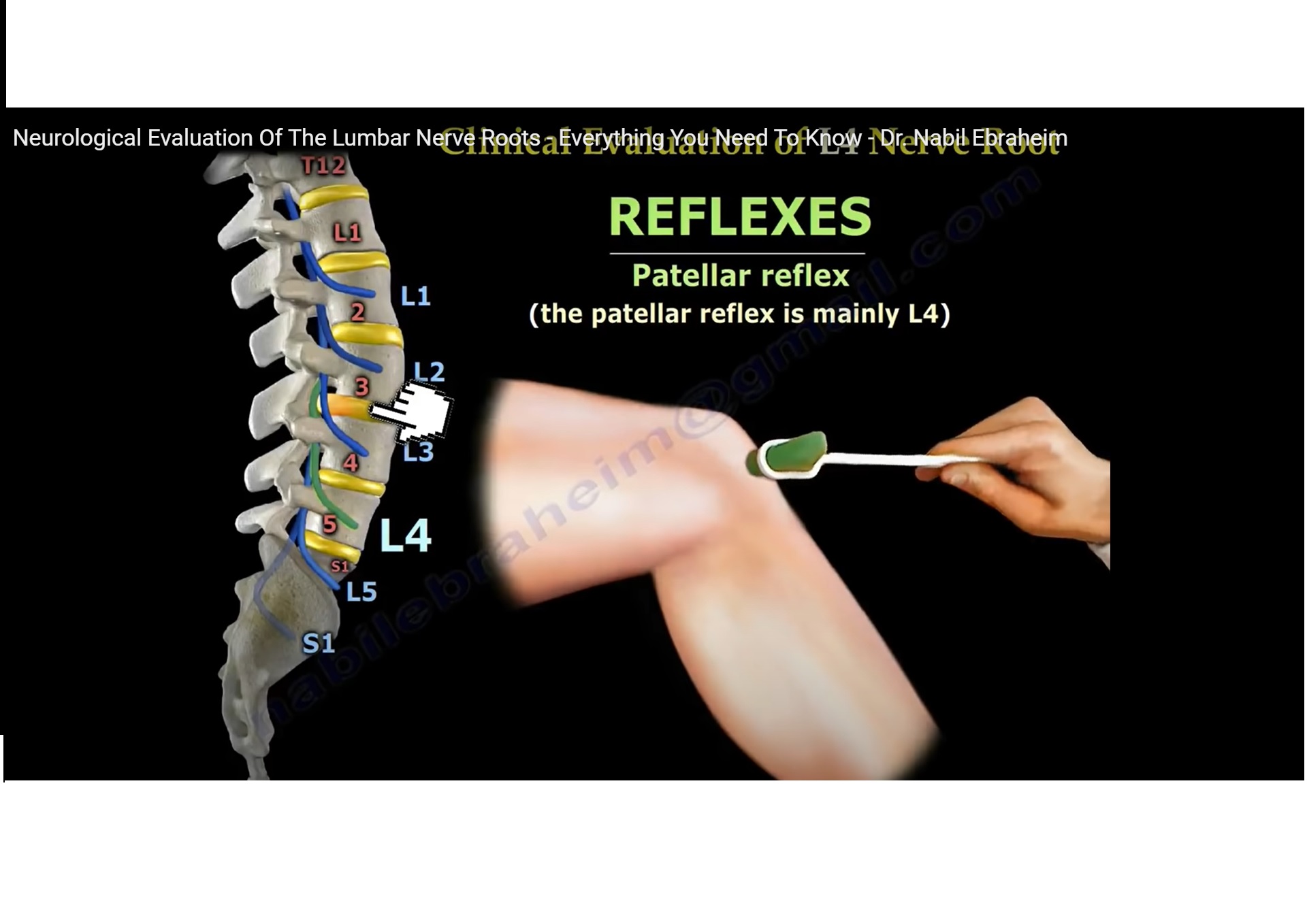
Patellar reflex — mainly L4
- L5 Nerve Root
Disc level
L4–L5 disc herniation – L5 nerve root
emphasizes that L5 is particularly important in examinations and clinical scenarios.
Sensory
Dorsum of the foot and adjacent leg
Quick localization:
Top of the foot = L5
Motor
Great-toe extension
The major motor finding emphasized is:
Great-toe extension = L5
Therefore, weakness of great-toe extension in the appropriate clinical setting suggests:
L4–L5 disc herniation – L5 root involvement
Hip abduction
also associates L5 with:
- Gluteus medius
- Gluteus minimus
Weakness may produce:
Trendelenburg gait
Straight Leg Raise
SLR may be positive with L5 nerve-root irritation.
The test is used to identify whether low-back pain may have a component of:
Disc herniation irritating a nerve root
Reflex
No specific reflex for L5 is emphasized in the transcript.
- S1 Nerve Root
Disc level
L5–S1 disc herniation – S1 nerve root
Sensory
Lateral and plantar aspect of the foot
Quick localization:
Lateral foot = S1
Motor
Hip extension
Muscle:
- Gluteus maximus
notes that this is not commonly used as the main clinical test.
Ankle plantar flexion
This is the clinically emphasized motor test.
Muscles:
- Gastrocnemius
- Soleus
Thus:
S1 – ankle plantar flexion
Foot eversion
Muscles mentioned:
- Peroneus longus
- Peroneus brevis
Straight Leg Raise
A positive SLR may also occur with S1 nerve-root irritation.
refers to this as a stretch test used when disc-related radiculopathy is suspected.
Reflex
Ankle reflex = S1
High-Yield Root Localization Table
| Root | Disc level | Sensory area | Motor finding | Reflex |
| L1 | T12–L1 | Upper anterior thigh / between inguinal ligament and mid-thigh | Hip flexion | None |
| L2 | L1–L2 | Mid-anterior thigh | Hip flexion, hip adduction, knee extension | None |
| L3 | L2–L3 | Distal thigh / knee region | Hip flexion, hip adduction, knee extension | None |
| L4 | L3–L4 | Medial leg – medial foot | Ankle dorsiflexion, knee extension | Patellar |
| L5 | L4–L5 | Dorsum/top of foot | Great-toe extension, hip abduction | None emphasized |
| S1 | L5–S1 | Lateral + plantar foot | Plantar flexion, eversion | Ankle |
Most Important Roots for Clinical Examination: L4, L5, S1
specifically highlights these three roots.
Motor
| Root | Best motor finding emphasized |
| L4 | Ankle dorsiflexion |
| L5 | Great-toe extension / hip abduction |
| S1 | Ankle plantar flexion |
Sensory
| Root | Sensory landmark |
| L4 | Medial foot |
| L5 | Dorsum/top of foot |
| S1 | Lateral foot |
Reflexes
| Root | Reflex |
| L4 | Patellar reflex |
| L5 | No specific reflex emphasized |
| S1 | Ankle reflex |
Provocative Tests
Femoral Stretch Test
associates this predominantly with:
L4 nerve-root irritation
Positive when there is:
Ipsilateral anterior-thigh pain
Straight Leg Raising Test
Associated particularly with:
- L5
- S1
A positive test supports the possibility of a herniated disc causing nerve-root irritation.
Disc Level – Nerve Root
gives the following straightforward relationship:
T12–L1 – L1
L1–L2 – L2
L2–L3 – L3
L3–L4 – L4
L4–L5 – L5
L5–S1 – S1
Practical Neurological Examination
For a patient with suspected lumbar radiculopathy:
- Sensory examination
Determine the dermatomal area involved. - Motor examination
Test the corresponding movement/muscle. - Reflex examination
Especially:
- Patellar reflex – L4
- Ankle reflex – S1
- Nerve stretch tests
- Femoral stretch – upper lumbar/L4 pattern
- SLR – L5/S1 pattern
- Correlate with the suspected disc level
Key Take-Home Points
- Every lumbar root should be assessed using sensory + motor + reflex findings.
- L4 – medial foot + ankle dorsiflexion + patellar reflex.
- L5 – dorsum of foot + great-toe extension + hip abduction.
- S1 – lateral/plantar foot + ankle plantar flexion + ankle reflex.
- Trendelenburg gait may occur with L5-associated gluteus medius/minimus weakness in ‘s framework.
- Femoral stretch test may be positive with L4 root irritation.
- SLR may be positive with L5 or S1 nerve-root irritation.
- considers L4, L5 and S1 the three most important roots for routine clinical examination.
Exam Pearls
L4 = medial foot + dorsiflexion + knee jerk
L5 = dorsum of foot + great-toe extension + Trendelenburg/hip abductor weakness
S1 = lateral foot + plantar flexion + ankle jerk
L4–L5 disc – L5 root
L5–S1 disc – S1 root
Femoral stretch – think L4
SLR – think L5/S1

Leave a Reply