
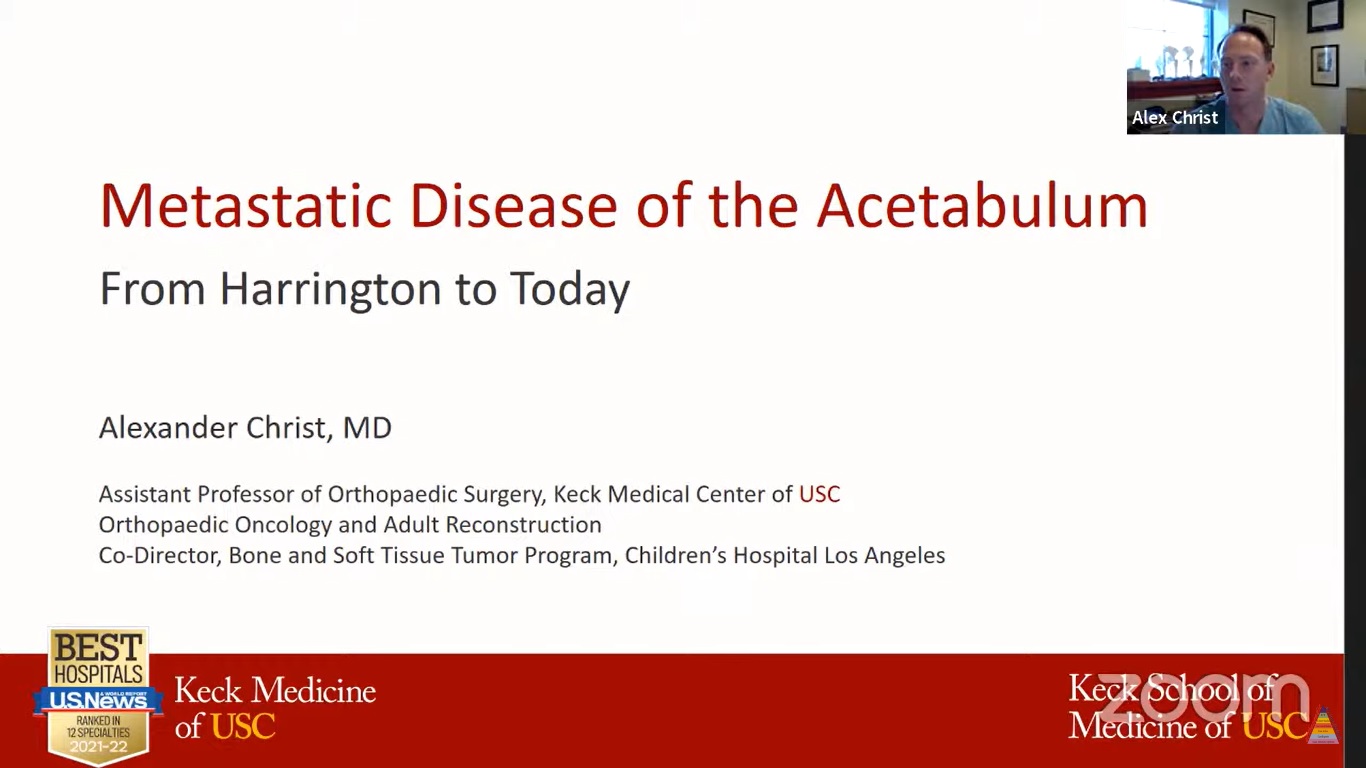
Courtesy:
Alexander Christ MD,Assistant Professor, UCLA, Los Angeles
Overview of the Webinar
- Educational session focusing on surgical and non?surgical management of metastatic disease affecting the acetabulum.
- Discussion centered on evolving treatment strategies, reconstruction techniques, and multidisciplinary care for patients with metastatic bone disease.
Background of the Presenter
- Orthopedic oncologist specializing in tumors and tumor?related conditions of the musculoskeletal system.
- Clinical focus includes limb salvage surgery and reconstructive techniques following tumor removal.
- Training background includes advanced study in molecular biophysics and biochemistry followed by medical education and specialized orthopedic oncology training.
- Research interests include sarcoma biology, drug delivery methods, and innovative reconstruction techniques after tumor surgery.
Early Understanding of Acetabular Metastatic Disease
- One of the earliest widely referenced clinical experiences described treatment of patients with metastatic acetabular lesions.
- Median survival after the first pathological fracture was approximately 18–19 months.
- Patients with breast cancer metastasis demonstrated relatively longer survival compared with other malignancies.
- Survival in patients with lung cancer metastasis was significantly shorter.
- Radiation therapy was routinely used as part of treatment in early studies.
Classification of Acetabular Metastatic Defects
- Class 1: Minimal metastatic involvement with largely intact acetabulum.
- Class 2: Defect involving the medial wall of the acetabulum.
- Class 3: Extensive structural destruction including lateral cortex or posterior wall.
- Class 4: Isolated metastatic lesion potentially amenable to wide surgical resection.
Traditional Surgical Treatment Strategies
- Class 1 lesions commonly treated with cemented total hip arthroplasty.
- Class 2 lesions treated using cemented total hip arthroplasty combined with reinforcement devices such as anti?protrusio rings.
- Class 3 lesions required extensive tumor removal, mechanical reinforcement using pins or screws, and hip reconstruction with cemented arthroplasty.
- Class 4 lesions sometimes treated with wide resection in selected solitary metastases.
Historical Outcomes
- Significant reduction in pain following surgery.
- Many patients regained the ability to walk with or without assistive devices.
- Early surgical techniques used relatively simple implants and instrumentation compared with modern technology.
Changing Epidemiology of Bone Metastases
- Bone is a frequent site of metastasis in many cancers.
- Breast and prostate cancers frequently metastasize to bone, with rates reported up to 70 percent in post?mortem studies.
- Approximately 40 percent of common carcinomas eventually produce symptomatic bone metastases.
- Large population studies suggest hundreds of thousands of patients are affected annually in the United States.
- The pelvis is the third most common site for bone metastases after the spine and femur.
Recent Data on Tumor Types Causing Bone Metastasis
- Lung cancer represents the most common source of metastatic bone disease in contemporary datasets.
- Prostate and breast cancers remain major contributors.
- Gastrointestinal malignancies are increasingly recognized as significant sources of bone metastasis.
- Patterns of metastatic disease continue to evolve as patients live longer with cancer.
Impact of Improved Cancer Therapies
- Advances such as targeted therapy and immunotherapy have significantly improved survival in several cancers.
- Patients with metastatic disease are living longer than previously expected.
- Orthopedic reconstructions must therefore be more durable to accommodate increased life expectancy.
Tools for Survival Prediction
- Clinical prediction tools can estimate survival after pathological fracture.
- These tools incorporate patient factors, tumor characteristics, and treatment variables.
- Such predictions help guide the selection of surgical procedures with appropriate durability.
Advances in Surgical Technology
- Modern implants include porous metal surfaces designed for bone ingrowth.
- Fenestrated and cannulated screws allow improved fixation and cement augmentation.
- Dual mobility hip implants help reduce dislocation risk.
- Computer navigation and advanced imaging techniques assist with accurate implant placement.
Principles of Multidisciplinary Care
- Management requires collaboration between orthopedic surgeons, medical oncologists, radiation oncologists, and primary care providers.
- Patient nutritional and metabolic status must be optimized before surgery.
- Radiation therapy often serves as a first?line treatment for bone metastases.
- Systemic cancer therapy is critical for controlling overall disease progression.
- Medications such as bisphosphonates help reduce skeletal complications.
Goals of Surgical Treatment
- Relief of pain caused by bone destruction or fracture.
- Immediate structural stability of the hip and pelvis.
- Durable fixation that allows early weight?bearing.
- Restoration of walking ability and daily function.
- Minimization of complications that could delay cancer therapy.
Challenges with Traditional Reconstruction
- Some surgical techniques have relatively high complication rates.
- Common complications include mechanical failure, infection, and hip dislocation.
- Large surgical exposures increase soft tissue disruption and instability risk.
Strategies to Reduce Complications
- Use of dual mobility hip implants can significantly reduce dislocation rates.
- Constrained liners may also improve joint stability.
- Appropriate use of postoperative radiation therapy improves local disease control.
Use of Porous Metal Implants
- Porous metal acetabular implants can provide durable fixation in selected patients.
- Clinical studies have demonstrated low mechanical failure rates and good long?term stability.
- These implants may be particularly useful for patients expected to survive longer.
Emerging Reconstruction Technologies
- Custom implants created using three?dimensional manufacturing techniques are being developed.
- These implants can be designed to match individual patient anatomy.
- Manufacturing time and regulatory approval processes have historically limited their widespread use.
- Recent improvements are making these implants more accessible.
Minimally Invasive Treatment Options
- Percutaneous cement injection techniques can stabilize bone defects and reduce pain.
- Procedures such as cryoablation or radiofrequency ablation may be combined with cement stabilization.
- These options are useful for patients who cannot tolerate major surgery.
Percutaneous Screw and Cement Techniques
- New approaches use image guidance to place screws around the acetabulum through small incisions.
- Bone cement is injected to reinforce structural stability.
- Many patients can mobilize soon after the procedure.
- Some patients may later undergo standard hip replacement if required.
Current Treatment Decision Framework
- Extent of tumor involvement in the acetabulum.
- Patient overall health and expected survival.
- Potential benefits and risks of surgery.
- Availability of systemic cancer therapies.
- Need for durable versus minimally invasive reconstruction.
Examples of Reconstruction Approaches
- Contained defects may be treated with standard cemented total hip replacement.
- Cavitary or medial wall defects may require reinforcement rings or cages.
- Extensive disease may require multiple screws across the pelvis combined with cemented hip implants.
- In severely ill patients, cement stabilization alone may provide adequate pain relief.
Future Directions
- The number of patients with metastatic bone disease is expected to increase.
- Longer survival will require more durable orthopedic reconstructions.
- Advanced imaging, navigation systems, and robotic technology may improve surgical precision.
- Minimally invasive techniques are likely to expand.
Economic and Ethical Considerations
- Increasing demand for complex reconstruction will raise healthcare costs.
- Decisions regarding resource allocation and treatment value will become increasingly important.
- Evidence demonstrating improved quality of life will help support these interventions.
Importance of Teamwork and Training
- Successful management requires close coordination among specialists.
- Surgeons must stay familiar with new implants and technologies.
- Collaboration with colleagues is essential when performing technically complex procedures.
Key Takeaways
- Metastatic disease of the acetabulum is a complex condition requiring individualized treatment.
- Advances in oncology have extended patient survival, changing surgical decision?making.
- Modern implants and minimally invasive techniques are improving outcomes.
- Multidisciplinary care and appropriate patient selection remain central to successful treatment.



Leave a Reply