
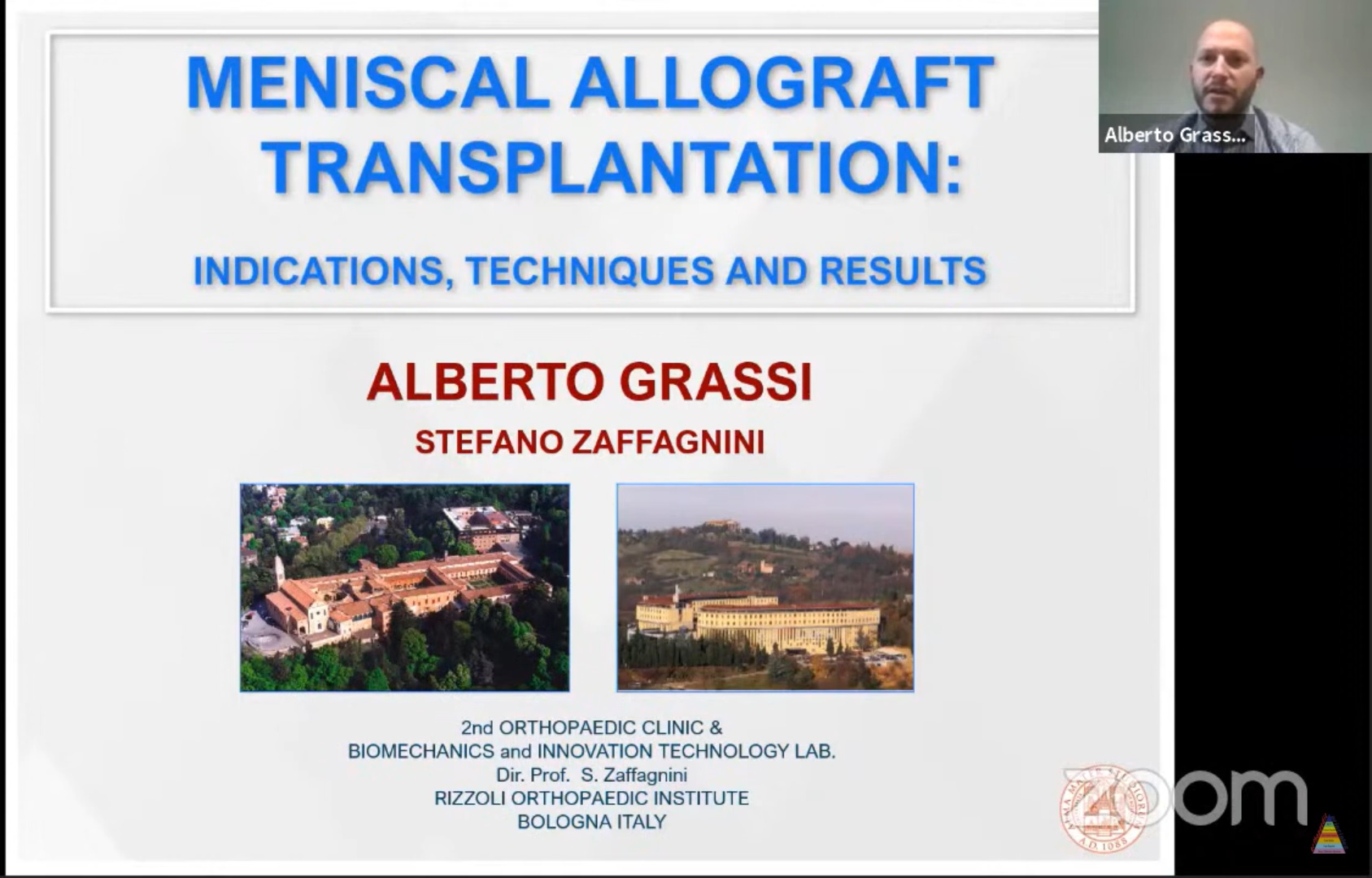
Courtesy: Alberto Grassi MD, Associate Professor, Rizzoli Orthopaedic Institute, Bologna, Italy
Introduction
- A webinar session featured an orthopedic surgeon specializing in knee ligament injuries, meniscal disorders, and sports traumatology.
- The speaker has extensive clinical and research experience in knee surgery and sports medicine, with numerous peer-reviewed publications and academic contributions.
- The presentation focused on meniscal allograft transplantation, including its indications, surgical principles, and clinical outcomes.
Importance of the Meniscus
- The meniscus is a critical structure within the knee joint.
- Historically, it was considered nonessential and frequently removed even for minor injuries.
- Athletes often performed well immediately after meniscectomy, which reinforced the belief that the meniscus was not necessary.
- Long-term follow-up later demonstrated that removal of meniscal tissue leads to significant degenerative changes in the knee joint.
Biomechanical Functions
- Distributes load across the knee joint.
- Increases contact area between the femur and tibia.
- Reduces stress on articular cartilage.
- Provides stability to the knee joint.
- Contributes to control of anterior tibial translation and rotational stability.
Consequences of Meniscectomy
Removal of meniscal tissue can lead to several biomechanical changes:
- Increased contact pressure on articular cartilage.
- Reduced contact area between the femoral condyle and tibial plateau.
- Increased shear stress within the joint.
- Increased anterior tibial translation.
- Reduced rotational stability, particularly after lateral meniscus removal.
Long-Term Effects
- Degenerative joint changes may occur over time.
- Studies show:
- Approximately 22% risk of osteoarthritis within 10 years after medial meniscectomy.
- Nearly 40% risk after lateral meniscectomy during the same period.
- After 20 years, almost 50% of patients with lateral meniscectomy may develop osteoarthritis.
Clinical Impact
- Young athletes who undergo meniscectomy early in life may develop premature degenerative knee disease.
Meniscus and Knee Stability
- The medial meniscus plays an important role in controlling anteroposterior knee stability.
- Removal of the medial meniscus can increase anterior tibial translation similar to that seen in anterior cruciate ligament deficiency.
- Meniscal deficiency may contribute to instability even after ligament reconstruction.
Clinical Evidence
- Studies using navigated knee evaluation showed increased anteroposterior laxity in patients with medial meniscus removal.
- This highlights the stabilizing function of the meniscus.
Shift Toward Meniscal Preservation
Modern orthopedic practice emphasizes preserving the meniscus whenever possible.
Strategies include:
- Meniscal repair techniques.
- Partial meniscus reconstruction.
- Meniscal scaffold implantation.
- Meniscal allograft transplantation.
The goal is to restore knee biomechanics and prevent long-term joint degeneration.
Meniscal Scaffold
- Used when there is partial loss of meniscal tissue.
- Requires intact anterior and posterior meniscal horns.
- Indications are limited because many patients have more extensive meniscal deficiency.
- Suitable mainly for younger patients with partial meniscal defects.
Meniscal Allograft Transplantation
Background
- Meniscal transplantation has been performed for nearly three decades.
- Early procedures involved open surgery with large incisions and complex techniques.
- Advances in arthroscopy have made the procedure less invasive and more standardized.
Evolution of Graft Preservation
Different preservation methods have been used over time:
- Lyophilized grafts
- Cryopreserved grafts
- Fresh frozen grafts
Currently, fresh frozen grafts are widely used because they preserve structural properties while being easier to store.
Biological Integration of the Graft
Research studies have demonstrated:
- Peripheral healing and revascularization of the transplanted meniscus.
- Increase in cellularity within the graft over time.
- Repopulation of the graft by recipient cells.
Immunological Response
- Approximately 90% of cells in the transplanted meniscus originate from the recipient.
- Because of this cellular replacement, immunosuppressive therapy is not required.
- Immune rejection is extremely rare.
Biomechanical Effects of Transplantation
Meniscal transplantation helps restore knee biomechanics by:
- Increasing joint contact area.
- Reducing peak pressure on articular cartilage.
- Improving load distribution.
- Restoring joint stability.
Proper fixation of the anterior and posterior horns is essential for maintaining the structural integrity of the graft.
Indications for Meniscal Transplantation
Primary indications include:
- Persistent compartmental knee pain after subtotal or total meniscectomy.
- Meniscal deficiency contributing to failure or instability after ligament reconstruction.
- Combined procedures with cartilage repair or corrective osteotomy in meniscus-deficient knees.
Situations Where Transplantation Is Not Recommended
Meniscal transplantation is not typically performed in:
- Asymptomatic patients without pain or functional limitation.
- Advanced degenerative joint disease.
- Severe obesity.
- Inflammatory joint disorders.
- Significant malalignment or instability that has not been corrected.
Graft Sizing and Matching
Accurate graft size is essential for successful transplantation.
Methods used to determine graft size include:
- Radiographic measurements
- Magnetic resonance imaging
- Computed tomography analysis
- Anthropometric measurements based on height, weight, and sex
Availability of appropriate graft sizes from tissue banks can also influence graft selection.
Surgical Fixation Techniques
Two main methods are commonly used:
- Bone plug fixation
- Soft tissue fixation
Key Principles
- Secure fixation of meniscal horns is critical.
- Both fixation techniques have shown comparable short-term clinical outcomes.
Graft Extrusion
- Some degree of graft extrusion may occur after transplantation.
- Although mild extrusion is often tolerated, excessive extrusion may be associated with joint degeneration over time.
Rehabilitation and Return to Activity
Postoperative rehabilitation typically includes:
- Partial or minimal weight-bearing for 4 to 6 weeks.
- Gradual range-of-motion exercises starting within 1 to 2 weeks.
- Progressive strengthening over several months.
Return to Sports
- Most patients resume sports activities after about 9 months.
- Low-impact activities are preferred.
- High-impact sports are generally limited to selected cases.
Clinical Outcomes
Evidence from clinical studies indicates:
- Significant improvement in pain and knee function after transplantation.
- Mean functional scores show good results in many patients.
- Mid-term failure rates are relatively low.
Long-Term Results
- Approximately 73% graft survival at 10 years.
- Around 70% survival at 15 years.
- Average functional survival ranges from 11 to 13 years.
Predictors of Outcome
Factors associated with better results include:
- Younger patient age.
- Minimal cartilage damage.
- Stable knee alignment.
- Early transplantation after meniscal loss.
Factors associated with poorer outcomes include:
- Advanced cartilage degeneration.
- Knee malalignment.
- Uncorrected ligament instability.
Return to Sports
- Around 70% of patients return to sports activities.
- Most return to low-impact activities rather than high-impact competitive sports.
- Some studies in military populations report return to active duty in a majority of patients.
Institutional Clinical Experience
- Over several years, hundreds of meniscal transplant procedures have been performed.
- Many cases involved isolated transplantation, while others required additional procedures such as ligament reconstruction or corrective osteotomy.
- Clinical follow-up demonstrated functional improvement and pain relief in most patients.

Leave a Reply