
Courtesy: Prof Nabil Ebraheim, University of Toledo, USA
1. Median Nerve Compression Sites
-
Compression can occur at multiple points along the nerve’s course.
-
~1% of individuals have a supracondylar spur (5 cm above medial epicondyle).
-
Struthers’ ligament bridges the spur to the medial epicondyle and can entrap the nerve.
-
Median nerve runs under the ligament with the brachial artery or ulnar branch.
2. Clinical Signs of Struthers’ Ligament Entrapment
-
Gradual hand weakness, pain, and sensory loss in median nerve distribution.
-
Inability to perform the “OK” sign.
-
Positive Tinel’s sign over the spur area (tingling on tapping).
3. Pronator Teres Syndrome
-
Compression of median nerve near elbow; more common in females.
-
Median nerve passes between two heads of pronator teres, then between FDS and FDP.
-
May be associated with medial epicondylitis.
Symptoms
-
Numbness in radial 3½ fingers.
-
Weakness in thenar muscles.
-
Often misdiagnosed as carpal tunnel syndrome (CTS).
Causes of Compression
-
Most common: Between two heads of pronator teres.
-
Bicipital aponeurosis thickening.
-
FDS fibrous arch.
Clinical Features
-
Symptoms worsen with forearm rotation.
-
Dull pain in proximal forearm; no night symptoms.
-
Tenderness over pronator teres.
-
Palmar cutaneous branch (sensory) affected—indicates proximal median nerve involvement, not CTS.
4. Diagnostic Signs
-
CTS tests negative: Tinel, Phalen, compression tests at wrist.
-
Tinel’s sign positive at proximal forearm.
-
Resisted tests help localize:
-
Forearm pronation + elbow extension ? Pronator teres compression.
-
Elbow flexion + forearm supination ? Bicipital aponeurosis compression.
-
Middle finger FDS contraction ? FDS arch compression.
-
5. Carpal Tunnel Syndrome (CTS)
-
Pain, numbness, tingling in palm, thumb, index, and middle fingers.
-
Symptoms worse at night, awaken patient.
-
Patients shake hands to relieve symptoms.
Tests
-
Tinel’s sign: Tapping wrist reproduces tingling.
-
Phalen’s test: Wrist flexion for 60s increases symptoms.
-
Durkan’s test: Thumb pressure over carpal tunnel—most sensitive.
-
Hand diagram: Most specific; patient marks symptom areas.
-
Thenar atrophy, weakness, clumsiness possible.
-
CTS is a clinical diagnosis.
6. Management Concept
-
Carpal tunnel = tunnel through which nerve passes.
-
Treatment: Widen tunnel by cutting transverse carpal ligament.
7. Anterior Interosseous Nerve (AIN) Injury
-
AIN is a branch of the median nerve, arises 4–6 cm below elbow.
-
Runs on interosseous membrane between FDP and FPL.
-
Purely motor nerve, not sensory.
Affected Muscles
-
FDP (index and long fingers)
-
FPL
-
Pronator quadratus
Clinical Signs
-
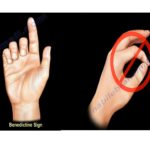
Benediction sign: When making a fist, index and middle fingers do not flex.
-
Inability to do “OK” sign: Due to FPL and FDP weakness.
Causes
-
Can occur in supracondylar fractures in children.
8. Important Anatomical & Diagnostic Notes
-
Dual innervation of FDP: Medial part by ulnar nerve.
-
Terminal AIN branches innervate volar wrist capsule.
-
Martin-Gruber connection: May cause intrinsic muscle weakness.
-
Differentiate AIN palsy from acute brachial neuritis.
-
Median nerve conduction studies may be normal.
-
Needle EMG of AIN will show abnormalities (motor involvement only).
Leave a Reply