
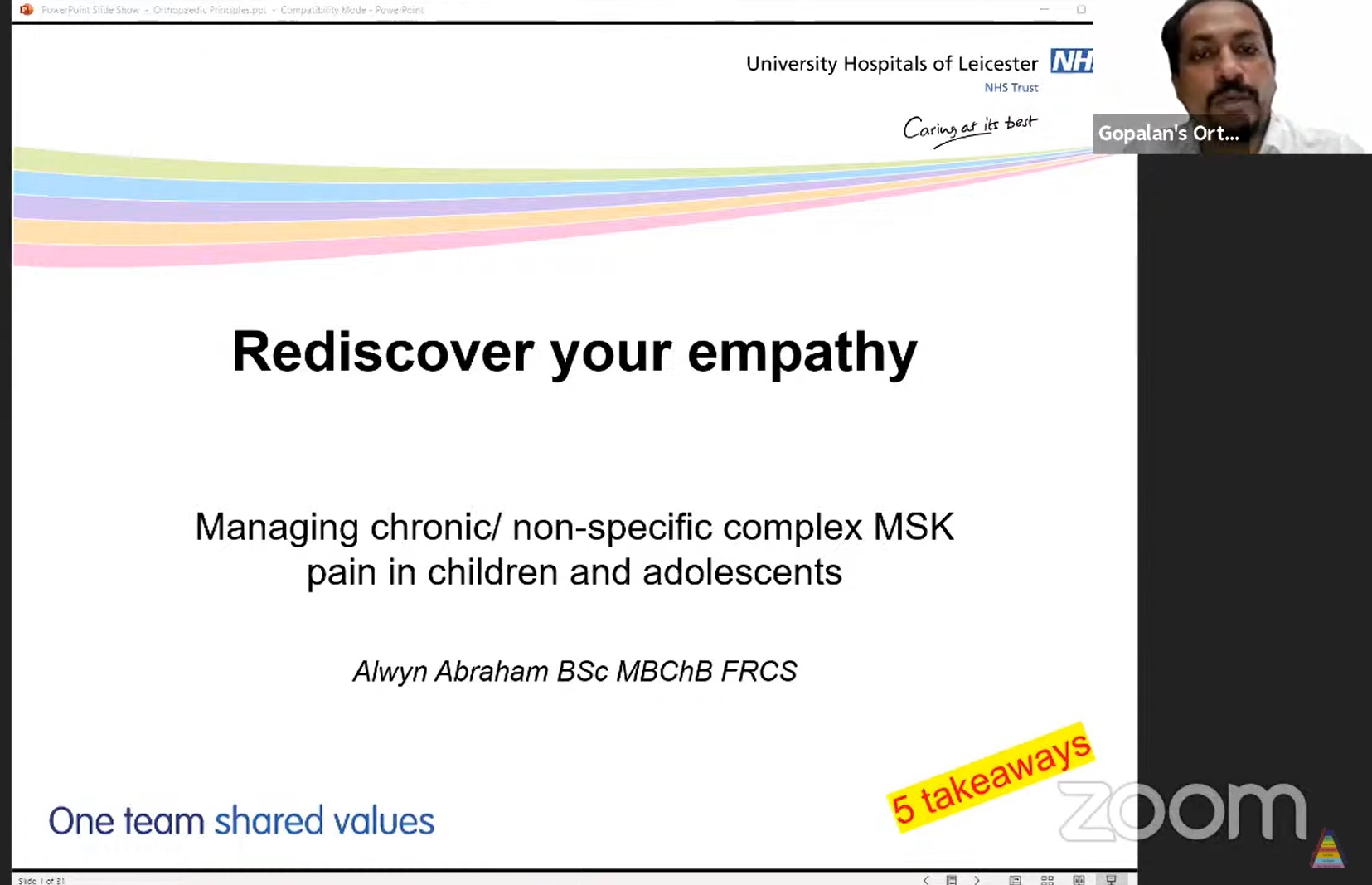
Courtesy: Alwyn Abraham, MB ChB, FRCS, Head of Trauma Services, University of Leicester, Leicester, UK
Chronic Non-Specific Musculoskeletal Pain in Children
Introduction
Chronic musculoskeletal (MSK) pain is a common presentation in pediatric orthopedic practice. In many children, pain occurs without a clearly identifiable structural abnormality on imaging or physical examination.
These conditions can be challenging because:
- Symptoms may be severe despite normal investigations
- Pain is often multifactorial
- Psychological and social factors may contribute significantly
Successful management requires:
- Careful clinical assessment
- Exclusion of serious pathology
- Reassurance
- Rehabilitation-focused treatment
The Concept of Orthopedic Vulnerability
Orthopedic practice traditionally relies heavily on:
- X-rays
- MRI scans
- Visible structural pathology
This approach becomes difficult when:
- Symptoms are significant
- Imaging appears normal
In such situations, the traditional strength of orthopedic diagnosis may become a limitation.
Clinical judgment therefore becomes essential.
Chronic Regional Pain Syndrome (CRPS)
Definition
Complex Regional Pain Syndrome is characterized by:
- Severe pain disproportionate to the original injury
- Abnormal pain sensitivity
- Autonomic and sensory changes
Children generally have a better prognosis than adults.
Clinical Features
Typical findings include:
- Burning pain
- Allodynia
- Hyperalgesia
- Skin color changes
- Swelling
- Temperature variation
- Reduced limb use
Pain is often significantly greater than expected for the injury.
Management
Treatment focuses on:
- Reassurance
- Physiotherapy
- Desensitization therapy
- Gradual functional restoration
Early mobilization is important.
Excessive immobilization should be avoided.
Growth-Related Joint Pain
Overview
Growth-related pain is common in adolescents and is often associated with:
- Sports participation
- Rapid growth
- Muscle tightness
Clinical Features
Typical presentation includes:
- Bilateral knee pain
- Activity-related symptoms
- Tight hamstrings
- Tight quadriceps
Symptoms usually worsen with physical activity.
Management
Treatment includes:
- Stretching exercises
- Physiotherapy
- Activity modification when required
Most cases improve with conservative management.
Chronic Apophyseal Injuries
Overview
Apophyseal injuries occur due to repetitive traction at tendon insertion sites.
Common examples include:
- Osgood-Schlatter Disease
- Sever’s Disease
Clinical Features
Typical findings include:
- Activity-related pain
- Localized tenderness
- Symptoms improving with rest
Diagnosis is primarily clinical.
Management
Treatment focuses on:
- Stretching programs
- Activity modification
- Relative rest
These conditions are usually self-limiting.
Growing Pains
Overview
Growing pains are a common benign pain syndrome seen in children between:
- Approximately 3–7 years of age
Clinical Features
Typical characteristics include:
- Night-time pain
- Bilateral lower limb discomfort
- Normal daytime activity
- Normal physical examination
Children are otherwise healthy.
Management
Treatment primarily involves:
- Reassurance
- Massage
- Observation
No extensive investigations are required when the presentation is typical.
Joint Hypermobility Syndrome
Overview
Joint hypermobility may cause chronic musculoskeletal symptoms in children.
Clinical Features
Children may present with:
- Generalized hyperflexibility
- Clumsiness
- Fatigue
- Recurrent pain
Diagnosis
Assessment commonly uses:
- Beighton score
- Brighton criteria
Management
Management focuses on:
- Fitness training
- Strengthening exercises
- Reassurance
Improving muscular support is important.
Central Sensitization Disorder
Definition
Central sensitization refers to abnormal amplification of pain processing within the nervous system.
Pain occurs despite minimal or absent tissue pathology.
Clinical Features
Common features include:
- Allodynia
- Hyperalgesia
- Widespread pain
- Increased pain sensitivity
Management
Treatment emphasizes:
- Patient and family education
- Gradual exercise programs
- Functional rehabilitation
The goal is restoration of normal activity rather than elimination of all pain.
Psychological and Social Factors
Importance
Psychological and social influences play a major role in pediatric chronic pain.
Factors include:
- Anxiety
- School stress
- Family dynamics
- Sleep disturbance
Parental Influence
Parental anxiety can unintentionally:
- Reinforce pain behaviors
- Increase disability perception
Education and reassurance of caregivers are therefore essential.
Clinical Principles
Rule Out Serious Conditions First
Always exclude important pathology such as:
- Infection
- Malignancy
- Inflammatory disease
- Fracture
- Neurological conditions
Avoid Over-Reliance on Imaging
Normal imaging does not exclude significant pain.
Similarly, incidental imaging abnormalities may not explain symptoms.
Clinical correlation is essential.
Rehabilitation-Focused Approach
Management should prioritize:
- Function
- Activity restoration
- Strengthening
- Gradual return to normal life
rather than prolonged rest or repeated investigations.
Opioid Use and Public Health Concerns
Opioid misuse is an increasing concern worldwide.
In pediatric chronic musculoskeletal pain:
- Non-pharmacological management is preferred
- Long-term opioid therapy should generally be avoided
Importance of Empathy
Children with chronic pain often feel:
- Frustrated
- Misunderstood
- Anxious
Empathy and clear communication are critical components of treatment.
Key Clinical Pearls
- Chronic musculoskeletal pain in children is common and often benign.
- Serious pathology must always be excluded first.
- Normal imaging does not invalidate symptoms.
- CRPS has a better prognosis in children than adults.
- Growing pains typically occur at night with a normal examination.
- Hypermobility commonly contributes to chronic pain.
- Rehabilitation and reassurance are central to treatment.
- Psychological and social factors significantly influence pain experience.
Final Take-Home Message
Chronic non-specific musculoskeletal pain in children requires a balanced clinical approach.
The key principles include:
- Careful evaluation
- Exclusion of serious pathology
- Avoidance of unnecessary investigations
- Reassurance
- Functional rehabilitation
Successful treatment depends not only on medical management but also on empathy, communication, and understanding the broader biopsychosocial aspects of pediatric pain.
Related Posts
 Hip Pain in Children
Courtesy: Dr Amr Abdelgawad,Associate Professor, University of Texas, USA
- Back pain in children Part I
Courtesy : Dr Amr Abdelgawad, Associate Professor, University of Texas, USA
- Back pain in children Part-II
Courtesy : Dr Amr Abdelgawad, Associate Professor, University of Texas, USA
Leave a Reply