
Courtesy: Prof Nabil Ebraheim, University of Toledo, Ohio, USA
Lumbrical Plus Finger and Quadriga Effect
Lumbrical Plus Finger
Definition
Lumbrical plus finger is a condition in which attempted finger flexion produces paradoxical extension of the interphalangeal (IP) joints.
This deformity is also known as:
- Paradoxical extension deformity
Key Concept
The term “plus” refers to paradoxical extension.
Instead of flexing during grip, the involved finger extends at the PIP and DIP joints.
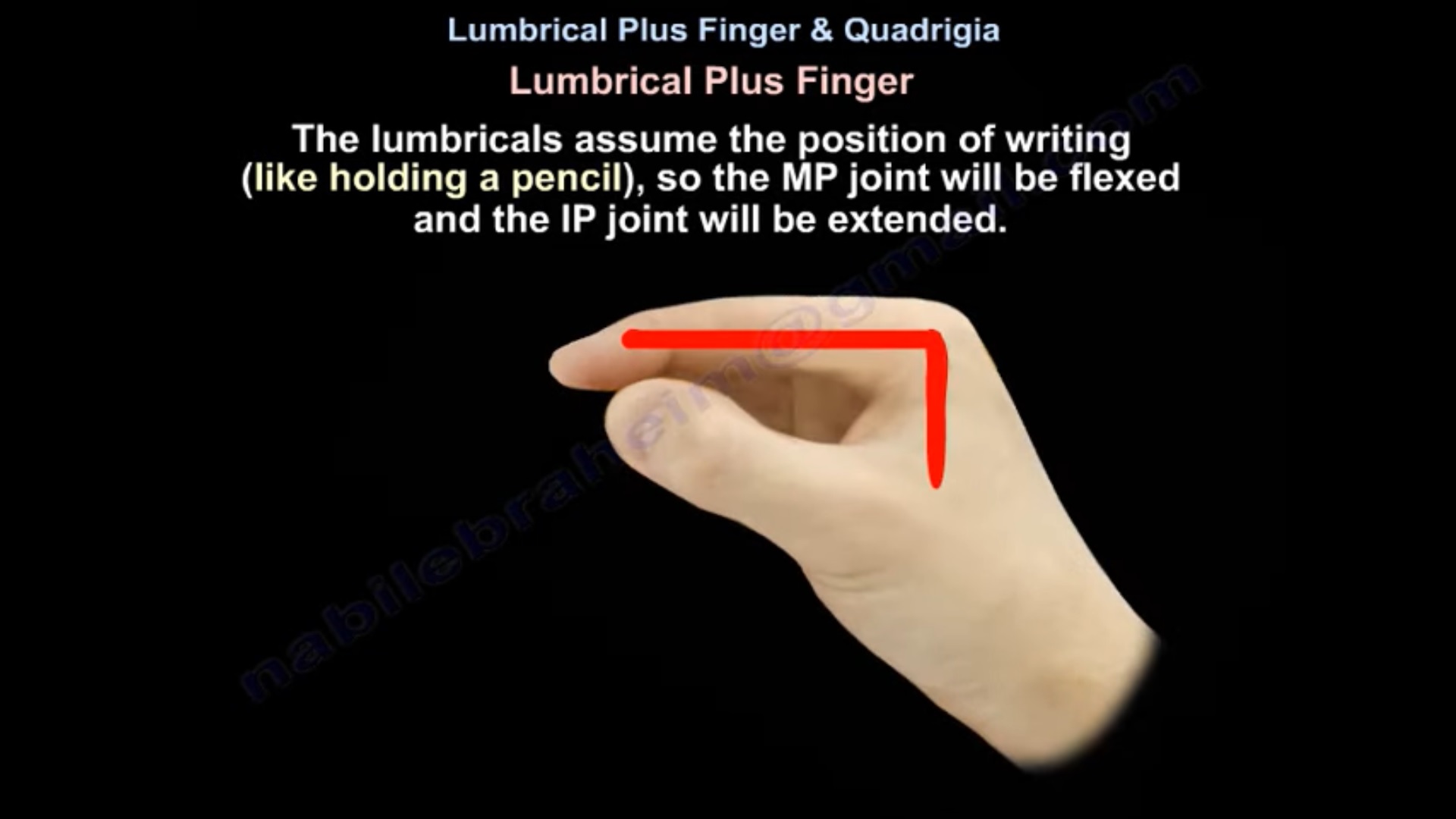
Normal Function of the Lumbricals
The lumbrical muscles normally:
- Flex the metacarpophalangeal (MCP) joints
- Extend the proximal and distal interphalangeal joints
This produces the normal “writing position” of the hand.
Pathophysiology
Lumbrical plus finger occurs when the Flexor Digitorum Profundus (FDP) tendon becomes:
- Lacerated
- Non-functional
- Loosely repaired
Mechanism
- The FDP tendon loses effective distal attachment
- The tendon retracts proximally
- Force is transmitted proximally to the lumbrical through the FDP tendon slip
- The lumbrical becomes overactive
This results in:
- MCP joint flexion
- IP joint extension instead of flexion
Clinical Features
When the patient attempts to grip or flex the finger:
- The IP joints extend paradoxically
Patients may complain of:
- Weak grip strength
- Difficulty holding objects such as a hammer
Causes
Common causes include:
- Untreated FDP tendon laceration
- Loose tendon graft or repair
- Distal finger amputation
Treatment
Surgical Treatment
Management focuses on correcting the tendon imbalance and may include:
- Release of the lumbrical insertion
- Tendon reconstruction or balancing procedures
Quadriga Effect
Definition
Quadriga effect refers to loss of flexion in adjacent fingers caused by shortening or overtightening of the FDP tendon in one finger.
Key Concept
The FDP tendons to the index, middle, ring, and little fingers share a common muscle belly.
If one tendon becomes excessively tight:
- Excursion of the shared muscle unit is reduced
- Adjacent fingers cannot flex normally
Pathophysiology
Quadriga effect commonly occurs after:
- Jersey finger repair
- Excessive advancement of the FDP tendon
Mechanism
- The repaired tendon is shortened or overtightened
- The common FDP muscle belly loses excursion
- Neighboring fingers develop flexion lag
Clinical Features
Patients may present with:
- Weak grip strength
- Inability to fully flex adjacent fingers
- Flexion lag involving neighboring digits
Common Cause
The most common cause is:
- Advancement of the FDP tendon by more than 1 cm during repair
Prevention
Important preventive principle:
- Avoid advancing the FDP tendon more than 1 cm
Treatment
Surgical Treatment
Correction may require:
- Tendon length adjustment
- Release procedures
- Revision tendon surgery
Comparison Between Lumbrical Plus Finger and Quadriga Effect
| Feature | Lumbrical Plus Finger | Quadriga Effect |
|---|---|---|
| Mechanism | FDP failure with lumbrical overaction | FDP overtightening |
| Finger motion | Attempted flexion causes IP extension | Reduced flexion in adjacent fingers |
| Number of fingers involved | Usually single finger | Multiple adjacent fingers |
| Main problem | Paradoxical extension | Flexion lag |
| Common cause | FDP laceration or loose repair | Excessive FDP advancement |
Key Clinical Points
- Lumbrical plus finger causes paradoxical IP extension during attempted flexion.
- Quadriga effect causes flexion lag in adjacent fingers because of shared FDP muscle excursion.
- Both conditions are related to abnormalities of the FDP tendon mechanism.
- Excessive FDP advancement during tendon repair should be avoided.
- Careful tendon balancing is essential for normal hand function.
Leave a Reply