• Skip to main content
  • Skip to secondary menu
  • Skip to primary sidebar
OrthopaedicPrinciples.com

OrthopaedicPrinciples.com

Integrating Principles and Evidence

Integrating Principles and Evidence

  • Home
  • Editorial Board
  • Our Books
    • Evidence Based Orthopaedic Principles
  • Courses
  • Exams
  • Reviews
  • Live Program
  • Contact

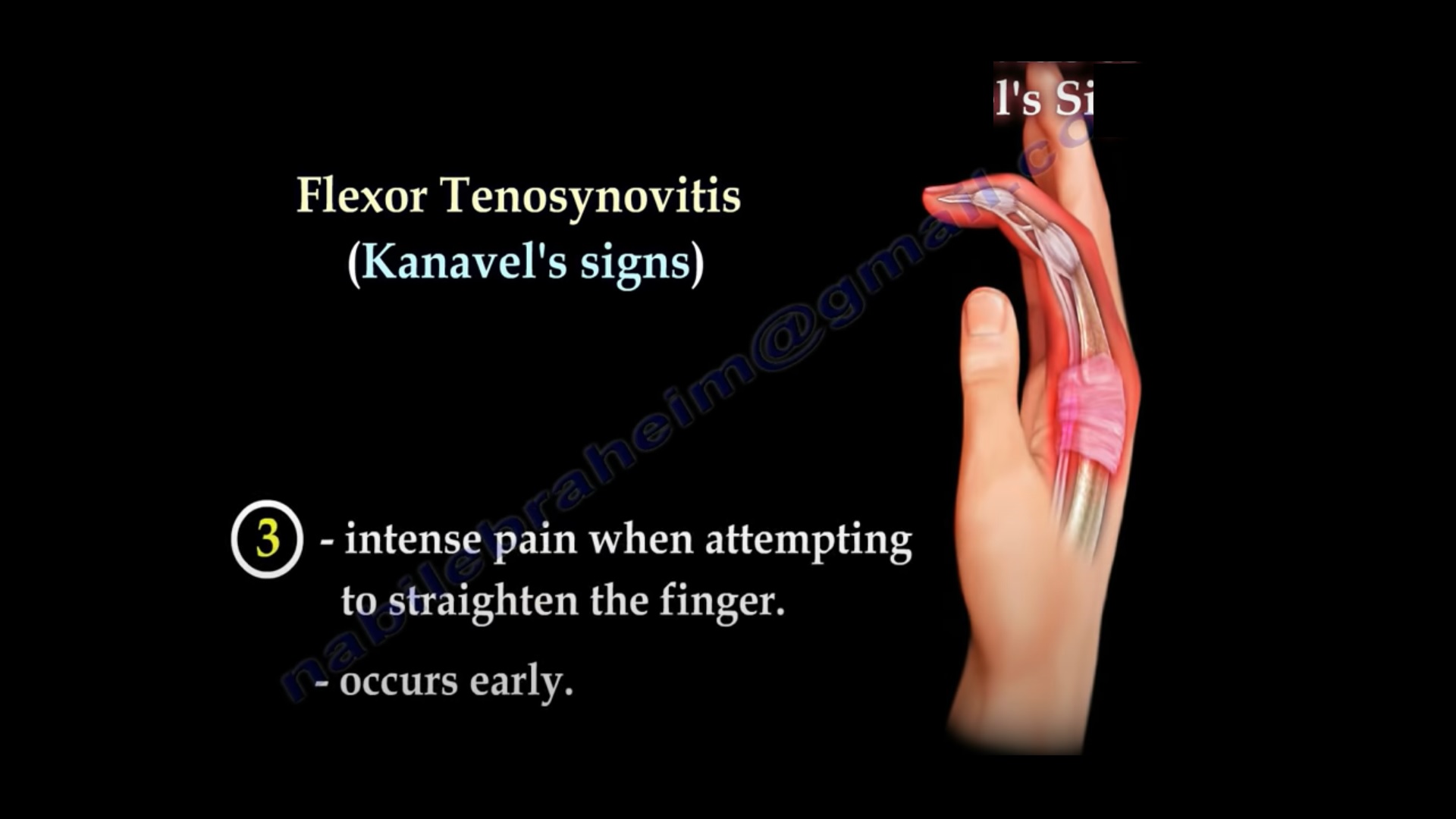
Kanavel’s Signs, Infection of the flexor tendons

Courtesy: Prof Nabil Ebraheim, University of Toledo, Ohio, USA


Kanavel Signs (Flexor Tendon Sheath Infection)


Definition

  • Kanavel signs are a group of four clinical findings suggestive of:
    • Pyogenic Flexor Tenosynovitis

Clinical Significance

  • Critical for early diagnosis of flexor tendon sheath infections
  • Helps guide urgent management decisions

The Four Kanavel Signs


1. Uniform Swelling of the Finger

  • Entire finger appears:
    • Fusiform (sausage-shaped)
  • Swelling follows the flexor tendon sheath

2. Finger Held in Flexion

  • Finger rests in a slightly flexed position

Reason

  • Flexion:
    • Reduces pressure within tendon sheath
    • Minimizes pain

3. Pain on Passive Extension

  • Attempting to extend the finger causes:
    • Severe pain

Key Feature

  • Most sensitive clinical sign

4. Tenderness Along Flexor Tendon Sheath

  • Marked tenderness along:
    • Palmar aspect of the finger

Location

  • Along the course of:
    • Flexor tendons

Clinical Importance


  • Early recognition is essential to prevent:
    • Tendon necrosis
    • Spread of infection
    • Loss of finger function

Complications of Delayed Treatment


  • Tendon damage
  • Deep space infection
  • Reduced range of motion
  • Permanent disability

Key Clinical Point


  • Presence of all four signs = strong suspicion of flexor tendon sheath infection

Management Implication

  • Requires:
    • Urgent evaluation
    • Early antibiotics
    • Possible surgical drainage

Post Views: 2,408

Related Posts

  • Kanavel's Signs

    Courtesy: Prof Nabil Ebraheim, University of Toledo, Ohio, USA

  • Pyogenic Flexor Tenosynovitis, Kanavel's signs

    Courtesy: Dept of Orthopaedics, Harborview Medical Centre, University of Washington, Seattle, USA

  • Current trends in Hand infection Management

    Courtesy: Dr. David Fuller, MD, Associate Professor and Program Director of Orthopaedic Surgery, Cooper Medical…

Reader Interactions

Leave a Reply

Your email address will not be published. Required fields are marked *

Primary Sidebar

Follow Us

instagram slideshare

Categories

  • -Applied Anatomy
  • -Approaches
  • -Basic Sciences
  • -Cartilage & Meniscus
  • -Classifications
  • -Examination
  • -Foot and Ankle
  • -Foot and Ankle Trauma
  • -FRCS(Tr and Orth) tutorials
  • -Gait
  • -Hand and Wrist
  • -Hand and Wrist Trauma
  • -Hand Infections
  • -Hip and Knee
  • -Hip Preservation
  • -Infections
  • -Joint Reconstruction
  • -Knee Arthroplasty
  • -Knee Preservation
  • -Metabolic Disorders
  • -Oncology
  • -OrthoBiologics
  • -OrthoPlastic
  • -Paediatric Orthopaedics
  • -Paediatric Trauma
  • -Patellofemoral Joint
  • -Pelvis
  • -Peripheral Nerves
  • -Principles
  • -Principles of Surgery
  • -Radiology
  • -Rheumatology
  • -Shoulder and Elbow
  • -Shoulder and Elbow Arthroplasty
  • -Spine Deformity
  • -Spine Oncology
  • -Spine Trauma
  • -Spine, Pelvis & Neurology
  • -Sports Ankle and Foot
  • -Sports Elbow
  • -Sports Knee
  • -Sports Medicine
  • -Sports Medicine Hip
  • -Sports Shoulder
  • -Sports Wrist
  • -Statistics
  • -Technical Tip
  • -Technology in Orth
  • -Trauma
  • -Trauma (Upper Limb)
  • -Trauma Life Support
  • -Trauma Reconstruction
  • Book Shelf
  • Book Shelf Medical
  • Careers
  • Case Studies and Free Papers
  • DNB Ortho
  • Evidence Based Orthopaedic Principles
  • Evidence Based Orthopaedics
  • Exam Corner
  • Fellowships
  • Guest Editor
  • Guest Reviews
  • Image Quiz
  • Instructional Course Lectures
  • Journal Club
  • MCQs
  • Meetings and Courses
  • Multimedia
  • News and Blog
  • Plaster Techniques
  • Podcasts
  • Public Health
  • Rehabilitation
  • Research
  • Shorts and Reels
Copyright@orthopaedicprinciples.com. All right rerserved.