
Courtesy: Prof Nabil Ebraheim, University of Toledo, Ohio, USA
Intrinsic Minus and Intrinsic Plus Hand
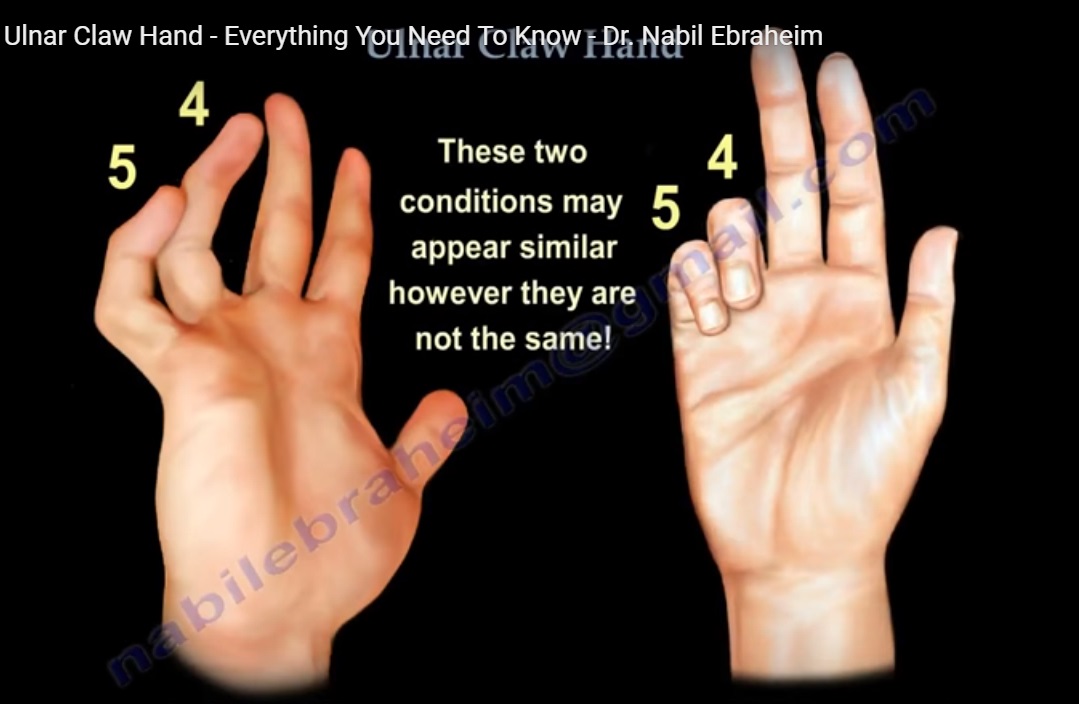
Intrinsic Minus Hand (Claw Hand)
Definition
Intrinsic minus hand is characterized by:
- Hyperextension at the metacarpophalangeal (MCP) joints
- Flexion at the proximal interphalangeal (PIP) and distal interphalangeal (DIP) joints
This produces the classic claw hand deformity.
Mechanism
The deformity results from imbalance between:
- Strong extrinsic muscles
- Weak intrinsic muscles
The intrinsic muscles include:
- Lumbricals
- Interossei
Loss of intrinsic muscle function removes:
- MCP joint flexion
- Interphalangeal joint extension
Muscle Actions Involved
Extensor Digitorum Communis (EDC)
- Produces hyperextension at the MCP joints
Flexor Digitorum Superficialis (FDS) and Flexor Digitorum Profundus (FDP)
- Produce flexion at the PIP and DIP joints
Resulting Deformity
The imbalance leads to:
- MCP hyperextension
- IP joint flexion
- Clawing of the fingers
The deformity is especially prominent in:
- Ulnar nerve palsy
- Particularly involving the ring and little fingers
Causes of Intrinsic Minus Hand
Common causes include:
- Ulnar nerve palsy
- Volkmann ischemic contracture
- Neglected compartment syndrome
- Charcot–Marie–Tooth disease
- Leprosy
- Improper splinting after hand trauma
Failure to splint the hand in the intrinsic plus position after injury may contribute to clawing.
Intrinsic Plus Hand (Safe Position of the Hand)
Definition
Intrinsic plus hand is characterized by:
- Flexion at the MCP joints
- Extension at the PIP and DIP joints
This is also called:
- Safe position
- Writing position
Mechanism
The deformity occurs due to imbalance between:
- Strong intrinsic muscles
- Weak extrinsic muscles
Muscle Actions Involved
Intrinsic Muscles (Lumbricals and Interossei)
These muscles:
- Flex the MCP joints
- Extend the PIP and DIP joints
Weak Extrinsic Muscles
Weakness of the following contributes to the posture:
- Extensor Digitorum Communis
- FDP
- FDS
This leads to:
- Reduced MCP extension
- Reduced interphalangeal flexion
Functional Effect
Patients may have difficulty with:
- Power grip
- Grasping large objects
The hand tends to assume a writing posture.
Clinical Sign: Bunnell Test
Purpose
Used to assess intrinsic muscle tightness.
Positive Test
- PIP joint flexion is limited when the MCP joint is extended
- PIP flexion improves when the MCP joint is flexed
This indicates intrinsic tightness.
Causes of Intrinsic Plus Hand
Common causes include:
- Trauma
- Stroke
- Brain injury
- Neurological spasticity involving intrinsic muscles
Comparison Between Intrinsic Minus and Intrinsic Plus Hand
| Feature | Intrinsic Minus Hand | Intrinsic Plus Hand |
|---|---|---|
| MCP joints | Hyperextension | Flexion |
| PIP/DIP joints | Flexion | Extension |
| Muscle imbalance | Strong extrinsics, weak intrinsics | Strong intrinsics, weak extrinsics |
| Functional problem | Clawing and poor grip | Poor power grip |
| Common cause | Ulnar nerve palsy | CNS lesions and spasticity |
Key Clinical Points
- Intrinsic muscles flex the MCP joints and extend the IP joints.
- Loss of intrinsic muscle function produces claw hand deformity.
- The intrinsic plus position is considered the safe position for splinting the hand.
- Clinical assessment should include:
- Nerve involvement
- Muscle balance
- Passive versus active deformity evaluation

Leave a Reply