• Skip to main content
  • Skip to secondary menu
  • Skip to primary sidebar
OrthopaedicPrinciples.com

OrthopaedicPrinciples.com

Integrating Principles and Evidence

Integrating Principles and Evidence

  • Home
  • Editorial Board
  • Our Books
    • Evidence Based Orthopaedic Principles
  • Courses
  • Exams
  • Reviews
  • Live Program
  • Contact

Intertrochanteric Fractures

Courtesy: Prof Nabil Ebraheim,
University of Toledo, Ohio, USA

Intertrochanteric fracture

  • It occurs in the region between greater trochanter and lesser trochanter
  • There is primary tensile trabeculae and compressive trabeculae and secondary tensile trabeculae and compressible trabeculae
  • In between this there is triangle called wards triangle which is responsible for this stress fracture
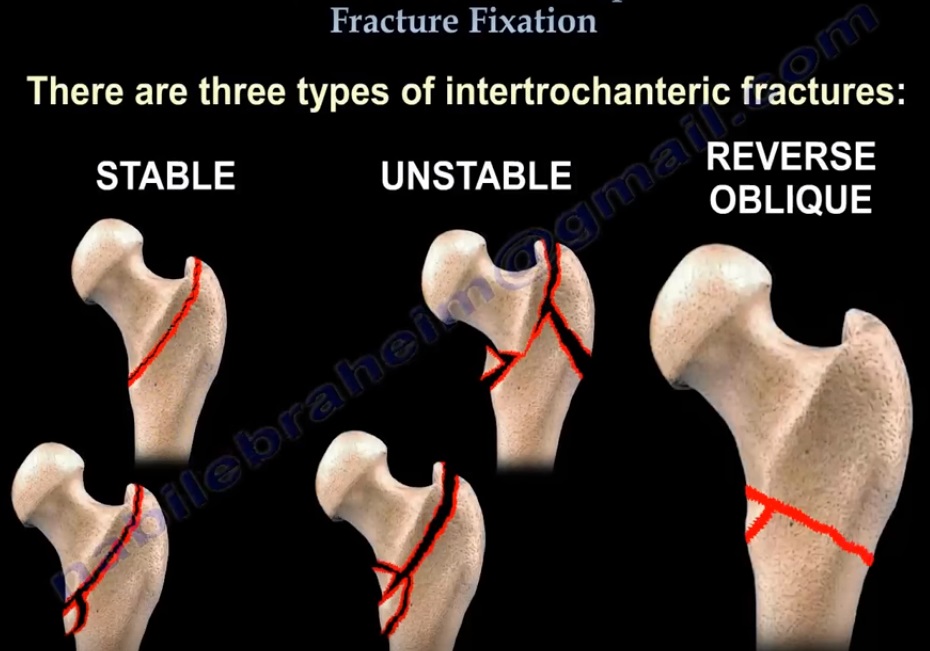
  • There are three type of intertrochanteric fracture – stable, unstable, reverse oblique. Occasionally IT fracture extend to form a subtrochanteric fracture

Stable IT fracture treated with a sliding hip compression screw. The screw inserted both in AP and lateral view within 1 cm from the joint. The tip apex distance should be less than 25 mm in combined AP and lateral view if it is greater than 25 mm it leads to fixation failure.
In case of unstable fracture there is loss of integrity of posteromedial cortex so it may collapse into varus and retroversion so an IM nail is used

In reverse oblique fracture the lateral cortex is not intact, compression cannot be controlled by sliding hip screw so rod, blade plate, dynamic condylar screw or proximal femoral locking plate are used.
Complications of IT fracture
– Implant failure which occurs in first 3 months
-Check for osteoporosis and start on vit D and calcium
Intertrochanteric fractures

Post Views: 9,036

Related Posts

  • Intertrochanteric Fractures

    Courtesy: Saqib Rehman MD Associate Professor Director of Orthopaedic Trauma Temple University Philadelphia Pennsylvania, USA

  • Intertrochanteric Fractures

    Courtesy: Saqib Rehman MD Associate Professor Director of Orthopaedic Trauma Temple University Philadelphia Pennsylvania, USA

  • Subtrochanteric Fractures

    Courtesy : Prof Nabile Ebraheim, University of Toledo, Ohio, USA

Reader Interactions

Leave a Reply

Your email address will not be published. Required fields are marked *

Primary Sidebar

Follow Us

instagram slideshare

Categories

  • -Applied Anatomy
  • -Approaches
  • -Basic Sciences
  • -Cartilage & Meniscus
  • -Classifications
  • -Examination
  • -Foot and Ankle
  • -Foot and Ankle Trauma
  • -FRCS(Tr and Orth) tutorials
  • -Gait
  • -Hand and Wrist
  • -Hand and Wrist Trauma
  • -Hand Infections
  • -Hip and Knee
  • -Hip Preservation
  • -Infections
  • -Joint Reconstruction
  • -Knee Arthroplasty
  • -Knee Preservation
  • -Metabolic Disorders
  • -Oncology
  • -OrthoBiologics
  • -OrthoPlastic
  • -Paediatric Orthopaedics
  • -Paediatric Trauma
  • -Patellofemoral Joint
  • -Pelvis
  • -Peripheral Nerves
  • -Principles
  • -Principles of Surgery
  • -Radiology
  • -Rheumatology
  • -Shoulder and Elbow
  • -Shoulder and Elbow Arthroplasty
  • -Spine Deformity
  • -Spine Oncology
  • -Spine Trauma
  • -Spine, Pelvis & Neurology
  • -Sports Ankle and Foot
  • -Sports Elbow
  • -Sports Knee
  • -Sports Medicine
  • -Sports Medicine Hip
  • -Sports Shoulder
  • -Sports Wrist
  • -Statistics
  • -Technical Tip
  • -Technology in Orth
  • -Trauma
  • -Trauma (Upper Limb)
  • -Trauma Life Support
  • -Trauma Reconstruction
  • Book Shelf
  • Book Shelf Medical
  • Careers
  • Case Studies and Free Papers
  • DNB Ortho
  • Evidence Based Orthopaedic Principles
  • Evidence Based Orthopaedics
  • Exam Corner
  • Fellowships
  • Guest Editor
  • Guest Reviews
  • Image Quiz
  • Instructional Course Lectures
  • Journal Club
  • MCQs
  • Meetings and Courses
  • Multimedia
  • News and Blog
  • Plaster Techniques
  • Podcasts
  • Public Health
  • Rehabilitation
  • Research
  • Shorts and Reels
Copyright@orthopaedicprinciples.com. All right rerserved.