
Courtesy: Prof Nabil Ebraheim, University of Toledo, Ohio, USA
Infections of the Finger
Overview
- Finger infections are common and range from mild to severe
- Advanced infections may require urgent surgical intervention
- Early diagnosis and appropriate treatment are critical to prevent complications
1. Felon (Fingertip Pulp Infection)
Definition
- Deep infection of the fingertip pulp space
- Often follows a puncture injury
Pathophysiology
- Infection is confined within fibrous septa of pulp
- Leads to:
- Increased pressure
- Tissue ischemia
- Necrosis
Clinical Features
- Redness and swelling at fingertip
- Tense, firm swelling
- Severe throbbing pain
- Yellowish discoloration (pus collection)
Complications (If Untreated)
- Skin necrosis
- Flexor tendon sheath infection
- Osteomyelitis
- Distal interphalangeal joint involvement
Management
Early Stage
- Antibiotics
Established Infection
- Incision and drainage (I&D)
Surgical Approaches
- Mid-axial incision
- J-shaped incision (if no foreign body)
- Volar longitudinal incision (if foreign body suspected)
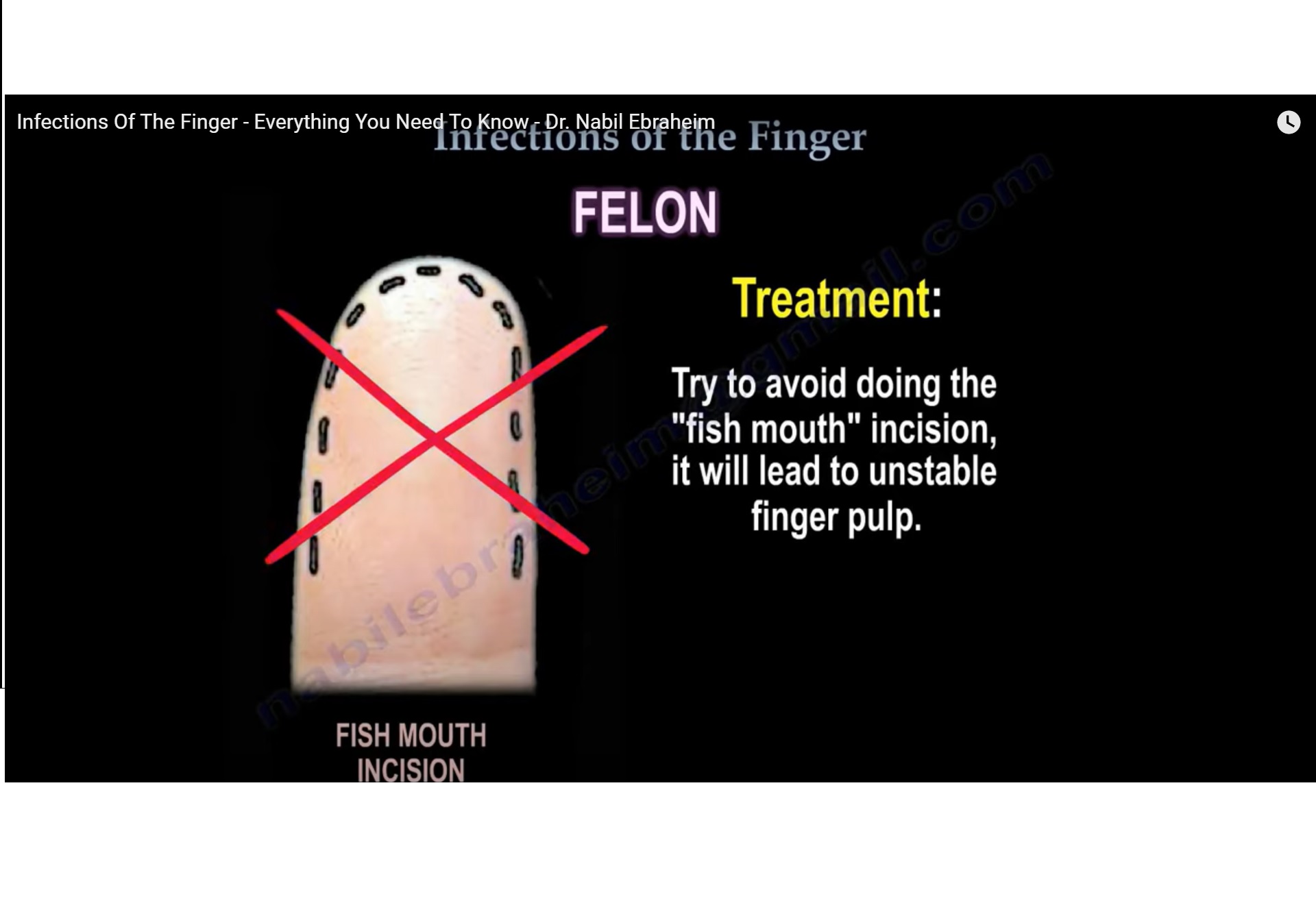
Important Precaution
- Avoid fish-mouth incision
- Risk of pulp instability
2. Paronychia
Definition
- Infection of tissue surrounding the nail fold
Clinical Features
- Redness and swelling around nail
- Pain and tenderness
- Pus formation
Management
Early Stage
- Antibiotics
Advanced Stage
- Incision and drainage
- Partial nail removal (if subungual abscess)
3. Herpetic Whitlow
Definition
- Viral infection caused by Herpes Simplex Virus (HSV)
Risk Groups
- Healthcare workers
- Children (thumb sucking)
Clinical Features
- Painful swelling
- Vesicles with clear fluid
- Burning sensation
- Fever and lymphadenopathy (sometimes)
Management
- Conservative (self-limiting condition)
- Topical antivirals (e.g., acyclovir)
- Antibiotics only if secondary infection
Important Rule
- Surgical drainage is contraindicated
4. Flexor Tenosynovitis
Definition
- Infection of the flexor tendon sheath
Cause
- Usually follows penetrating injury
Common Organism
- Staphylococcus aureus
Commonly Affected Fingers
- Index
- Middle
- Ring
Clinical Features (Kanavel Signs)
- Fusiform swelling of finger
- Finger held in flexion
- Severe pain on passive extension
- Tenderness along tendon sheath (most important)
Management of Flexor Tenosynovitis
Early Stage
- Intravenous antibiotics
Advanced Stage
- Urgent surgical drainage
Surgical Techniques
- Mid-axial incision
- Bruner incision
Alternative Technique
- Two small incisions:
- Proximal (A1 pulley)
- Distal (A5 pulley)
Additional Steps
- Catheter irrigation
- Culture-directed antibiotics
Spread of Infection
Potential Spread
- Deep palmar spaces
- Forearm compartments
Anatomical Pathways
- Little finger — Ulnar bursa
- Thumb — Radial bursa
- Radial & ulnar bursae:
- Communicate proximally (near carpal tunnel)
Clinical Implication
- Can lead to:
- Proximal spread
- Horseshoe abscess
Key Takeaways
- Early diagnosis is critical
- Deep infections often require surgical drainage
- Recognize Kanavel signs in flexor tenosynovitis
- Understand anatomical spread pathways
- Avoid surgery in herpetic whitlow



Leave a Reply