
Courtesy: Dr T Vail, Ashok Shyam TV, Ortho
Why Hip Imaging Matters
-
Imaging plays a critical role in:
-
Understanding hip biomechanics
-
Planning hip reconstruction procedures
-
Identifying intra-articular pathology
-
-
Direct visualization (e.g., arthroscopy) highlights how challenging it can be to detect subtle pathology using imaging alone.
-
Each modality (plain radiographs, MRI) has specific strengths and limitations.
1. Imaging for Assessment of Hip Morphology
Hip morphology refers to:
-
Femoral–pelvic relationship
-
Leg length
-
Femoral offset
-
Acetabular coverage
Radiographic Evaluation Using Plain X-Rays
Several established radiographic indices guide hip analysis and preoperative templating.
Key Measurements on AP Pelvis Radiograph
-
Acetabular Index (Index of Elevation)
-
Assesses acetabular inclination and coverage.
-
Measured from a horizontal reference line to the lateral acetabular edge.
-
-
Extrusion Index
-
Ratio of uncovered femoral head to total femoral head diameter.
-
Quantifies degree of acetabular coverage.
-
-
Center–Edge (CE) Angle
-
Evaluates superolateral femoral head coverage.
-
-
Femoral Neck–Shaft Angle
-
Determines varus or valgus alignment.
-
-
Femoral Neck Offset
-
Assessed best on frog-leg lateral view.
-
Important in:
-
Impingement evaluation
-
Hip resurfacing
-
Component positioning
-
-
Reliable Radiographic Landmarks
-
Teardrop Landmark
-
Most dependable reference point.
-
Compensates for pelvic rotation and tilt.
-
Used to assess:
-
Lateral subluxation
-
Superior migration
-
-
-
Shenton’s Line
-
Helpful in assessing alignment, especially in developmental dysplasia of the hip.
-
Disruption suggests displacement.
-
2. Imaging in Femoroacetabular Impingement (FAI)
Crossover Sign (AP Pelvis View)
-
Occurs when:
-
The anterior acetabular rim crosses over the posterior rim.
-
-
Suggests:
-
Acetabular retroversion
-
Potential anterior impingement
-
-
Pelvic positioning and lumbar lordosis influence interpretation.
-
Important for surgical planning.
3. Imaging of Cartilage and Labral Pathology
Limitations of Plain Radiographs
-
Poor sensitivity for:
-
Isolated chondral defects
-
Cartilage delamination
-
Early degenerative changes
-
-
Detect only ~30% of loose bodies.
-
Cannot reliably identify:
-
Labral tears
-
Subtle cartilage injury
-
Clinical implication:
Duration of symptoms often correlates with degree of degeneration, which directly impacts the success of hip-preserving procedures.
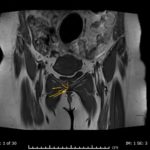
MRI: Improved Diagnostic Accuracy
MRI offers:
-
Superior visualization of:
-
Labrum
-
Articular cartilage
-
Subchondral bone
-
Soft tissues
-
-
Better detection of:
-
Labral tears
-
Cartilage defects
-
Osteonecrosis
-
Delamination
-
MR Arthrography (Gadolinium-Enhanced MRI)
-
Intra-articular contrast significantly improves:
-
Sensitivity
-
Diagnostic accuracy for labral pathology
-
-
Enhances visualization of:
-
Chondral surface irregularities
-
Intra-articular lesions
-
4. Cam Lesions and Radial MRI Imaging
Newer MRI techniques, including radial imaging:
-
Provide detailed assessment of:
-
Femoral head–neck junction
-
-
Identify:
-
Cam deformities
-
Bony prominences in metaphyseal region
-
-
Essential for diagnosing:
-
Femoroacetabular impingement
-
Associated labral tears
-
Cartilage delamination
-
5. Prognostic Implications of Imaging Findings
Outcomes of hip arthroscopy and preservation surgery are influenced by:
-
Degree of cartilage degeneration
-
Presence of osteonecrosis
-
Extent of chondral damage
Key principle:
Greater degeneration ? poorer surgical outcomes.
Therefore:
-
Early and accurate imaging is critical.
-
Treating labral tears alone is insufficient.
-
Underlying morphological abnormalities must be addressed for optimal results.
Clinical Takeaways
-
Plain radiographs remain foundational for:
-
Morphologic assessment
-
Preoperative planning
-
-
MRI (especially MR arthrography) is superior for:
-
Labral pathology
-
Cartilage evaluation
-
-
Recognition of impingement patterns is essential in treatment planning.
-
Imaging findings must always be interpreted in conjunction with:
-
Clinical presentation
-
Duration of symptoms
-
Surgical goals
-

Leave a Reply