
Courtesy Dr. Alexander Gibson, Dr Ashok Shyam, Ortho TV
High-Grade Spondylolisthesis – Surgical Principles and Management
Introduction
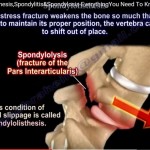
High-grade spondylolisthesis is a complex spinal disorder characterized by significant anterior translation of one vertebra over another, most commonly at the lumbosacral junction.
Management is technically demanding because of:
- Distorted anatomy
- Difficult instrumentation
- High biomechanical stress
- Neurological considerations
Goals of Treatment
The primary objectives of surgery are:
- Achieving solid spinal fusion
- Relieving neurological symptoms
- Restoring sagittal balance
- Improving spinal alignment
- Reducing the slip when safe and feasible
The aim is not simply anatomical reduction, but restoration of stable spinal balance.
Anatomical Challenges
High-grade dysplastic slips are commonly associated with:
- Sacral rounding
- Wedge-shaped L5 vertebra
- Increased lumbosacral kyphosis
These abnormalities make:
- Screw placement difficult
- Pelvic parameter assessment challenging
- Complete reduction technically demanding
Surgical Options
1. Non-Instrumented Fusion
Technique
In-situ fusion without hardware fixation.
Common methods include:
- Posterior fusion
- Iliac crest autograft
- Posterolateral fusion
- Interbody fusion
Advantages
- Avoids implant-related complications
- Good long-term outcomes reported in literature
Limitations
- Less immediate mechanical stability
- Higher risk of pseudoarthrosis in severe deformity
2. Posterior Instrumented Fusion
Common procedures include:
- PLIF (Posterior Lumbar Interbody Fusion)
- TLIF (Transforaminal Lumbar Interbody Fusion)
Technical Considerations
Important surgical principles include:
- Use of reduction screws or long-tab screws
- Adequate disc space preparation
- Controlled reduction maneuvers
Reduction Strategy
Partial reduction is generally preferred over aggressive complete reduction because it reduces:
- Neurological risk
- Stretch injury to nerve roots
PLIF Advantages
PLIF may provide:
- Larger graft surface area
- Better cage stability
- Improved anterior column support
3. Delta Fixation (Transdiscal Screws)
Technique
Screws are passed:
- From S1
- Across the disc space
- Into the L5 vertebral body
Advantages
- Provides three-column stability
- Useful in narrow disc spaces
- Helpful when spontaneous fusion is expected
4. Strut Graft Techniques
Bohlman Technique
Technique
Posterior placement of a graft:
- From S1
- Across the disc space
- Into L5
Reverse Bohlman Technique
Technique
Anterior placement of graft:
- From L5
- Into the sacrum
Indications
Useful in:
- Very high-grade slips
- Revision surgery
- High sacral slope deformity
Graft Options
Possible graft choices include:
- Fibular strut graft
- Mesh cage
- Threaded cage
5. Gaines Procedure
A complex reduction procedure used by select experienced surgeons.
Because of technical difficulty and neurological risk, it has limited widespread use.
Technical Considerations
Instrumentation may require:
- Extension to additional spinal levels
Important principles include:
- Avoiding excessive stress on L5 and S1 screws
- Preventing implant failure
- Maintaining sagittal alignment
Staged Procedures
In selected cases, staged surgery may be considered:
- Initial fusion
- Later adjustment or revision of hardware
Revision Surgery
Common Causes
Revision surgery is commonly required due to:
- Pseudoarthrosis
- Implant failure
- Screw breakage
- Progressive deformity
Management Strategies
Options include:
- Revision posterior instrumentation
- Addition of anterior interbody fusion
- Multi-level stabilization
Combined anterior and posterior approaches are often required in complex revision cases.
Surgical Approach Selection
Posterior Approach
Advantages
- Familiar technique
- Avoids anterior exposure
- Commonly used
Anterior Approach
Advantages
Provides better access for:
- Interbody graft placement
- Strut graft techniques
- Anterior column reconstruction
Useful Situations
Particularly helpful in:
- Revision surgery
- High sacral slope deformity
- Severe disc collapse
Key Surgical Principles
Important concepts include:
- No single technique is appropriate for all patients
- Surgical strategy must be individualized
- Flexibility in approach is essential
Choice of surgery depends on:
- Anatomy
- Reducibility
- Bone quality
- Surgeon experience
Evidence-Based Insights
Non-Instrumented Fusion
- Can provide satisfactory long-term outcomes in selected patients
Instrumented Fusion
- Offers improved mechanical stability in high-grade slips
Reduction Strategy
- Partial reduction is often safer than complete reduction
- Aggressive reduction increases neurological risk
Important Complications
Potential complications include:
- Neurological injury
- Pseudoarthrosis
- Implant failure
- Adjacent segment disease
- Sagittal imbalance
- Infection
Key Take-Home Messages
- High-grade spondylolisthesis requires careful preoperative planning.
- The main goals are fusion, decompression, and restoration of balance.
- Complete reduction is not always necessary.
- Partial reduction is often safer and biomechanically effective.
- Multiple surgical strategies are available and should be individualized.
- Revision surgery may require combined anterior and posterior approaches.

Leave a Reply