
Courtesy: Donald Rose MD, NewYork School of Medicine, NY, USA
Hamstring Tendon Harvest for ACL Reconstruction
Introduction
Hamstring tendon harvest is one of the most commonly performed graft harvesting techniques in anterior cruciate ligament (ACL) reconstruction.
The tendons typically harvested include:
- Semitendinosus tendon
- Gracilis tendon
Proper harvesting technique is essential to ensure:
- Adequate graft length
- Preservation of surrounding structures
- Prevention of premature graft amputation
- Successful graft preparation
Surgical Anatomy
Pes Anserinus
The hamstring tendons are harvested from the:
- Pes anserinus region
located on the:
- Proximal medial tibia
The pes anserinus consists of:
- Sartorius
- Gracilis
- Semitendinosus
Important Neurovascular Structures
Care must be taken to protect:
- Saphenous nerve branches
- Superficial vessels
during dissection.
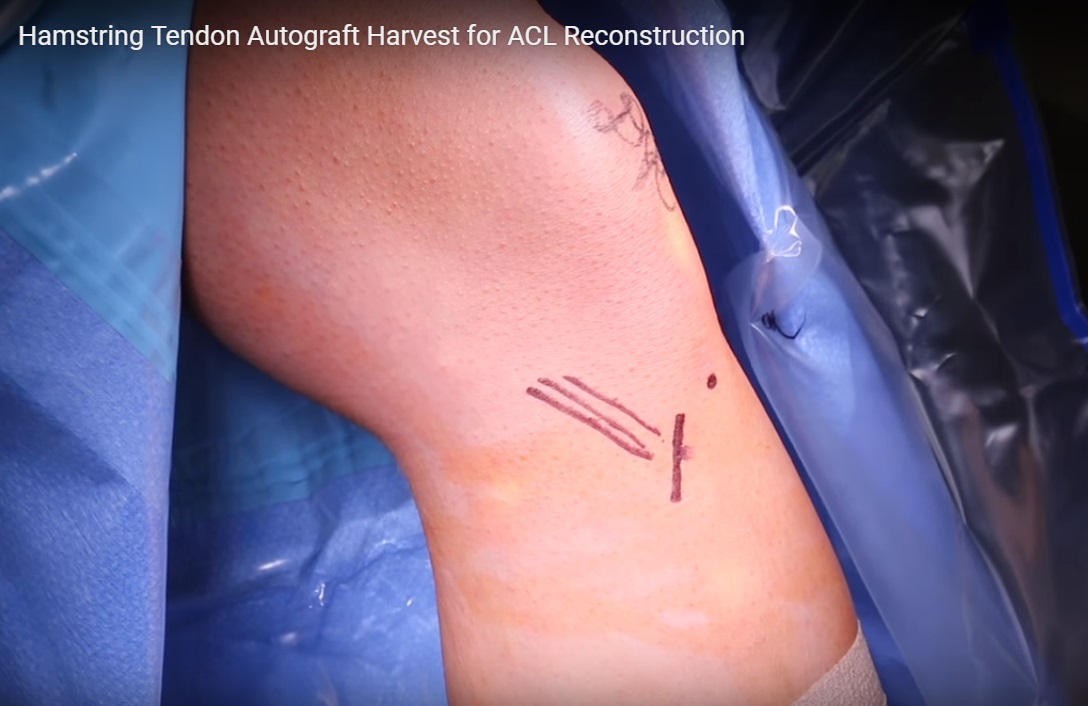
Surface Landmarks and Skin Incision
Landmark Identification
Key landmarks include:
- Tibial tubercle
- Medial proximal tibia
The pes anserinus region is identified approximately:
- Two finger breadths distal and medial to the tibial tubercle
Skin Incision
A small incision is typically made:
- Approximately 2–3 cm in length
The incision may be:
- Oblique
- Vertical
depending on surgeon preference.
Superficial Dissection
Skin and Subcutaneous Tissue
The dissection proceeds through:
- Skin
- Subcutaneous tissue
Blunt spreading is preferred over aggressive cutting to minimize injury to:
- Saphenous nerve branches
- Superficial veins
Hemostasis
Superficial bleeding vessels should be:
- Carefully cauterized when necessary
Identification of Sartorius Fascia
The next important structure encountered is the:
- Sartorial fascia
also called:
- Pes anserinus fascia
Appearance
The fascia typically appears:
- Glistening
- Fibrous
- Occasionally vascular
The fascia is carefully incised to expose the underlying tendons.
Identification of Hamstring Tendons
Palpation Technique
The tendons are often identified by their:
- “Speed bump” feel
on palpation.
Tendon Identification
Semitendinosus
- Thicker tendon
- Usually harvested first
Gracilis
- Thinner tendon
- Located adjacent to semitendinosus
Freeing the Tendons
Elevation of Tendon
The tendon is gently lifted using:
- A clamp or tendon hook
Critical Step: Release of Fascial Bands
This is one of the most important steps in tendon harvest.
Fibrous fascial attachments commonly extend toward:
- Gastrocnemius fascia
- Inferior fascial structures
Clinical Importance
Failure to release these bands may result in:
- Premature graft amputation
during tendon stripping.
Tendon Stripping Technique
Tendon Stripper
A closed tendon stripper is commonly used.
Technique
Steps include:
- Passing the stripper over the tendon
- Advancing with steady controlled pressure
- Avoiding excessive force
Important Principle
There should be:
- Minimal resistance during advancement
Resistance may indicate:
- Unreleased fascial bands
- Incorrect tendon passage
Harvesting the Semitendinosus Tendon
The semitendinosus tendon is usually harvested first because it is:
- Larger
- Easier to identify
Proper release of all fascial bands is essential before advancing the stripper.
Harvesting the Gracilis Tendon
After semitendinosus harvest, gracilis harvest is generally easier.
Important principles remain the same:
- Identify all fascial bands
- Release attachments completely
- Advance the stripper carefully
Common Pitfall
Thick fascial bands may sometimes mimic tendon tissue.
Incorrect passage of the stripper may lead to:
- Tendon transection
- Incomplete graft harvest
Graft Preparation
Removal of Muscle Tissue
Residual muscle fibers are gently removed from the harvested tendons.
Preservation of Distal Attachment
Some surgeons may preserve the distal attachment because it may provide:
- Increased graft length
- Additional fixation strength
Final Graft Assessment
The final graft should be assessed for:
- Adequate length
- Appropriate diameter
- Clean tendon preparation
Hemostasis
After graft harvest:
- The tourniquet is released
- Bleeding is checked and controlled
Complications of Hamstring Tendon Harvest
Potential complications include:
- Premature graft amputation
- Saphenous nerve injury
- Hematoma formation
- Inadequate graft length
- Tendon damage during stripping
Technical Pearls
- Always identify and release fascial bands completely.
- Resistance during stripping usually indicates incomplete release.
- Semitendinosus is typically thicker than gracilis.
- Careful blunt dissection helps protect the saphenous nerve.
- Proper graft preparation is critical for successful ACL reconstruction.
Advantages of Hamstring Grafts
Hamstring tendon grafts offer several advantages:
- Smaller incision
- Reduced anterior knee pain
- Lower risk of patellar fracture
- Good graft strength
Limitations of Hamstring Grafts
Potential disadvantages include:
- Hamstring weakness
- Variable graft size
- Risk of tendon harvest complications
- Slower graft incorporation compared to bone-patellar tendon-bone grafts
Final Take-Home Message
Hamstring tendon harvest is a reliable and commonly used technique in ACL reconstruction.
Successful graft harvest depends on:
- Precise anatomical knowledge
- Careful soft tissue dissection
- Complete release of fascial bands
- Controlled tendon stripping technique
Meticulous surgical technique helps prevent complications and ensures optimal graft quality for ACL reconstruction
Leave a Reply