• Skip to main content
  • Skip to secondary menu
  • Skip to primary sidebar
OrthopaedicPrinciples.com

OrthopaedicPrinciples.com

Integrating Principles and Evidence

Integrating Principles and Evidence

  • Home
  • Editorial Board
  • Our Books
    • Evidence Based Orthopaedic Principles
  • Courses
  • Exams
  • Reviews
  • Live Program
  • Contact

Gower’s Sign

Courtesy: Prof Nabil Ebraheim, University of Toledo, Ohio, USA


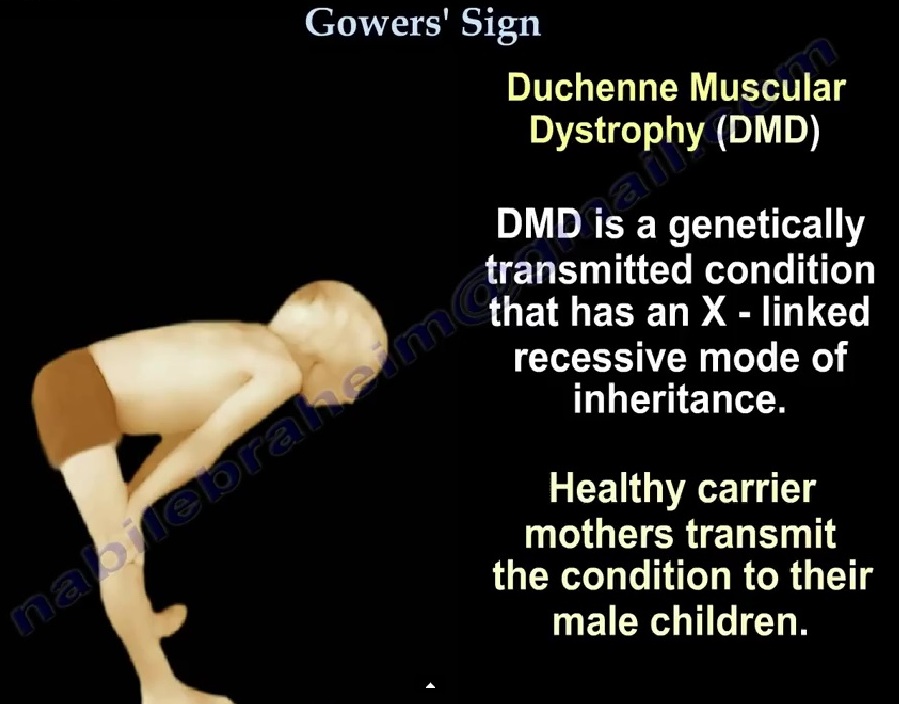
Gowers Sign

Definition

Gowers sign describes a patient who uses the hands and arms to “walk up” the thighs/body in order to rise from the floor and achieve a standing position.

Mechanism

It occurs due to weakness of the proximal lower-limb muscles, particularly:

  • Gluteal muscles
  • Quadriceps

Because of this proximal weakness, the patient uses the upper limbs to assist in extending the hips and knees while standing.

Association

particularly associates Gowers sign with:

Duchenne muscular dystrophy (DMD)

Duchenne Muscular Dystrophy

According to  :

  • Due to absence of dystrophin
  • Inheritance – X-linked recessive

Exam Pearl

Gowers sign – proximal lower-limb muscle weakness – patient “climbs up” his own thighs using the hands – classically Duchenne muscular dystrophy.

One-line viva answer

Gowers sign is the use of the hands to climb up the thighs while rising from the floor due to proximal lower-limb muscle weakness, classically seen in Duchenne muscular dystrophy.
 

Post Views: 1,355

Related Posts

  • Gower's Sign

    Courtesy: Prof Nabile Ebraheim, University of Toledo, Ohio, USA

  • Trendelenburg Sign

    Courtesy: Prof Nabil Ebraheim, University of Toledo, Ohio, USA

  • Cervical Spine Examination

    Courtesy: Prof Nabil Ebraheim, Unviersity of Toledo, Ohio, USA

Reader Interactions

Leave a Reply

Your email address will not be published. Required fields are marked *

Primary Sidebar

Follow Us

instagram slideshare

Categories

  • -Applied Anatomy
  • -Approaches
  • -Basic Sciences
  • -Cartilage & Meniscus
  • -Classifications
  • -Examination
  • -Foot and Ankle
  • -Foot and Ankle Trauma
  • -FRCS(Tr and Orth) tutorials
  • -Gait
  • -Hand and Wrist
  • -Hand and Wrist Trauma
  • -Hand Infections
  • -Hip and Knee
  • -Hip Preservation
  • -Infections
  • -Joint Reconstruction
  • -Knee Arthroplasty
  • -Knee Preservation
  • -Metabolic Disorders
  • -Oncology
  • -OrthoBiologics
  • -OrthoPlastic
  • -Paediatric Orthopaedics
  • -Paediatric Trauma
  • -Patellofemoral Joint
  • -Pelvis
  • -Peripheral Nerves
  • -Principles
  • -Principles of Surgery
  • -Radiology
  • -Rheumatology
  • -Shoulder and Elbow
  • -Shoulder and Elbow Arthroplasty
  • -Spine Deformity
  • -Spine Oncology
  • -Spine Trauma
  • -Spine, Pelvis & Neurology
  • -Sports Ankle and Foot
  • -Sports Elbow
  • -Sports Knee
  • -Sports Medicine
  • -Sports Medicine Hip
  • -Sports Shoulder
  • -Sports Wrist
  • -Statistics
  • -Technical Tip
  • -Technology in Orth
  • -Trauma
  • -Trauma (Upper Limb)
  • -Trauma Life Support
  • -Trauma Reconstruction
  • Book Shelf
  • Book Shelf Medical
  • Careers
  • Case Studies and Free Papers
  • DNB Ortho
  • Evidence Based Orthopaedic Principles
  • Evidence Based Orthopaedics
  • Exam Corner
  • Fellowships
  • Guest Editor
  • Guest Reviews
  • Image Quiz
  • Instructional Course Lectures
  • Journal Club
  • MCQs
  • Meetings and Courses
  • MS Ortho
  • Multimedia
  • News and Blog
  • Plaster Techniques
  • Podcasts
  • Public Health
  • Rehabilitation
  • Research
  • Shorts and Reels
Copyright@orthopaedicprinciples.com. All right rerserved.