
Courtesy: Krishna VA Reddy, Assistant Professor, University of Cincinnati School of Medicine, Cincinatti, Ohio, USA
Sarcoma: Overview, Reconstruction, and Current Trend
Introduction
- Guest speaker: Dr. Krishna Reddy
- Orthopaedic surgeon at University of Cincinnati Medical Center
- Special interests:
- Musculoskeletal oncology
- Sports medicine
- Shoulder reconstruction
- Arthroplasty (primary & revision)
Overview of the Lecture
- Incidence of:
- Soft tissue sarcomas
- Bone sarcomas
- Reconstruction options
- Case examples
- Current trends in:
- Diagnosis
- Treatment
Understanding Sarcomas
Definition
- Heterogeneous group of mesenchymal tumors
- Account for ~1% of all malignancies
Origin
- Arise from connective tissue derivatives:
- Fat — Liposarcoma
- Cartilage — Chondrosarcoma
Key Feature
- High heterogeneity — Difficult classification
Epidemiology
Soft Tissue Sarcomas
- ~12,000 cases/year (USA)
- <1% of all cancers
- Slight male predominance
- Incidence increases with age
- Peak: 6th–7th decade
Bone Sarcomas
- ~2,500 cases/year
- Common types:
- Osteosarcoma
- Ewing sarcoma
- Chondrosarcoma
Age Distribution
- Osteosarcoma & Ewing:
- Adolescents
- Osteosarcoma:
- Second peak in elderly
- Chondrosarcoma:
- Older adults
Survival Trends
- Osteosarcoma:
- ~60–65% 10-year survival
- Minimal improvement in last 30 years
- Contrast:
- Carcinomas (e.g., breast) show major survival gains
Reconstruction Options in Bone Sarcoma
Types
- Resection without reconstruction
- Endoprosthetic replacement (EPR)
- Allograft reconstruction
- Amputation
Endoprosthetic Replacement (EPR)
Features
- Custom implants
- Cemented fixation
- Hydroxyapatite (HA) collar
Advantages
- Immediate weight bearing
- Predictable outcomes (~80% function scores)
- Low early complication rate
Disadvantages
- Expensive
- Long-term complications
- ~10% risk of amputation
HA Collar Concept
- Promotes bone ingrowth
- Improves long-term fixation
Outcomes
- ~95% survival at ~19 years
- Very low aseptic loosening (~1.7%)
Key Limitation
- Infection remains the major problem
Infection in EPR
Risk
- ~1% per year (cumulative)
High-Risk Factors
- Prior radiotherapy
- Myeloma
- Tibia/pelvis location
Treatment Outcomes
- Debridement success: ~30%
- Two-stage revision: ~70%
Silver-Coated Implants
Benefits
- Infection reduction:
- From ~18–22% – 6–12%
- Improved revision success:
- ~57% ~85%
Cost Effectiveness
- Coating cost: ~£600
- Infection treatment: >£20,000
Clearly cost-effective
Expandable Prosthesis (Growing Implants)
Indication
- Skeletally immature patients
Types
- Mechanical (screw-based)
- Minimally invasive
- Non-invasive magnetic systems
Modern System
- Electromagnetic lengthening
- ~5 mm in 20 minutes
Limitations
- Expensive
- Not MRI compatible
- Infection risk
Biological Reconstruction Options
Extracorporeal Irradiation & Reimplantation
- Tumor bone:
- Removed
- Sterilized with radiation
- Reimplanted
Advantages
- Uses patient’s own bone
- Avoids graft mismatch
Pedicle Frozen Autograft
- Tumor bone frozen in liquid nitrogen
- Reimplanted with fixation
Allograft Reconstruction
Principle
- Donor bone matched to patient anatomy
Application
- Common in USA & South America
Allograft-Prosthetic Composite
- Combines:
- Allograft bone
- Prosthetic implant
Advanced Surgical Techniques
Navigation in Tumor Surgery
- Improves:
- Accuracy
- Margin clearance
- Reduces local recurrence
3D Printing
- Custom implants
- Patient-specific reconstruction
Soft Tissue Sarcoma Case Insight
Key Points
- Large tumors can spare bone due to periosteal barrier
- Radiation + periosteal stripping weakens bone
Preventive Strategy
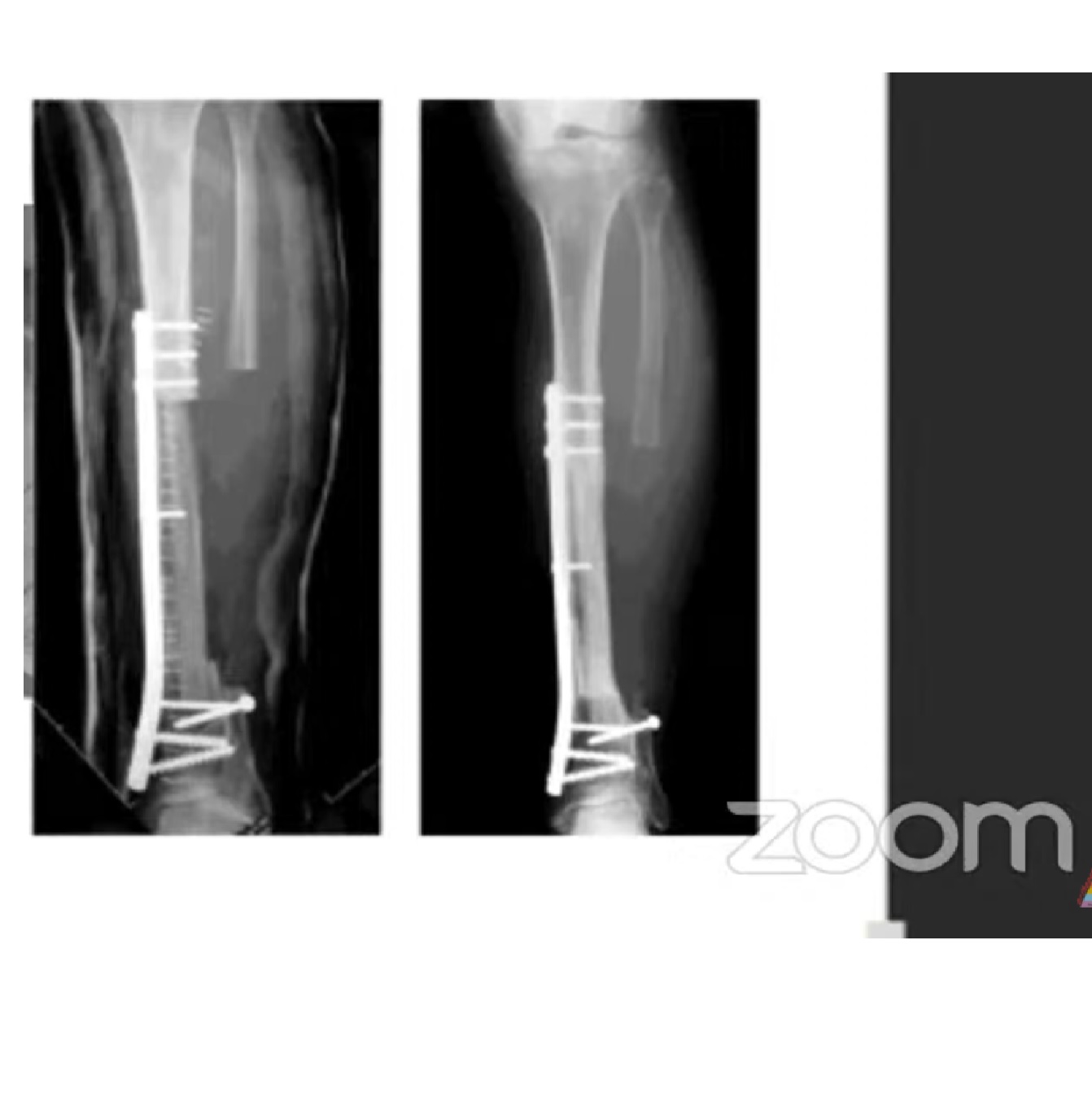
- Prophylactic fixation (e.g., carbon fiber nail)
Carbon Fiber Implants
- Advantage:
- Better MRI imaging
- Limitation:
- Cost
Special Reconstructions
Rotationplasty
- Used in extensive tumors
- Converts ankle ? knee function
Osseointegration Prosthesis
- Implant extends through skin
- Direct attachment to prosthesis
Advantages
- Better energy efficiency
Challenges
- Infection risk at skin interface
Genetic and Molecular Advances
Soft Tissue Sarcoma Markers
- MDM2 – Liposarcoma
- TLE1 – Synovial sarcoma
Bone Tumor Markers
- CD99 – Ewing sarcoma
- H3F3 mutation – Aneurysmal bone cyst
Trend
- Shift toward precision medicine
Targeted Therapy
FoundationOne Testing
- Analyzes ~324 genes
- Identifies:
- Mutations
- Targeted therapies
- Clinical trials
New Drugs
Denosumab
- Used in giant cell tumor
- Reduces tumor size
Concerns
- Long-term safety unclear
- Risk of malignant transformation
CSF-1 Inhibitors (e.g., Pexidartinib)
- Used in PVNS
- Reduces need for surgery
Key Clinical Principle
Early Diagnosis is Critical
- Any lump:
-
5 cm
- Deep
- Painless
- Increasing in size
-
Avoid
- Unplanned excision (“whoops surgery”)
Management of Pathological Fractures
Principle
- Assume bone will NOT heal
Fixation Strategy
- Strong construct
- Augment with cement
Replacement vs Fixation
- Depends on:
- Life expectancy
- Disease burden
Guideline
- Long survival – aggressive reconstruction
- Short survival – palliative fixation
Take-Home Messages
- Sarcomas are rare but complex tumors
- Reconstruction options are expanding
- Infection remains a major challenge
- Precision medicine is the future
- Early diagnosis significantly improves outcomes
Leave a Reply