
Courtesy: Amr Abdelgawad, Maimonaiedes Medical Centre, New York, USA
Overview
- Genetic abnormalities frequently affect the musculoskeletal system.
- Many skeletal dysplasias, connective tissue disorders, and neuromuscular diseases have identifiable gene mutations.
- Understanding these genes helps explain clinical features and inheritance patterns.
Genetic Disorders with Musculoskeletal Manifestations
- Osteogenesis imperfecta – mutation in COL1A1 gene affecting type I collagen.
- Achondroplasia – mutation in fibroblast growth factor receptor 3 (FGFR3).
- Marfan syndrome – mutation in FBN1 gene affecting fibrillin.
- Diastrophic dysplasia – mutation in SLC26A2 gene affecting sulfate transport in cartilage.
- Pseudoachondroplasia – mutation in cartilage oligomeric matrix protein (COMP).
- Multiple epiphyseal dysplasia – commonly associated with COMP gene mutation.
- Spondyloepiphyseal dysplasia – mutation in type II collagen gene (COL2A1).
- Duchenne muscular dystrophy – mutation in dystrophin gene causing progressive muscle degeneration.
- Becker muscular dystrophy – mutation in dystrophin gene with milder clinical severity.
- Fibrous dysplasia – mutation in GNAS gene affecting G protein signaling.
- Osteopetrosis – defects in osteoclast function including mutations in CLCN7 or TCIRG1.
- Multiple hereditary exostoses – mutations in EXT1 or EXT2 genes.
- Neurofibromatosis type 1 – mutation in NF1 gene located on chromosome 17.
- Charcot–Marie–Tooth disease – frequently associated with mutation in PMP22 gene.
- Spinal muscular atrophy – mutation in survival motor neuron (SMN) gene.
Additional Genetic Disorders Relevant to Orthopedics
- Turner syndrome – short stature associated with SHOX gene deficiency.
- Vitamin D dependent rickets type 1 – mutation affecting vitamin D activation enzymes.
- Cleidocranial dysplasia – mutation in RUNX2 gene affecting bone formation.
- Apert syndrome – mutation in fibroblast growth factor receptor 2 (FGFR2).
- X-linked hypophosphatemic rickets – mutation in PHEX gene affecting phosphate metabolism.
- Friedreich ataxia – mutation in FXN gene.
- Clubfoot – associated with PITX1 and TBX4 genes involved in limb development.
- Fibular hemimelia – associated with abnormalities in sonic hedgehog signaling.
- Fibrodysplasia ossificans progressiva – mutation in ACVR1 gene causing heterotopic ossification.
Patterns of Genetic Inheritance
- Autosomal dominant – disease occurs when one mutated gene is inherited.
- Examples include achondroplasia, Marfan syndrome, multiple hereditary exostoses, cleidocranial dysplasia, and neurofibromatosis type 1.
- Autosomal recessive – disease occurs only when two mutated genes are inherited.
- Examples include diastrophic dysplasia, hypophosphatasia, homocystinuria, vitamin D dependent rickets, and sickle cell disease.
- X-linked recessive – mutation occurs on the X chromosome and mainly affects males.
- Examples include Duchenne muscular dystrophy, Becker muscular dystrophy, hemophilia, and Hunter syndrome.
- X-linked dominant – less common inheritance pattern.
- Examples include X-linked hypophosphatemic rickets and Leri–Weill dyschondrosteosis.
Genes Regulating Bone Development
- RUNX2 (core binding factor alpha 1) is a transcription factor essential for osteoblast differentiation.
- Mutation of RUNX2 causes cleidocranial dysplasia with absent or hypoplastic clavicles.
Wnt Signaling Pathway in Bone Formation
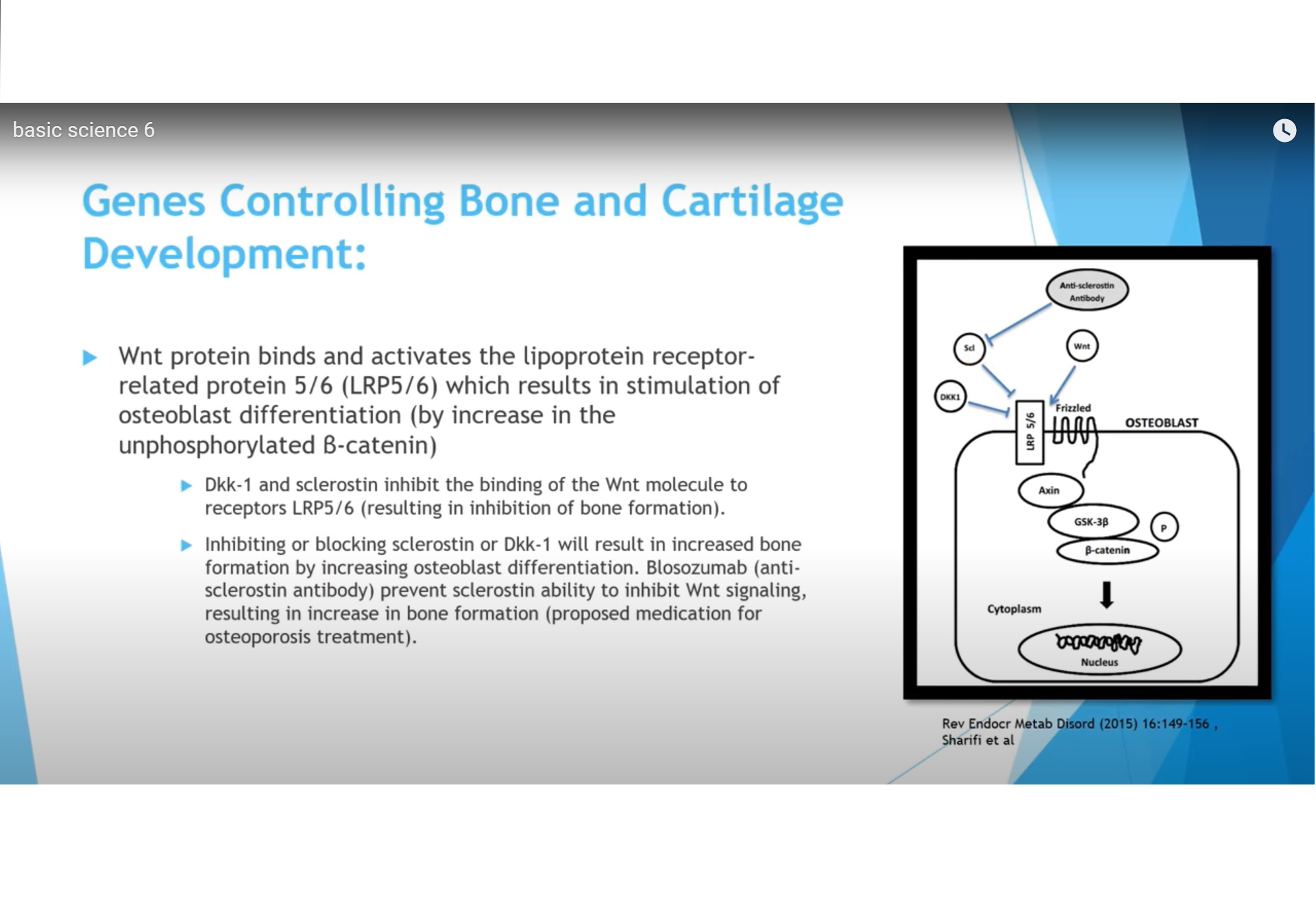
- Wnt proteins bind to LRP5 and LRP6 receptors on osteoblast precursor cells.
- This interaction increases beta-catenin signaling.
- Activation of beta-catenin promotes osteoblast differentiation and bone formation.
- Inhibitory proteins such as sclerostin and DKK1 suppress this pathway.
Therapeutic Target in Osteoporosis
- Blocking sclerostin enhances Wnt signaling and stimulates bone formation.
- Romosozumab is a monoclonal antibody against sclerostin used in osteoporosis treatment.
Fibrodysplasia Ossificans Progressiva
- A rare autosomal dominant disorder characterized by progressive heterotopic ossification.
- Caused by activating mutation in ACVR1 gene.
- The mutation alters bone morphogenetic protein signaling and results in abnormal bone formation in soft tissues.
Genes Involved in Cartilage Development
- SOX9 is a major transcription factor regulating chondroblast differentiation.
- It plays a central role in cartilage development and maintenance of chondrocyte lineage.
Leave a Reply