
Courtesy: Dr Vijay Bose, Dr Ashok Shyam, Ortho TV
Revision Total Hip Arthroplasty: Monoblock vs. Modular Tapered Fluted Stems
Historical Perspective & The Transatlantic Divide
-
The American Philosophy (1980s–1990s): Popularized by Charles Engh and William Harris Jr., advocating extensively porous-coated cylindrical cobalt-chromium stems (e.g., AML).
-
The European Philosophy: Heinz Wagner introduced the Wagner stem in 1985, pioneering the concept of the fluted, tapered titanium stem.
-
Failure Modes of Cylindrical Cobalt-Chromium Stems:
-
Severe proximal stress shielding due to high metal stiffness.
-
Inability to achieve secondary axial engagement once bone resorbs.
-
Absence of endosteal bone regenerate.
-
Increased incidence of stem fatigue fracture.
-
-
Current Gold Standard: Fluted, tapered titanium stems represent the definitive standard of care in revision femoral reconstruction. Extensively coated cylindrical cobalt-chromium stems are largely obsolete due to unacceptably high failure rates.
The Wagner Monoblock Stem: Merits and Complications
-
Clinical Role: The traditional workhorse for femoral revision across multiple decades, particularly in resource-constrained settings.
-
Economic Advantage: Significantly lower implant cost, reduced hospital shelf inventory, and streamlined surgical instrumentation compared to modular systems.
-
Key Complications in the Literature:
-
Subsidence: Occurs in roughly 10% to 20% of cases due to a low distal taper angle and limited proximal fill.
-
Dislocation: Postoperative dislocation rates range between 5% and 10%, frequently precipitated by early subsidence and loss of soft-tissue myofascial tension.
-
Modular Tapered Stems: Biomechanical Advantages
-
Independent Fixation and Balancing:
-
Allows the surgeon to establish rigid distal diaphyseal scratch-fit fixation first.
-
Proximal body length, offset, and version are adjusted independently to restore leg length and abductor tension without disrupting distal stem seating.
-
-
Secondary Proximal Stability: Independent proximal sleeve sizing allows circumferential fill of a capacious metaphysis, restoring proximal load transfer.
-
Curved Stem Geometry: Accommodates native femoral anterior bow, facilitating longer bypass lengths in complex endofemoral revisions without cortical perforation.
-
The Modularity Trade-Off (Yin and Yang):
-
Modularity introduces junctional fretting, corrosion, and catastrophic stem fatigue fracture.
-
Junctional failure risks rise significantly when there is complete loss of proximal bony support (unsupported proximal junction).
-
Considerably higher implant cost and larger surgical tray inventory.
-
Indications: When to Choose Monoblock vs. Modular
Absolute Indications for Modular Stems
-
Long Endofemoral Revision Without an ETO: When inserting a long, curved revision stem through an intact proximal femur, modularity allows sequential distal seating followed by proximal body assembly.
-
Mismatch Between Diaphyseal Fixation and Proximal Geometry: Cases requiring independent correction of version or significant leg length lengthening while distal fixation is locked into the diaphysis.
Classic Indications for Monoblock Stems
-
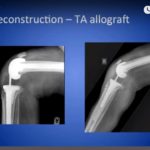
Complete Loss of Proximal Bone Support (Tumor Resection / High Transactions):
-
Proximal femoral oncologic resections (e.g., osteosarcoma) or high transverse diaphyseal non-unions where zero proximal bone stock exists.
-
In the entire English literature, there are no reported cases of a Wagner tapered titanium monoblock stem fracturing under cantilever bending loads.
-
A modular stem in this setting carries a high risk of junctional fatigue breakage.
-
-
Cost-Sensitive Scenarios: Ideal for healthcare systems where modular inventories impose prohibitive costs.
The “MonoMod” Hybrid Concept & Modern Design Innovations
-
Rationale: A dual-step technique designed to achieve the biological and mechanical advantages of modularity while retaining the fracture resistance and lower cost of a monoblock titanium stem.
-
Two-Step Reaming Protocol:
-
Dedicated reamers feature dual markings.
-
Step 1 establishes distal diaphyseal axial and rotational scratch fit.
-
Step 2 prepares the proximal canal for soft-tissue balancing and secondary fit before final monoblock stem impaction.
-
-
Off-the-Shelf 3D-Printed Titanium Proximal Augments:
-
Modular or add-on porous titanium augments fitted around the proximal segment of the monoblock stem after distal seating.
-
Provides secondary proximal rotational stability in capacious, osteoporotic femoral metaphyses without a vulnerable taper junction.
-
-
Optimized Taper Angle:
-
The traditional Wagner stem has a low taper angle of 2°, which predisposes to subsidence.
-
High taper stems (e.g., 3°) resist subsidence effectively but require long diaphyseal bone segments to achieve adequate contact area.
-
An intermediate taper angle of 2.5° balances axial load resistance against sufficient contact length in shorter diaphyseal segments.
-
-
Guided Anteversion Alignment:
-
Eliminates freehand “eyeballing” of version when proximal trochanteric landmarks are absent.
-
An alignment guide references the tibia and functional axis to dial in definitive femoral anteversion (10°, 20°, or 30°) accurately prior to final seating.
-
Summary Comparison
-
Fluted Tapered Titanium Monoblock (Wagner-Type):
-
Fracture risk: Extremely low (zero reported breakages in pure monoblock designs).
-
Proximal support dependence: Can function with zero proximal support.
-
Inventory and cost: Low cost, minimal trays.
-
Main technical challenge: Higher risk of subsidence (10–20%) and dislocation (5–10%); version cannot be adjusted after distal engagement.
-
-
Modular Fluted Tapered Titanium:
-
Fracture risk: Present at the mid-stem modular taper junction if proximally unsupported.
-
Proximal support dependence: Requires proximal bony contact to protect the junction from cyclic bending fatigue.
-
Inventory and cost: High cost, extensive instrumentation.
-
Main technical challenge: Solves version mismatch, leg length discrepancies, and subsidence through independent distal and proximal sizing.
-

Leave a Reply