
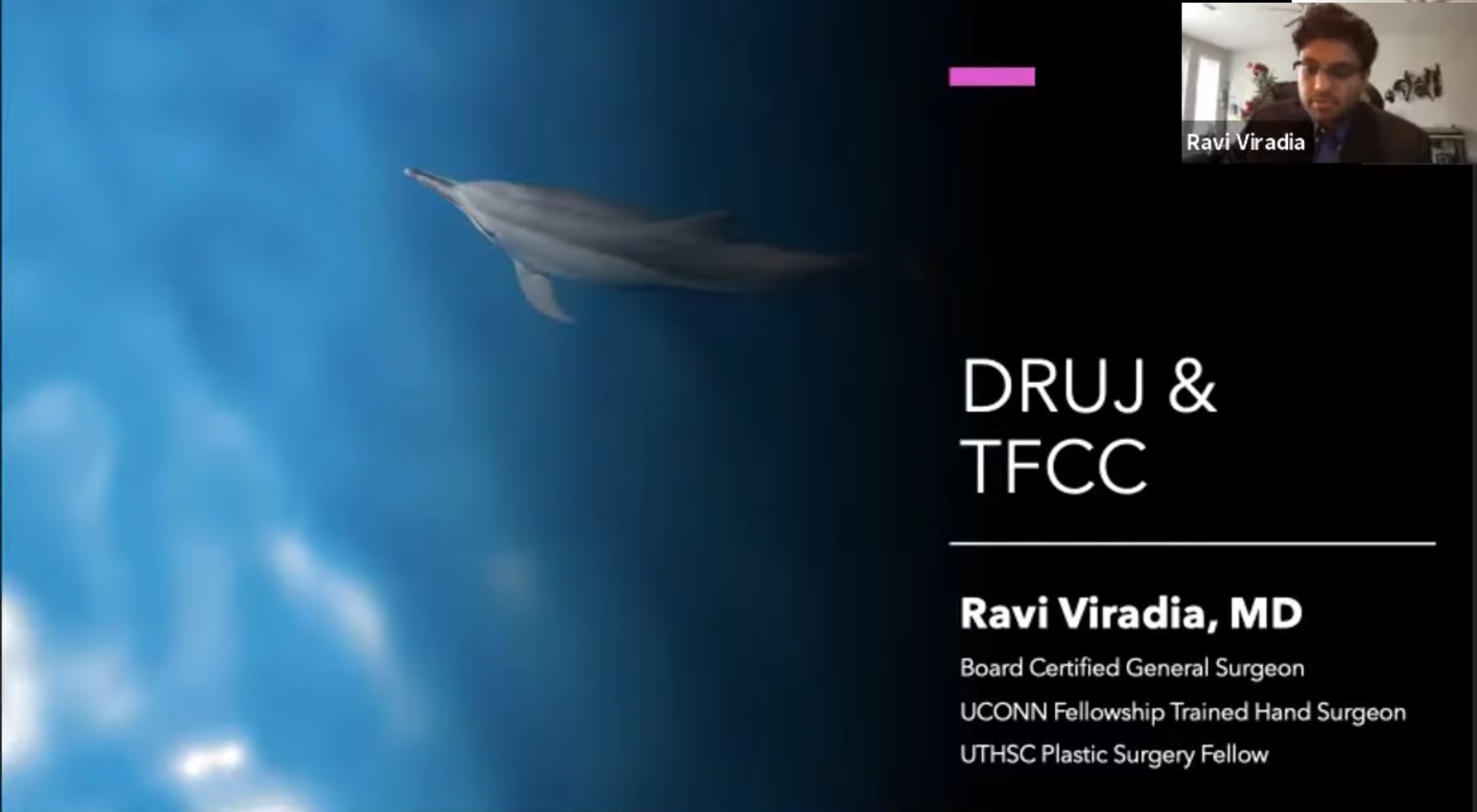
Courtesy: Ravi Viradia MD, Tennesse, United States
TFCC and Distal Radioulnar Joint (DRUJ)
Introduction
The Triangular Fibrocartilage Complex (TFCC) is a key stabilizing structure on the ulnar side of the wrist. It plays a critical role in:
- Distal radioulnar joint stability
- Load transmission across the wrist
- Smooth forearm rotation
Injuries to the TFCC commonly produce ulnar-sided wrist pain and instability.
Triangular Fibrocartilage Complex (TFCC)
Definition
The TFCC is a fibrocartilaginous structure located on the ulnar side of the wrist.
It functions as:
- A cushion between the distal ulna and carpal bones
- The primary stabilizer of the distal radioulnar joint (DRUJ)
Distal Radioulnar Joint (DRUJ)
Joint Type
- Synovial pivot joint
Function
The DRUJ allows:
- Pronation
- Supination
During forearm rotation:
- The radius rotates around the relatively stable ulna
Components of the TFCC
The TFCC is composed of several important structures:
- Central articular disc
- Meniscal homologue
- Dorsal radioulnar ligament
- Volar radioulnar ligament
- Ulnocarpal ligaments
- Contribution from the ECU tendon sheath
Vascularity of the TFCC
Peripheral Region
- Well vascularized
- Better healing potential
Central Region
- Avascular
- Poor intrinsic healing capacity
This difference is important in treatment planning.
Functions of the TFCC
The TFCC performs several essential biomechanical roles:
- Stabilizes the DRUJ
- Transmits load from the carpus to the ulna
- Allows smooth forearm rotation
- Suspends and stabilizes the ulnar carpus
Causes of TFCC Injury
Common mechanisms include:
- Fall on an outstretched hand (FOOSH)
- Distal radius fractures
- Degenerative wear
- Repetitive loading activities
Clinical Features
Patients commonly present with:
- Ulnar-sided wrist pain
- Clicking or popping sensation
- Pain during pronation and supination
- Reduced grip strength
- DRUJ instability
Clinical Examination Tests
Press Test
Method
The patient pushes upward from a chair using the hands.
Positive Test
- Reproduction of ulnar wrist pain suggests TFCC injury
Piano Key Sign
Finding
- Increased mobility of the distal ulna head
Suggests DRUJ instability.
Ballottement Test
Used to assess:
- DRUJ stability
Fovea Sign
Location of Tenderness
Tenderness between:
- Ulnar styloid
- Flexor Carpi Ulnaris (FCU) tendon
This is highly sensitive for TFCC pathology.
Imaging
X-ray
Useful to exclude:
- Fractures
- Degenerative arthritis
- Ulnar variance abnormalities
MRI
Sensitivity ranges approximately from:
- 74% to 100%
Useful for identifying TFCC tears.
Gold Standard
- Wrist arthroscopy
Provides direct visualization of the TFCC and DRUJ.
Palmer Classification
Type 1 – Traumatic Lesions
Type 1A
- Central tear
- Occurs in avascular region
Type 1B
- Ulnar-sided avulsion
Type 1C
- Distal ulnocarpal ligament tear
Type 1D
- Radial-sided avulsion
Type 2 – Degenerative Lesions
Associated with:
- Ulnar positive variance
- Chronic ulnocarpal loading
Treatment
Conservative Management
Initial treatment usually includes:
- Rest
- Wrist or thumb spica splint
- NSAIDs
- Steroid injection
Surgical Treatment
Type 1A Central Tears
Because the central region is avascular:
- Arthroscopic debridement is preferred
Peripheral Tears (1B, 1C, 1D)
Because the peripheral region is vascular:
- Arthroscopic repair
- Open repair
may be performed.
Management of Ulnar Positive Variance
More Than 2 mm Positive Variance
- Ulnar shortening osteotomy
Less Than 2 mm Positive Variance
- Wafer procedure
- Open or arthroscopic
Salvage Procedure
Darrach Procedure
- Resection of distal ulna
Usually reserved for:
- Elderly patients
- Severe arthritis
- Salvage situations
DRUJ Instability
Important Clinical Point
The DRUJ should always be assessed after distal radius fracture fixation.
Persistent instability may require:
- Temporary K-wire stabilization
Important Differential Diagnoses
1. Ulnocarpal Impaction Syndrome
Associated with:
- Ulnar positive variance
- Chronic ulnocarpal overload
2. Extensor Carpi Ulnaris (ECU) Pathology
May produce:
- Ulnar-sided wrist pain
- Snapping or instability
3. Triquetral Impingement Ligament Tear (TILT)
Features
- Ulnar wrist pain
- Normal X-rays
Treatment
- Excision of fibrous tissue
Key Clinical Points
- The TFCC is the primary stabilizer of the DRUJ.
- Peripheral TFCC tears heal better because of vascularity.
- Central tears are usually treated with debridement rather than repair.
- Always evaluate DRUJ stability after distal radius fractures.
- Wrist arthroscopy remains the gold standard for diagnosis and treatment.
Related Posts
- TKR Debate: Conventional jigs are the best
Courtesy: Hemant Wakankar MD, Ashok Shyam, IORG, OrthoTV
 Cartilage repair for the Knee Joint
? Courtesy: Christopher McCrum, Assistant Professor, UT SouthWestern, Dallas, Texas, USA Articular Cartilage Structure Basic…
 Geriatric Pelvis and Acetabulum Fractures
Courtesy: Saqib Rehman MD and Dr. Nicholas Quercetti moderating, with panelists Drs. Matthew Craig, Matthew…
Leave a Reply