• Skip to main content
  • Skip to secondary menu
  • Skip to primary sidebar
OrthopaedicPrinciples.com

OrthopaedicPrinciples.com

Integrating Principles and Evidence

Integrating Principles and Evidence

  • Home
  • Editorial Board
  • Our Books
    • Evidence Based Orthopaedic Principles
  • Courses
  • Exams
  • Reviews
  • Live Program
  • Contact

Distal Femur Physeal Fractures

Courtesy: Prof Nabil Ebraheim, University of Toledo, Ohio, USA


Distal femur physeal fractures in children

  • There is 60 percentage physeal arrest following physeal injuries in the distal femur.
  • The risk is higher in case where the initial fracture is displaced
  • If MCL/LCL sprain in young patients, then consider the growth plate injury of the distal femur
  • The thurston Holland fragment is a spike of metaphyseal bone in salter 2 distal femur fracture.
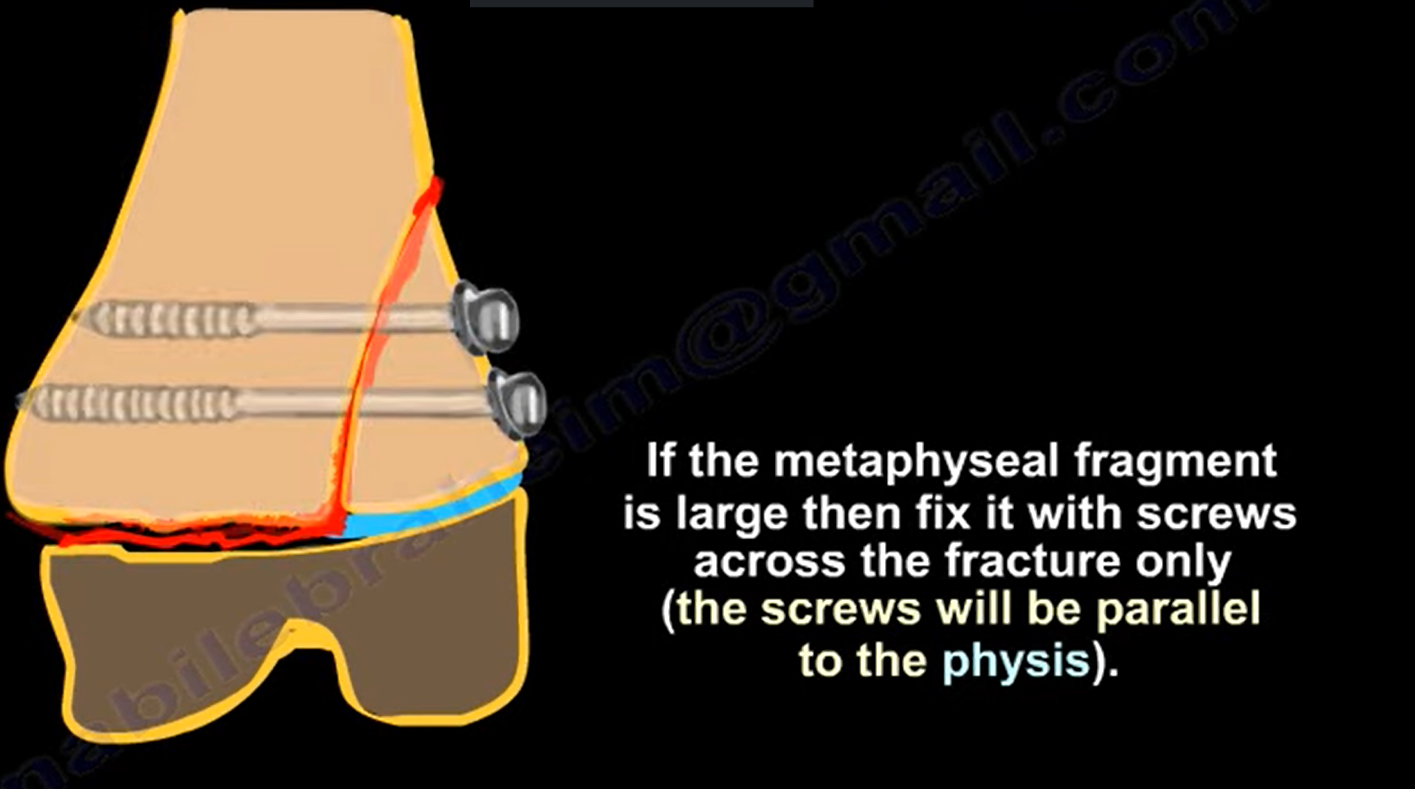
  • if metaphyseal fragment is large then fix it with screws(parallel to physis)
  • If fragment is small then do percutaneous pinning with smooth k wires.
  • Distal femur grows at a rate of 9 mm/years
  • Epiphysis of the distal femur is the first one to ossify &last one to fuse(contribute to 70perc growth of femur).
  • Girls finish their growth at age of 14 yrs &boys at 16 yrs.
  • Premature growth arrest will affect the metaphyseal part of the bone, not the epiphyseal part of the bone.
Post Views: 1,913

Related Posts

  • Lower trapezius for posterosuperior tears

    Courtesy: Emmanouil Brilakis, Bassam ELhassan, Athens Shoulder Course

  • Fractures of the Distal Femur

    Courtesy: Prof Nabil Ebraheim, University of Toledo, Ohio, USA

  • Distal femur fractures and Nonunion

    ? Courtesy: Prof Nabil Ebraheim, University of Toledo, Ohio, USA DELAYED UNIONS OR NON UNIONS…

Reader Interactions

Leave a Reply

Your email address will not be published. Required fields are marked *

Primary Sidebar

Follow Us

instagram slideshare

Categories

  • -Applied Anatomy
  • -Approaches
  • -Basic Sciences
  • -Cartilage & Meniscus
  • -Classifications
  • -Examination
  • -Foot and Ankle
  • -Foot and Ankle Trauma
  • -FRCS(Tr and Orth) tutorials
  • -Gait
  • -Hand and Wrist
  • -Hand and Wrist Trauma
  • -Hand Infections
  • -Hip and Knee
  • -Hip Preservation
  • -Infections
  • -Joint Reconstruction
  • -Knee Arthroplasty
  • -Knee Preservation
  • -Metabolic Disorders
  • -Oncology
  • -OrthoBiologics
  • -OrthoPlastic
  • -Paediatric Orthopaedics
  • -Paediatric Trauma
  • -Patellofemoral Joint
  • -Pelvis
  • -Peripheral Nerves
  • -Principles
  • -Principles of Surgery
  • -Radiology
  • -Rheumatology
  • -Shoulder and Elbow
  • -Shoulder and Elbow Arthroplasty
  • -Spine Deformity
  • -Spine Oncology
  • -Spine Trauma
  • -Spine, Pelvis & Neurology
  • -Sports Ankle and Foot
  • -Sports Elbow
  • -Sports Knee
  • -Sports Medicine
  • -Sports Medicine Hip
  • -Sports Shoulder
  • -Sports Wrist
  • -Statistics
  • -Technical Tip
  • -Technology in Orth
  • -Trauma
  • -Trauma (Upper Limb)
  • -Trauma Life Support
  • -Trauma Reconstruction
  • Book Shelf
  • Book Shelf Medical
  • Careers
  • Case Studies and Free Papers
  • DNB Ortho
  • Evidence Based Orthopaedic Principles
  • Evidence Based Orthopaedics
  • Exam Corner
  • Fellowships
  • Guest Editor
  • Guest Reviews
  • Image Quiz
  • Instructional Course Lectures
  • Journal Club
  • MCQs
  • Meetings and Courses
  • Multimedia
  • News and Blog
  • Plaster Techniques
  • Podcasts
  • Public Health
  • Rehabilitation
  • Research
  • Shorts and Reels
Copyright@orthopaedicprinciples.com. All right rerserved.