
Courtesy: Prof Nabil Ebraheim, University of Toledo, Ohio, USA
DELAYED UNIONS OR NON UNIONS OF THE DISTAL FEMUR
Introduction
- Failure rate: 20–30%
- Key: Mechanical stability + autologous bone graft
- may require dual-plate fixation or intramedullary nail-plate combinations
- Bone graft substitutes/biologics: further research needed
Anatomy
- Distal femur: ~15 cm segment
- metadiaphyseal junction to the articular surface
- Trapezoidal shape in axial plane
- Key landmarks: condyles, epicondyles
Definition
- Nonunion (FDA): 9 months post-injury, no healing in last 3 months
- Delayed union: prolonged healing, often >6 months
Epidemiology
- Nonunion rate: 0–34%
- Bimodal age distribution
- Higher in open, comminuted, unstable fractures
Risk Factors
- Obesity, diabetes, open fractures
- Medial bone loss, comminution
- Unstable fixation
Pathophysiology
Weber & Cech classification:
- Hypertrophic: abundant callus, poor stability
- Oligotrophic: incomplete healing, decreases biologic response
- Atrophic: no callus, poor biologic response
Treatment Principles
- Stability + Biology
- Patient-specific approach
- Autologous bone graft = gold standard
Fixation Options
- Lateral plate
- Medial + lateral plate
- IM nailing
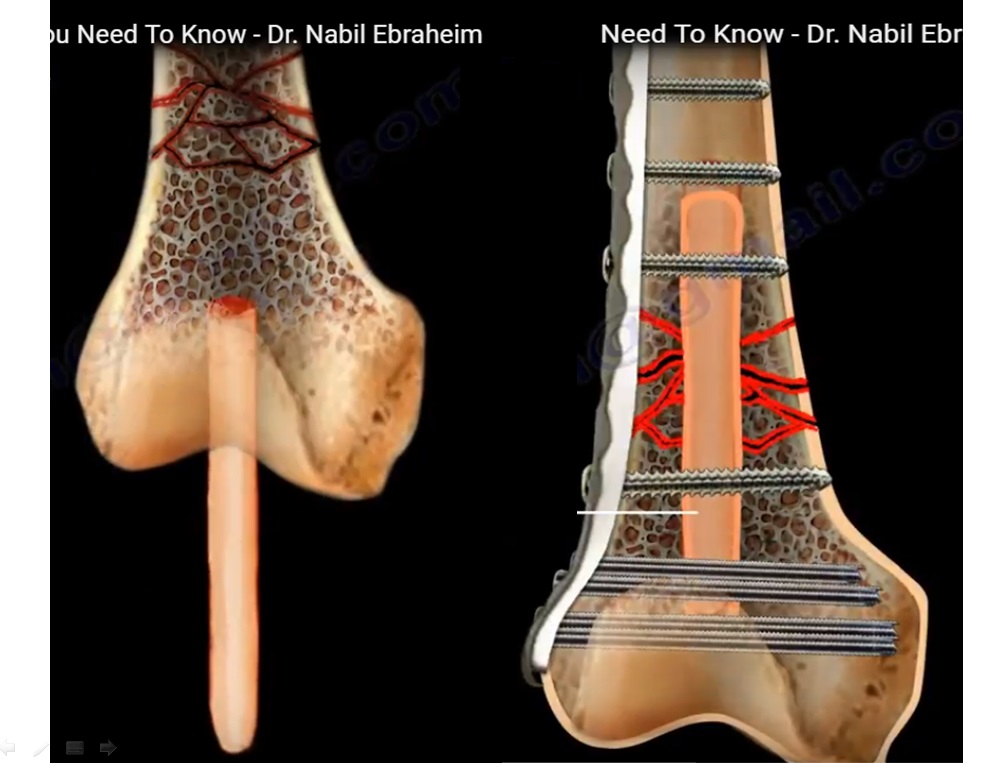
- Nail-plate combo
- External fixation
- Arthroplasty
Lateral Plate Fixation
- Historically standard
- Union rate up to 97%
- Failures still reported
- Lateral Plating – Studies
-Gardner: 97% union in 31 pts
– Bellabarba: 100% union in 20 pts
– Wang: 5-month avg healing time
Dual Plating
- Adds medial stability
- Improves outcomes in varus collapse
- Minimally invasive options
- Dual Plating – Evidence
-Higher union, lower complications
– Safe vascular zone
-Useful in atrophic non unions
Intramedullary Nailing
- Retrograde nail preferred
- Soft-tissue preservation
- Success rate: 25–100%
- Nailing – Studies
– Wu: 100% union in 12 pts
– Koval: 25% union in 16 pts - Effectiveness varies with location
- Exchange nailing is more effective for diaphyseal or isthmus fractures than metaphyseal fractures.
Nail + Plate Combination
- Improved biomechanical stability
- Early weight-bearing
- Useful in osteoporotic bone,substantial medial bone loss or severe comminution
Nail + Plate – Evidence
- Attum: 100% union in 10 pts
- Liporace: early mobilization success
- Saxena: strong outcomes in elderly
External Fixation
- Reserved for infection/soft tissue loss
- Ilizarov method: effective but uncomfortable pin-site infections
- prolonged time to union
- device poorly tolerated
- External Fixation – Studies
-Saridis: 100% union, poor tolerance
-Cavusoglu: effective for complex fractures
Distal Femoral Replacement
- Salvage option
- Used in elderly, severe comminution
- Early mobilization possible
Bone Grafting
- Autograft = gold standard
- Allografts, BMPs as adjuncts
- Masquelet technique for large defects
Outcomes & Prognosis
- Risk of reoperation, infection
- Good functional recovery if treated
- Impaired QoL persists
Summary
- No gold standard
- Technique based on fracture pattern and bone quality
- Nail-plate or dual plate = good stability
Recommendations
- Stability + biology essential
- Use autograft
- Choose fixation based on fracture type
- Allow early mobilization
Leave a Reply