
Courtesy- Dr Nabil
Overview
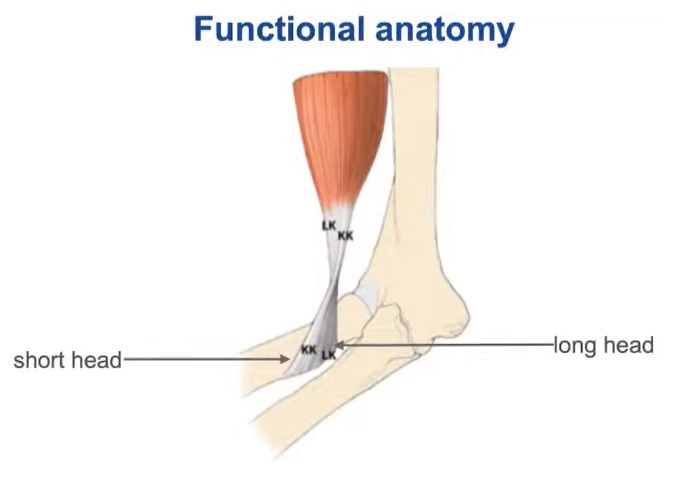
• Distal biceps tendon rupture is an injury of the distal insertion of the biceps tendon at the radial tuberosity.
• It usually results from a sudden eccentric load applied to a flexed elbow.
• The Hook Test is one of the most reliable clinical tests for diagnosing a complete distal biceps tendon rupture.
Anatomy
• The distal biceps tendon inserts onto the radial tuberosity.
• Functions of the biceps:
? Forearm supination
? Elbow flexion
Mechanism of Injury
• Sudden eccentric force on the elbow while flexed to approximately 90 degrees.
• Typically occurs when an unexpected extension force is applied to a contracting biceps muscle.
Epidemiology
• Most common in middle aged men.
• Usually affects the dominant upper limb.
• Typically results from a single traumatic event.
Clinical Features
Symptoms
• Sudden painful pop in the front of the elbow.
• Immediate anterior elbow pain.
• Weakness of forearm supination.
• Weakness of elbow flexion.
Clinical Signs
• Bruising around the elbow.
• Palpable defect at the distal biceps tendon.
• Proximal retraction of the biceps muscle belly producing the “reverse Popeye sign.”
Functional Deficits if Untreated
Failure to diagnose and repair a complete rupture may result in:
• 40 to 50 percent loss of forearm supination strength.
• Approximately 30 percent loss of elbow flexion strength.
Hook Test
Purpose
To diagnose complete rupture of the distal biceps tendon.
Patient Position
• Elbow flexed to 90 degrees.
• Forearm fully supinated.
Technique
• Examiner attempts to hook the lateral edge of the distal biceps tendon using the index finger.
• The finger is inserted beneath the tendon from the lateral side.
Interpretation
Normal or Partial Tear
• Tendon can be hooked with the examiner’s finger.
• Test is negative.
Complete Tear
• Tendon cannot be hooked.
• Test is positive for complete distal biceps tendon rupture.
Causes of False Positive Hook Test
• Partial distal biceps tendon tear.
• Intact lacertus fibrosus masking the injury.
• Mistaking the brachialis tendon for the distal biceps tendon.
Biceps Squeeze Test
Purpose
Alternative clinical test for distal biceps tendon rupture.
Patient Position
• Elbow flexed to approximately 80 degrees.
• Forearm held in slight pronation.
Technique
• Examiner squeezes the biceps muscle belly using one or both hands.
Interpretation
Intact Tendon
• Forearm supinates when the muscle is squeezed.
Complete Rupture
• No forearm supination occurs.
Partial Versus Complete Tears
Complete Tear
• Positive Hook Test.
• Palpable tendon defect.
• Reverse Popeye deformity may be present.
Partial Tear
• Pain over the anterior elbow.
• Hook Test is often normal.
• Frequently missed or misdiagnosed.
• Clinical presentation may resemble a complete tear.
Role of MRI
MRI is not required in every patient but is useful when:
• Partial tendon rupture is suspected.
• Clinical examination is inconclusive.
• Surgical planning is required.
MRI can determine:
• Presence of tendon tear.
• Partial versus complete rupture.
• Degree of tendon retraction.
Key Take Home Messages
• Distal biceps tendon rupture usually occurs after a sudden eccentric load on a flexed elbow.
• The Hook Test is highly useful for diagnosing complete distal biceps tendon rupture.
• A normal Hook Test does not exclude a partial tear.
• The Biceps Squeeze Test is a useful additional clinical test.
• MRI is most valuable for diagnosing partial tears and assessing tendon retraction.
• Early diagnosis and repair help preserve forearm supination and elbow flexion strength.
Exam Pearls
• Distal biceps tendon inserts on the radial tuberosity.
• Middle aged men are most commonly affected.
• Reverse Popeye sign suggests distal biceps tendon rupture.
• Complete tears produce a positive Hook Test.
• Partial tears often have a normal Hook Test and require MRI for confirmation.
• Untreated complete rupture results in significant loss of forearm supination strength.
Leave a Reply