
Epidemiology
- Relatively uncommon (~10% of all biceps ruptures)
- Typically affects:
- Men
- Age 40–50 years
- Dominant arm
- Much less common than proximal (shoulder) biceps rupture
Mechanism of Injury
- Usually a single traumatic event
- Classic scenario:
- Elbow flexed
- Sudden eccentric load (forced extension)
- Patients often report:
- “Pop” sensation
- Immediate pain
Risk Factors
- Smoking (major risk)
- Anabolic steroid use
- Male gender
- Repetitive forearm use
Anatomy Highlights
- Main functions of biceps:
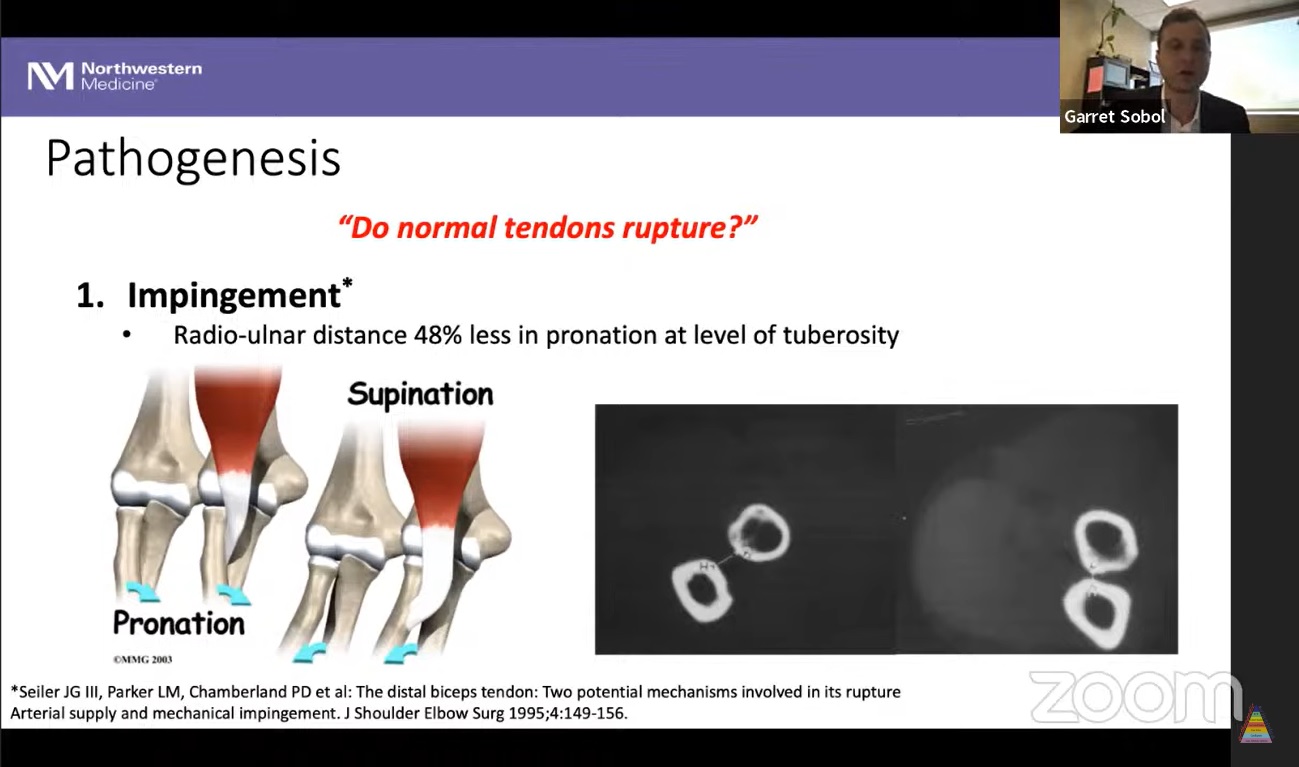
- Supination (primary role)
- Elbow flexion (secondary to brachialis)
- Two heads:
- Long head more supination
- Short head more flexion
- Important structure:
- Lacertus fibrosus (bicipital aponeurosis)
- May remain intact limits tendon retraction
- Lacertus fibrosus (bicipital aponeurosis)
Clinical Presentation
- Sudden pain in antecubital fossa
- Weakness:
- Supination (most affected)
- Flexion (variable)
- Visible deformity:
- Reverse Popeye sign
Physical Examination Tests
- Hook Test (Most reliable)
- Try to hook tendon with finger
- ` Cannot hook positive test (rupture)
- Squeeze Test
- Squeeze biceps look for forearm supination
- No movement – rupture
Imaging
- X-ray: usually normal
- MRI:
- Gold standard for:
- Partial tears
- Chronic/retracted tears
- Surgical planning
- Gold standard for:
Classification
- Complete vs Partial
- Acute vs Chronic
Treatment
Non-Operative (Selective cases)
Indications:
- Low-demand patients
- Medically unfit
- Patient preference
Expected deficits:
- Flexion strength: 10–20%
- Supination strength: 30–40%
- endurance
Still acceptable functional outcomes for some patients
Operative Treatment (Most common)
Techniques:
- Single Incision
- Anterior approach
- Fixation with:
- Cortical button (most common)
- Suture anchors
Pros:
- Smaller incision
- Easier technique
Cons:
- Risk of nerve injury (especially PIN)
- Double Incision
- Anterior + posterior
Pros:
- More anatomic repair (theoretical)
- Less nerve risk
Cons:
- Risk of:
- Heterotopic ossification
- Radioulnar synostosis
Fixation Methods
- Cortical button strongest biomechanically
- Suture anchors
- Bone tunnels
- Interference screws (less used alone)
Outcomes
- Both single & double incision:
- Similar functional results
- Good recovery
- Complications:
- Single incision nerve issues
- Double incision heterotopic ossification
Partial Tears
- Symptoms similar but:
- Hook test negative
- Tendon still palpable
Treatment:
- <50% tear try conservative
- 50% tear surgery often considered
In practice: decision is individualized
Chronic Tears (>4–12 weeks)
Problems:
- Tendon retraction
- Scar formation
- Muscle atrophy
Treatment Options:
- Direct repair (if possible)
- May need elbow flexed up to 90°
- Reconstruction
- Using graft (e.g., Achilles allograft)
- Tenodesis to brachialis
- Reduces pain but does NOT restore supination strength
Key Surgical Insight
- Repairs done in flexion (even up to 90°) can:
gradually stretch out over 6–8 weeks
regain full extension
Take-Home Messages
- Distal biceps rupture = eccentric overload injury
- Supination weakness is the key deficit
- Diagnosis is mainly clinical
- Surgery is preferred for active patients
- No clear superiority:
- Single vs double incision
- Chronic cases are more complex and often need graft
Courtesy: Garett Sobol MD, New Jersey, USA

Leave a Reply