
Courtesy: Rishi Dhir, FRCS Tr and Orth, CEO, Let’s Talk Dr
DEVELOPMENTAL DYSPLASIA OF HIP
- Defined as abnormal development of the hip resulting from capsular laxity along with combination of genetic and mechanical factors. It results in a spectrum of disease from dysplasia to subluxation and then to frank dislocation
Pathophysiology
- Initial instability which causes dysplasia (abnormal development) of acetabulum which causes subluxation of femoral head, which gradually progresses to dislocation.
- Over a long period of time secondary barriers develop which then hinders reduction.
As a result of chronic dislocation, certain anatomical changes occur in the form of
• Flattening of femoral head
• Increased femoral and acetabular anteversion
• Increased obliquity and decreased concavity of acetabular roof
• Thickening of medial acetabular wall
Evaluation
Every baby is screened for hip abnormalities at birth. Those who have an abnormal examination are referred to baby ultrasound clinic within 6 weeks where triple assessment of babies are done.
Triple assessment includes
1. History (risk factors)- 5 F’s
• First bone
• Female
• Fluid(oligohydramnios)
• Foetal malposition (breech)
• Family history
2. Examination
• Asymmetry of skin creases on gluteal fold
• Asymmetry of leg length (Galeazzi test)
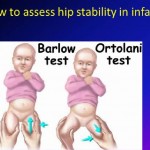
• Barlow’s test
• Ortolani’s test
Barlow’s test: In a dislocatable hip, hip is dislocated by adducting the hip and depressing a flexed femur (clunking sound is heard)
Ortolani’s test: In a reducible hip, the dislocated hip is reduced by abducting the hip and elevating the flexed femur
Radiological assessment – using USG
- In DDH the alpha angle decreases and beta angle increases
Alpha angle: angle between baseline(ilium) and acetabular roof, normal>60 degree
Beta angle : angle between baseline(ilium) and labrum, normal<55 degree
In a 4-6 month old child we can use an x-ray to diagnose DDH. - Typical x-ray finding are
• Ossific nucleus will be small
• Shenton’s line will be broken
• Acetabular index increases (normally 5 years), - lateral centre edge angle of Wiberg. Normally it will be <25 degree, whereas it increases in acetabular dysplasia
Treatment
Goals
• Stable hip
• Concentric reduction of hip
• Normal acetabular development
• Prevent degenerative joint disease
-AGE < 6 MONTHS: Pawlik’s Harness
• Flexion abduction orthosis(dynamic)
• 4 straps- shoulder, chest, anterior strap, posterior strap(abduction strap)
• Ramsey safe zone(too much abduction causes AVN whereas too much adduction causes dislocation)
-AGE 6 MONTHS: X-ray+ EUA +Arthrogram + adductor tenotomy + closed reduction , followed by hip spica application
Blocks for reduction- Intrinsic & extrinsic
Extrinsic – tight muscles(psoas, rectus femoris, hamstrings etc)
Intrinsic- hour glass capsule constriction, inverted labrum, transverse acetabular ligament, pulvinar fat
-AGE 12 MONTHS: Open reduction, followed by hip spica application
• Smith Peterson- anterior approach, internervous plane between femoral and superior gluteal nerve
• Ludloff – medial approach
-AGE 18 MONTHS OR OLDER: Osteotomies
1. Femoral- Varus derotation osteotomy, shortening osteotomy
2. Acetabular redirectional osteotomies
- Prerequistes-congruent correctible hip with good movements
- 18 moths to 2 years – SALTER
- 6 years to teenager – Triple osteotomy (TONNIS/STEEL)
- Teenager to adulthood – peri acetabular osteotomy (GANZ)
3. Acetabular volume reducing osteotomy
Prerequisites- congruent hip with good movements
Types – PEMBERTON, DEGA(in patients with neuromuscular conditions)
4. Acetabular salvage osteotomies
Done for patients with incongruent and uncontained hip
Types- SHELF, CHIARI
Healing occurs by fibrous metaplasia


woow sir today i get concpts of DDH