
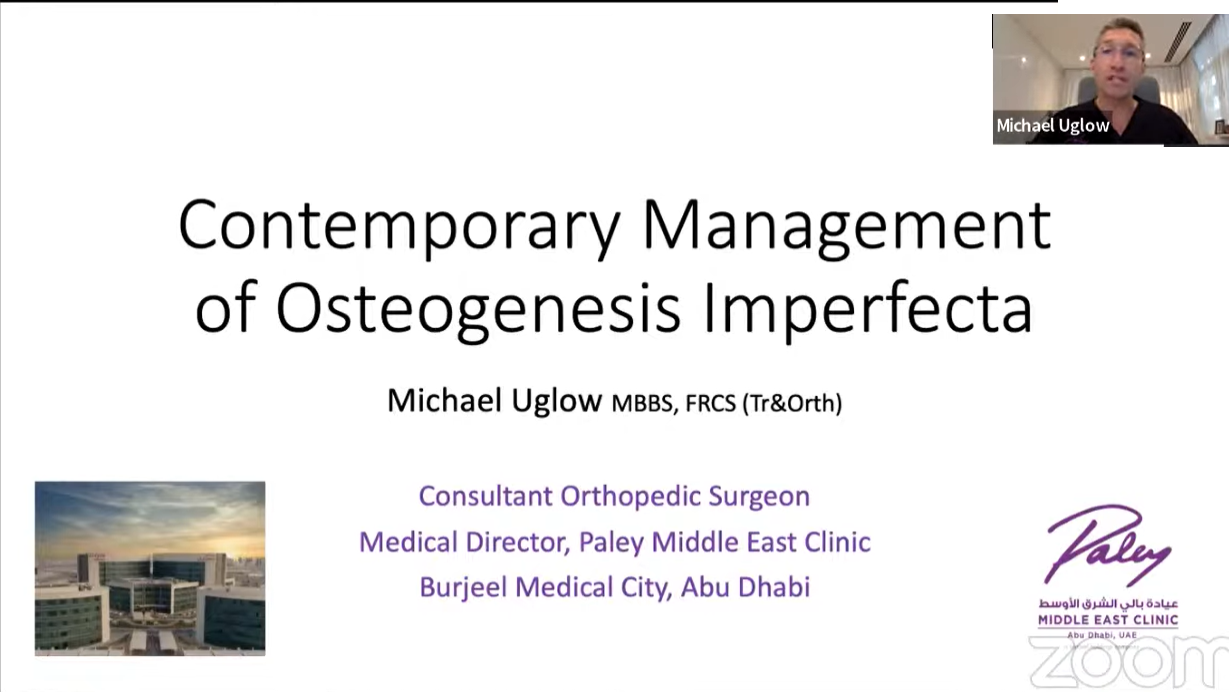
Courtesy: Michael Uglow, FRCS Orth, UK
OVERVIEW
-
Osteogenesis imperfecta is a genetic disorder of connective tissue.
-
It is commonly known as brittle bone disease.
-
The disorder is characterized by bone fragility and recurrent fractures.
-
The underlying defect involves type I collagen, which constitutes approximately 90 percent of total body collagen.
CLINICAL FEATURES
-
Bone fragility with recurrent long bone fractures
-
Skeletal deformities
-
Blue sclerae
-
Hearing loss
-
Fragile, opalescent teeth (dentinogenesis imperfecta)
-
Short stature in moderate to severe forms
TYPE I COLLAGEN AND PATHOGENESIS
-
Type I collagen is composed of a triple helix structure:
-
Two procollagen alpha-1 chains
-
One procollagen alpha-2 chain
-
-
Procollagen alpha-1 is encoded by the COL1A1 gene.
-
Procollagen alpha-2 is encoded by the COL1A2 gene.
Collagen Defects in Osteogenesis Imperfecta
Type I Osteogenesis Imperfecta
-
Caused by a stop codon mutation on the long arm of chromosome 17.
-
Results in reduced production of the alpha-1 chain.
-
Leads to a quantitative reduction of normal type I collagen.
-
Approximately 50 percent reduction in collagen production.
Types II, III, and IV Osteogenesis Imperfecta
-
Caused by abnormal production of alpha-1 or alpha-2 chains.
-
Results in defective cross-linking.
-
Leads to qualitative abnormalities in collagen structure.
SILLENCE CLASSIFICATION (SIMPLIFIED)
Type I
-
Autosomal dominant inheritance
-
Blue sclerae
-
Mildest form
-
Presents in early childhood
-
Hearing loss in approximately 50 percent
-
Subtypes A and B based on dentinogenesis imperfecta
Type II
-
Autosomal recessive inheritance
-
Blue sclerae
-
Perinatal lethal form
Type III
-
Autosomal recessive inheritance
-
Normal sclerae
-
Fractures present at birth
-
Progressive deformity and short stature
-
Most severe survivable form
Type IV
-
Autosomal dominant inheritance
-
Normal sclerae
-
Moderate severity
-
Bowing of long bones and vertebral fractures common
-
Hearing usually normal
-
Subtypes A and B based on dentinogenesis imperfecta
Type V
-
Autosomal recessive inheritance
-
Hypertrophic callus formation after fractures
-
Ossification of interosseous membranes between:
-
Radius and ulna
-
Tibia and fibula
-
Type VI
-
Autosomal recessive inheritance
-
Moderate severity
-
Clinically similar to type IV
Type VII
-
Autosomal recessive inheritance
-
Associated with rhizomelia
-
Coxa vara commonly present
OTHER CLASSIFICATIONS
-
Sillence classification (1979)
-
Shapiro classification (1985)
-
Congenita type A and B (based on bone morphology)
-
Tarda type A and B:
-
Type A: fractures before walking age
-
Type B: fractures after walking age
-
MANAGEMENT PRINCIPLES
-
Reduce fracture incidence
-
Correct deformities
-
Maintain mobility and function
-
Promote safe weight bearing
-
Improve bone strength
BISPHOSPHONATE THERAPY
Commonly Used Agent
-
Zoledronic acid
Dosage
-
0.025 to 0.05 milligrams per kilogram
-
Intravenous administration
-
Every 6 months
-
Dose adjusted based on age
Timing Relative to Surgery
-
First dose administered approximately 2 weeks before surgery
-
Second dose administered 12 weeks after surgery
Pre-Treatment Evaluation
-
Complete metabolic panel including:
-
Calcium
-
Phosphate
-
Magnesium
-
-
Serum 25-hydroxy vitamin D
-
Target vitamin D level greater than 50 nanograms per milliliter
Vitamin D Supplementation
-
Infants: 1,000 to 1,500 international units per day
-
Children 1 to 8 years: 2,500 to 3,000 international units per day
-
Children older than 9 years: 4,000 international units per day
-
Ergocalciferol may be used as high-dose replacement when indicated
Calcium Supplementation
-
Begin 2 weeks prior to infusion
-
Calcium 1,200 milligrams daily
-
Vitamin D 1,000 international units daily if not on high-dose therapy
Infusion Protocol
-
Pre-hydration required
-
Intravenous fluids at 10 milliliters per kilogram over 1 hour
-
Zoledronic acid diluted in 50 to 100 milliliters of normal saline
-
Infusion over approximately 30 minutes
-
Acetaminophen may be administered to reduce infusion-related symptoms
WOLFF LAW AND FROST UTAH PARADIGM
Disuse
-
Reduced bone loading
-
Decreased bone mass and strength
Adapted State
-
Balanced bone resorption and formation
-
Bone mass remains stable
Overload
-
Increased bone modeling
-
Increased bone mass and strength
Fracture
-
Occurs when elastic deformation limits are exceeded
SURGICAL MANAGEMENT
Aims of Surgical Correction
-
Correct deformity
-
Provide internal stabilization
-
Allow growth and remodeling
-
Maintain alignment and rotation
Preferred Implant
-
Intramedullary telescopic nails
-
Tethering to epiphysis when required
-
Additional rotational control if needed
FASSIER–DUVAL ROD COMPLICATIONS
-
Loss of proximal or distal fixation
-
Implant migration
-
Implant breakage
-
Limited telescoping
-
Intra-articular or cortical protrusion
-
Fracture
-
Rod bending
BENT ROD OUTCOMES IN OSTEOGENESIS IMPERFECTA
-
Approximately 27.4 percent of telescopic rods bend during follow-up
-
Average angulation approximately 7.3 degrees
-
Higher bending rates in non-severe osteogenesis imperfecta
-
Over half of bent rods require revision
-
Some bent rods continue telescoping but may increase angulation
-
Refracture risk remains significant
“STAND” PRINCIPLE
-
Straight bones
-
Therapy
-
Adjunctive medicines
-
Nails and plates
-
Vitamin supplementation
KEY RECOMMENDATIONS
-
Use the largest feasible intramedullary nail
-
Maintain optimal bone health
-
Ensure secure proximal and distal fixation
-
Maintain adequate vitamin D levels
-
Provide additional rotational stability when needed
-
Use plates when appropriate, or casting if plating is not possible
-
Monitor with serial radiographs
-
Recognize ongoing risks of rod bending and fracture
-
Continue bisphosphonate therapy every 6 months
-
Encourage safe ambulation and walking
CONCLUSION
-
Osteogenesis imperfecta requires multidisciplinary, lifelong management.
-
Medical therapy, surgery, and rehabilitation must be coordinated.
-
Functional independence and fracture prevention are the primary goals.
-
Early intervention and vigilant follow-up improve long-term outcomes.
Leave a Reply