• Skip to main content
  • Skip to secondary menu
  • Skip to primary sidebar
OrthopaedicPrinciples.com

OrthopaedicPrinciples.com

Integrating Principles and Evidence

Integrating Principles and Evidence

  • Home
  • Editorial Board
  • Our Books
    • Evidence Based Orthopaedic Principles
  • Courses
  • Exams
  • Reviews
  • Live Program
  • Contact

Congenital Muscular Torticollis


CONGENITAL MUSCULAR TORTICOLLIS

  • Usually caused by contracture of the sternocleidomastoid muscle
  • Usually occurs in infants.
  • It’s a common neck problem in childhood
  • Cause is unknown – May be caused form pressure on the muscle or compartment syndrome of the muscle.
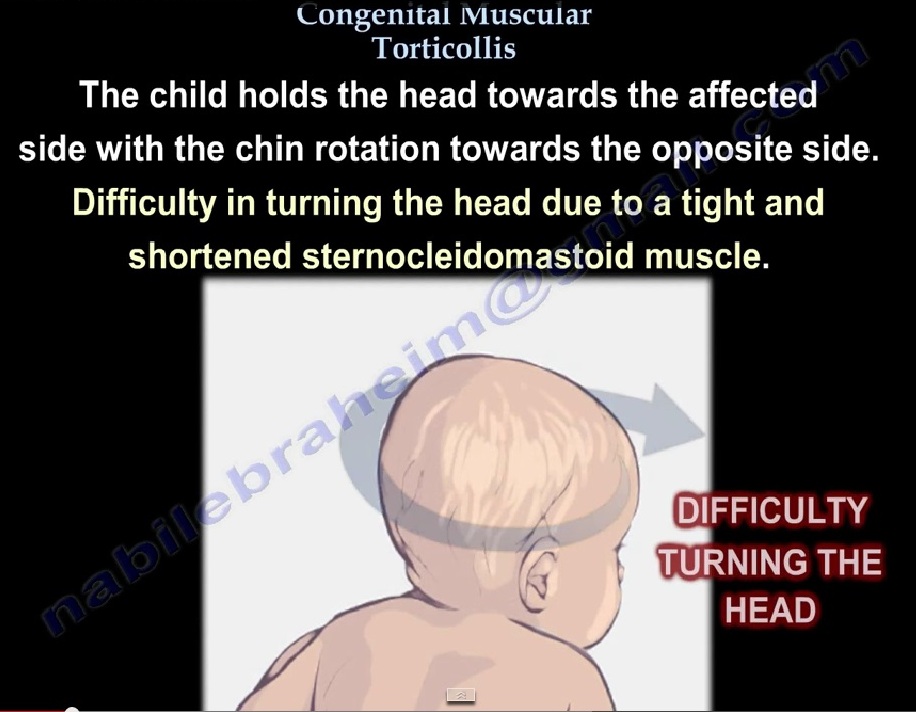
  • Child holds the head towards the affected side with the chin rotated towards the opposite side
  • Difficulty in turning the head due to a tight and shortened sternocleidomastoid muscle.
  • Usually delivery is traumatic and probably breach
  • Child will have a firm palpable mass within the first four weeks of life.
  • Conditions associated – Molding disorder or packaging deformity such as hip dysplasia (DDH) and metatarsus adductus (up to 20%).
  •  X-rays of the cervical spine are needed to exclude other conditions such as rotatory C1, C2 instability and Klippel Feil syndrome.
  • Ultrasound can differentiate between mild cases and severe fibrosis.
  • Differential diagnosis: Rotatory Atlanto-axial instability/ Grisel’s disease, Klippel Feil syndrome.

Treatment

  • Usually resolves spontaneously in about 90% of infants by passive stretching in the first year
  • Stretching technique should include lateral head tilt away from the affected side and chin rotation towards the affected side.
  • Passive Treatment may be guided by the findings in USG of the muscle.
  • Surgical treatment by Z plasty is done if the child is older than 1 year with severe limitation or rotation.
5 congenital muscular torticollisJ
Courtesy: Prof Nabile Ebraheim, University of TOledo, Ohio, USA
Post Views: 3,611

Related Posts

  • Congenital Muscular Torticollis

    Congenital muscular torticollis or congenital wry neck, is the most common cause of torticollis in…

  • Congenital Femoral Deficiency

    COurtesy: William Mackenzie, Jefferson Medical College, USA OVERVIEW Congenital femoral deficiency is a spectrum of…

  • Congenital Talipes Equinovarus

    Courtesy: Sameer Qureshi, Consultant Orthopaedic Surgeon, The Young Orthopod Channel

Reader Interactions

Leave a Reply

Your email address will not be published. Required fields are marked *

Primary Sidebar

Follow Us

instagram slideshare

Categories

  • -Applied Anatomy
  • -Approaches
  • -Basic Sciences
  • -Cartilage & Meniscus
  • -Classifications
  • -Examination
  • -Foot and Ankle
  • -Foot and Ankle Trauma
  • -FRCS(Tr and Orth) tutorials
  • -Gait
  • -Hand and Wrist
  • -Hand and Wrist Trauma
  • -Hand Infections
  • -Hip and Knee
  • -Hip Preservation
  • -Infections
  • -Joint Reconstruction
  • -Knee Arthroplasty
  • -Knee Preservation
  • -Metabolic Disorders
  • -Oncology
  • -OrthoBiologics
  • -OrthoPlastic
  • -Paediatric Orthopaedics
  • -Paediatric Trauma
  • -Patellofemoral Joint
  • -Pelvis
  • -Peripheral Nerves
  • -Principles
  • -Principles of Surgery
  • -Radiology
  • -Rheumatology
  • -Shoulder and Elbow
  • -Shoulder and Elbow Arthroplasty
  • -Spine Deformity
  • -Spine Oncology
  • -Spine Trauma
  • -Spine, Pelvis & Neurology
  • -Sports Ankle and Foot
  • -Sports Elbow
  • -Sports Knee
  • -Sports Medicine
  • -Sports Medicine Hip
  • -Sports Shoulder
  • -Sports Wrist
  • -Statistics
  • -Technical Tip
  • -Technology in Orth
  • -Trauma
  • -Trauma (Upper Limb)
  • -Trauma Life Support
  • -Trauma Reconstruction
  • Book Shelf
  • Book Shelf Medical
  • Careers
  • Case Studies and Free Papers
  • DNB Ortho
  • Evidence Based Orthopaedic Principles
  • Evidence Based Orthopaedics
  • Exam Corner
  • Fellowships
  • Guest Editor
  • Guest Reviews
  • Image Quiz
  • Instructional Course Lectures
  • Journal Club
  • MCQs
  • Meetings and Courses
  • Multimedia
  • News and Blog
  • Plaster Techniques
  • Podcasts
  • Public Health
  • Rehabilitation
  • Research
  • Shorts and Reels
Copyright@orthopaedicprinciples.com. All right rerserved.