• Skip to main content
  • Skip to secondary menu
  • Skip to primary sidebar
OrthopaedicPrinciples.com

OrthopaedicPrinciples.com

Integrating Principles and Evidence

Integrating Principles and Evidence

  • Home
  • Editorial Board
  • Our Books
    • Evidence Based Orthopaedic Principles
  • Courses
  • Exams
  • Reviews
  • Live Program
  • Contact

Clinical Evaluation of the Hamstring Muscles

Courtesy: Prof Nabil Ebraheim, University of Toledo, Ohio, USA


Three Hamstring muscles

1. Biceps femoris
2. Semitendinosus
3. Semimembranosus

Biceps femoris:-
Long head:
Origin- ischium
Insertion- fibular head

Short head:
Origin- femur
Insertion- along with long head laterally on the fibula

Semitendinosus:-
Origin- common origin with biceps femoris muscle, then separated from the Biceps femoris as it descends medially, and long head of Biceps femoris descends laterally.

Semimembranosus:-
Origin- ischial tuberosity
Insertion- proximal tibia medially next to the insertion of semitendinosus muscle

Nerve supply:-
All hamstring muscles supplied by tibial nerve, branch of sciatic nerve except short head of Biceps femoris which is supplied by common peroneal nerve

Function:-
Flexion of the knee and extension of hips

Examination:-
Hamstring muscle function should be examined in case of any injury to muscle/ tendon/ sciatic nerve injury

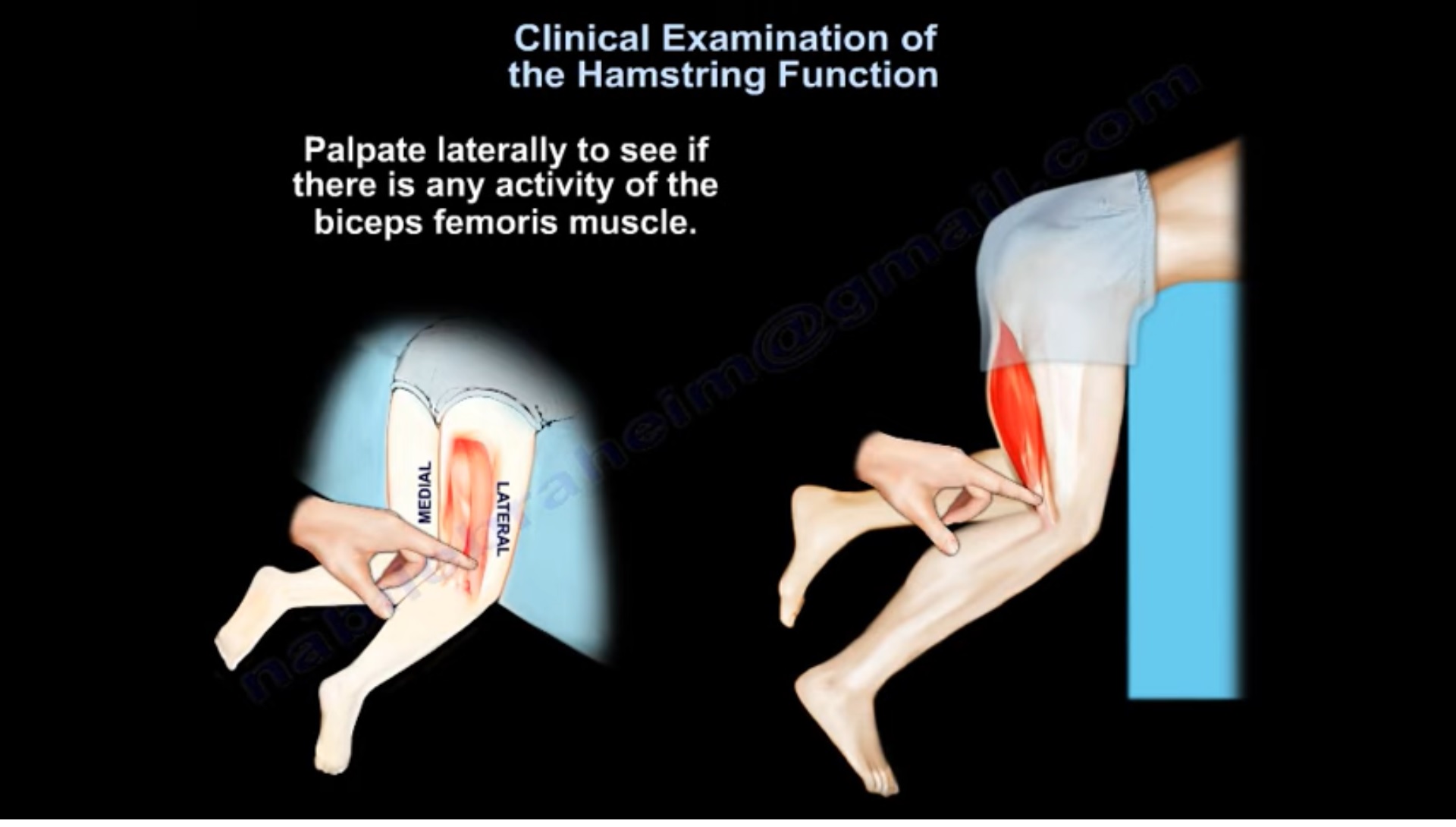
Patient in prone position, hips and lower extremities hang freely from the edge of the table (dangle)

Assess if the patient is able to flex the knee and do that against gravity and against resistance.

Palpate on medial side to look for contraction of semimembranosus and semitendinosus

Palpate lateral side to look for contraction of Biceps femoris.
Post Views: 2,100

Related Posts

  • Clinical Evaluation of the Shoulder

    Courtesy: Prof Nabil Ebraheim, University of Toledo, Ohio, USA

  • Applied Clinical anatomy of the Scapula

    Courtesy: Mock FRCS Cardiff Saqib Masud FRCS, John Davies FRCS

  • Anatomy of the #Peroneal Muscles

    Courtesy : Prof Nabile Ebraheim, University of Toledo, Ohio, USA

Reader Interactions

Leave a Reply

Your email address will not be published. Required fields are marked *

Primary Sidebar

Follow Us

instagram slideshare

Categories

  • -Applied Anatomy
  • -Approaches
  • -Basic Sciences
  • -Cartilage & Meniscus
  • -Classifications
  • -Examination
  • -Foot and Ankle
  • -Foot and Ankle Trauma
  • -FRCS(Tr and Orth) tutorials
  • -Gait
  • -Hand and Wrist
  • -Hand and Wrist Trauma
  • -Hand Infections
  • -Hip and Knee
  • -Hip Preservation
  • -Infections
  • -Joint Reconstruction
  • -Knee Arthroplasty
  • -Knee Preservation
  • -Metabolic Disorders
  • -Oncology
  • -OrthoBiologics
  • -OrthoPlastic
  • -Paediatric Orthopaedics
  • -Paediatric Trauma
  • -Patellofemoral Joint
  • -Pelvis
  • -Peripheral Nerves
  • -Principles
  • -Principles of Surgery
  • -Radiology
  • -Rheumatology
  • -Shoulder and Elbow
  • -Shoulder and Elbow Arthroplasty
  • -Spine Deformity
  • -Spine Oncology
  • -Spine Trauma
  • -Spine, Pelvis & Neurology
  • -Sports Ankle and Foot
  • -Sports Elbow
  • -Sports Knee
  • -Sports Medicine
  • -Sports Medicine Hip
  • -Sports Shoulder
  • -Sports Wrist
  • -Statistics
  • -Technical Tip
  • -Technology in Orth
  • -Trauma
  • -Trauma (Upper Limb)
  • -Trauma Life Support
  • -Trauma Reconstruction
  • Book Shelf
  • Book Shelf Medical
  • Careers
  • Case Studies and Free Papers
  • DNB Ortho
  • Evidence Based Orthopaedic Principles
  • Evidence Based Orthopaedics
  • Exam Corner
  • Fellowships
  • Guest Editor
  • Guest Reviews
  • Image Quiz
  • Instructional Course Lectures
  • Journal Club
  • MCQs
  • Meetings and Courses
  • Multimedia
  • News and Blog
  • Plaster Techniques
  • Podcasts
  • Public Health
  • Rehabilitation
  • Research
  • Shorts and Reels
Copyright@orthopaedicprinciples.com. All right rerserved.