
Courtesy: Prof Nabil Ebraheim, University of Toledo, Ohio, USA
Cat Bites and Cat-Scratch Disease
Cat bites and cat-scratch disease are both associated with cats, but they are two distinct clinical entities.
1. Cat Bites
Epidemiology
- Cat bites have a relatively high infection rate, approximately 30–50%.
- Dog bites are more common overall but have a lower infection rate.
- Cat bites are more common in females.
- Animal bites are common in children.
- Cat bites commonly involve the upper extremity, particularly the hand.
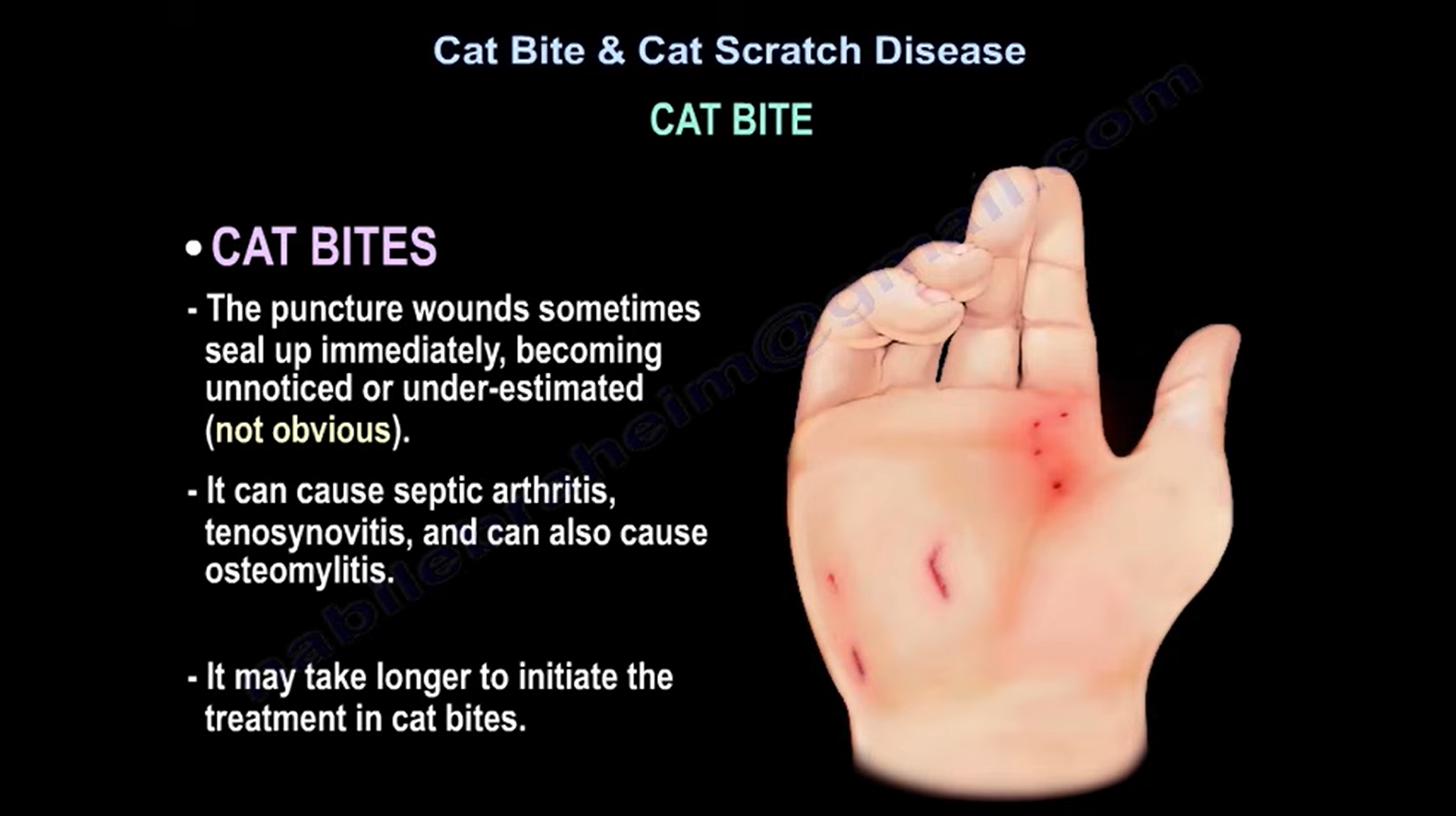
- Presentation may be delayed because the initial puncture wound is often underestimated.
Why Cat Bites Are Highly Infectious
Cats have small, sharp, needle-like teeth that can produce deep puncture wounds.
The puncture may penetrate:
- Bone
- Joint
- Tendon sheath
The skin may seal rapidly over the puncture, making the injury appear deceptively minor.
This can result in:
- Septic arthritis
- Tenosynovitis
- Osteomyelitis
- Abscess
Risk Factors for Infection
Risk increases with:
- Treatment delayed beyond 12 hours
- Older age
- Puncture wounds
- Diabetes
- Immunosuppression
Causative Organisms
The lecture identifies Pasteurella as the most common organism.
- Present in approximately 80% of cat bites
- Infection is often polymicrobial
- Pasteurella can produce significant pain and swelling within approximately 48 hours
- Culture may take several days to grow
Early Treatment
For an early presentation:
- Irrigation
- Wound care
- Tetanus prophylaxis as appropriate
- Splinting when necessary
- Antibiotics when indicated
- Observation
Antibiotics
The lecture specifically identifies amoxicillin-clavulanate (Augmentin) as the commonly used antibiotic.
Antibiotics are particularly emphasized for:
- Hand injuries
- Facial injuries
- Severe or deep wounds
- Wounds extending toward bone
The lecture describes a 3–5 day course for prophylaxis.
Delayed Presentation
Delayed treatment can result in:
- Abscess
- Septic arthritis
- Tenosynovitis
- Osteomyelitis
These patients may require:
- Surgical incision and drainage
- Debridement/cleaning of the wound
- Antibiotic treatment
A significant proportion of cat-bite patients requiring surgery is noted in the lecture.
2. Cat-Scratch Disease
Cat-scratch disease is different from a cat bite infection.
It is an infection transmitted through a cat scratch and is associated with Bartonella species.
Clinical Course
The typical course is:
Cat scratch-
Within approximately 1 week
Small skin lesion-
Within approximately 2 weeks
Regional lymph-node enlargement
The skin lesion is usually:
- Small
- Less than approximately 1 cm
The disease is generally self-limiting, with symptoms lasting several weeks.
Clinical Features
Important symptoms include:
- Regional lymphadenopathy
- Fever
- Fatigue
- Headache
- Tender or enlarged lymph nodes
- Occasionally draining lymph nodes
The key clinical feature is:
Regional lymphadenopathy following exposure to a cat.
Common Lymph-Node Groups
Depending on the site of inoculation, lymphadenopathy may occur in:
- Cervical nodes
- Axillary nodes
- Epitrochlear nodes
- Inguinal nodes
Enlarged nodes can sometimes be mistaken for a soft-tissue tumour.
Therefore, cat-scratch disease should be considered in the differential diagnosis of an unexplained regional mass.
Investigations
The lecture mentions:
- ESR
- CRP
- Testing for cat-scratch disease
It also notes that biopsy is generally unnecessary.
If performed, biopsy may demonstrate:
- Lymphoid tissue
- Necrotizing granulomatous inflammation
Treatment
The lecture describes the disease as generally self-limiting.
Antibiotics mentioned include:
- Azithromycin
- Ciprofloxacin
- Doxycycline
Cat Bite vs Cat-Scratch Disease
| Feature | Cat bite | Cat-scratch disease |
|---|---|---|
| Mechanism | Bite/puncture | Scratch |
| Main problem | Local bacterial infection | Regional lymphadenopathy |
| Important organism | Pasteurella | Bartonella |
| Wound | Deep puncture | Small skin lesion |
| Major complications | Septic arthritis, tenosynovitis, osteomyelitis | Usually self-limiting lymphadenopathy |
| Typical timing | Infection can develop rapidly | Skin lesion followed by nodes over 1–2 weeks |
| Treatment | Wound care + antibiotics when indicated | Often self-limiting; antibiotics in selected cases |
High-Yield Points
- Cat bite is not the same as cat-scratch disease.
- Cat bites have a high risk of infection because the teeth produce deep puncture wounds.
- Pasteurella is the important organism emphasized for cat bites.
- A seemingly small cat bite to the hand can involve the tendon sheath or joint.
- Delayed treatment increases the risk of tenosynovitis, septic arthritis and osteomyelitis.
- Amoxicillin-clavulanate is the antibiotic highlighted in the lecture.
- Cat-scratch disease is associated with Bartonella.
- Regional lymphadenopathy after a cat scratch is the characteristic clinical clue.
- Cat-scratch disease is generally self-limiting.
- Enlarged epitrochlear or other regional lymph nodes can mimic a soft-tissue tumour.

Leave a Reply