• Skip to main content
  • Skip to secondary menu
  • Skip to primary sidebar
OrthopaedicPrinciples.com

OrthopaedicPrinciples.com

Integrating Principles and Evidence

Integrating Principles and Evidence

  • Home
  • Editorial Board
  • Our Books
    • Evidence Based Orthopaedic Principles
  • Courses
  • Exams
  • Reviews
  • Live Program
  • Contact

Carpal Tunnel Syndrome and #Diabetes


Courtesy: Prof Nabil Ebraheim, University of Toledo, Ohio, USA
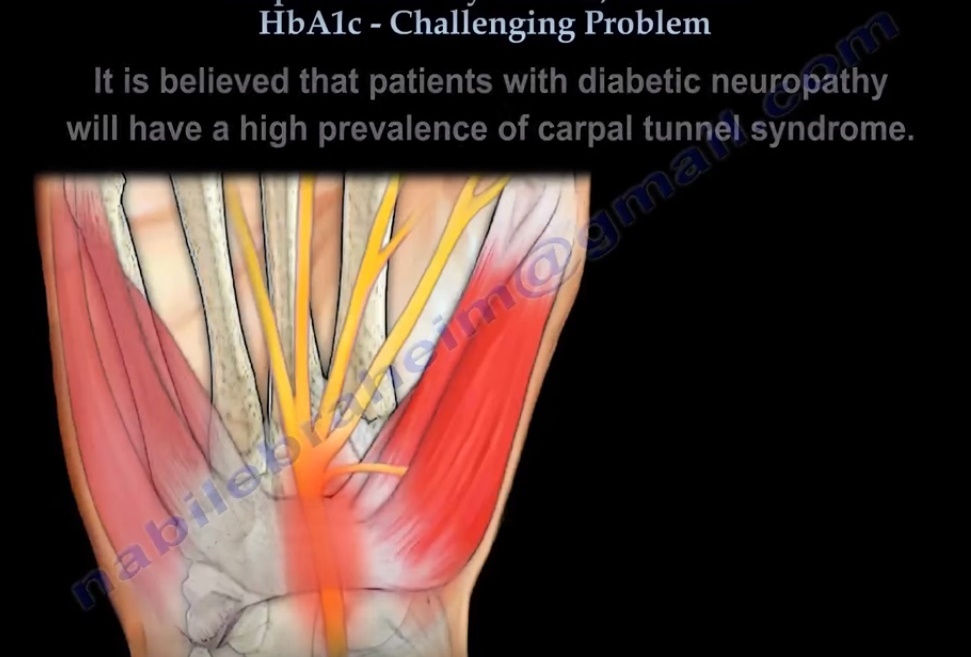
CTS and diabetes

Video describes association between carpal tunnel syndrome and diabetes mellitus. About 20 % of diabetic patients develops carpal tunnel syndrome. Nerves which developed peripheral neuropathy are more vulnerable to damage in carpal tunnel compression. Managemant of carpal tunnel syndrome in diabetic patient is a challenging situation.Initially it is imperative to know the blood sugar levels and HbA1c value which reflect glycemic control of past 2-3 months.If it is an Acute condition emergency surgical decompression is the treatment of choice. Elective surgery should be performed after controlling blood sugar levels.If surgery is performed in the backround of high blood sugar levels patient may develop surgical site infection

Post Views: 2,081

Related Posts

  • Diabetes and Carpal Tunnel Syndrome

    Courtesy: Prof Nabil Ebraheim, University of Toledo, Ohio, USA

  • Carpal Tunnel Syndrome Treatment

    Courtesy: Prof Nabil Ebraheim, University of Toledo, Ohio, USA This video focuses on the treatment…

  • Carpal Tunnel Syndrome

    Courtesy: Prof Nabile Ebraheim, University of Toledo, Ohio, USA

Reader Interactions

Leave a Reply

Your email address will not be published. Required fields are marked *

Primary Sidebar

Follow Us

instagram slideshare

Categories

  • -Applied Anatomy
  • -Approaches
  • -Basic Sciences
  • -Cartilage & Meniscus
  • -Classifications
  • -Examination
  • -Foot and Ankle
  • -Foot and Ankle Trauma
  • -FRCS(Tr and Orth) tutorials
  • -Gait
  • -Hand and Wrist
  • -Hand and Wrist Trauma
  • -Hand Infections
  • -Hip and Knee
  • -Hip Preservation
  • -Infections
  • -Joint Reconstruction
  • -Knee Arthroplasty
  • -Knee Preservation
  • -Metabolic Disorders
  • -Oncology
  • -OrthoBiologics
  • -OrthoPlastic
  • -Paediatric Orthopaedics
  • -Paediatric Trauma
  • -Patellofemoral Joint
  • -Pelvis
  • -Peripheral Nerves
  • -Principles
  • -Principles of Surgery
  • -Radiology
  • -Rheumatology
  • -Shoulder and Elbow
  • -Shoulder and Elbow Arthroplasty
  • -Spine Deformity
  • -Spine Oncology
  • -Spine Trauma
  • -Spine, Pelvis & Neurology
  • -Sports Ankle and Foot
  • -Sports Elbow
  • -Sports Knee
  • -Sports Medicine
  • -Sports Medicine Hip
  • -Sports Shoulder
  • -Sports Wrist
  • -Statistics
  • -Technical Tip
  • -Technology in Orth
  • -Trauma
  • -Trauma (Upper Limb)
  • -Trauma Life Support
  • -Trauma Reconstruction
  • Book Shelf
  • Book Shelf Medical
  • Careers
  • Case Studies and Free Papers
  • DNB Ortho
  • Evidence Based Orthopaedic Principles
  • Evidence Based Orthopaedics
  • Exam Corner
  • Fellowships
  • Guest Editor
  • Guest Reviews
  • Image Quiz
  • Instructional Course Lectures
  • Journal Club
  • MCQs
  • Meetings and Courses
  • Multimedia
  • News and Blog
  • Plaster Techniques
  • Podcasts
  • Public Health
  • Rehabilitation
  • Research
  • Shorts and Reels
Copyright@orthopaedicprinciples.com. All right rerserved.