
Courtesy: Prof Nabil Ebraheim, University of Toledo, Ohio, USA
Topic / Overview
Cervical myelopathy represents neurologic impairment secondary to compression of the spinal cord within the cervical canal. It is characterized by progressive spinal cord compromise, classically impacting hand function, coordination, and gait.
Background / Problems
-
Natural History: Characterized by a slow, stepwise deterioration over time, interspersed with variable periods of stable neurologic function. Spontaneous recovery is rare; the disease typically worsens progressively without surgical intervention.
-
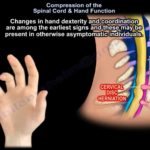
Early Manifestations: Subtle deterioration in hand dexterity and coordination represents one of the earliest clinical signs, often manifesting in otherwise asymptomatic individuals.
-
Diagnostic Pitfall: Diffuse hand numbness is frequently misdiagnosed as carpal tunnel syndrome. A high index of suspicion is required to prevent diagnostic delay and subsequent neurological decline.
-
Diagnostic Modality of Choice: Magnetic Resonance Imaging (MRI) is the gold standard imaging modality to establish the diagnosis of cervical myelopathy.
Classification or Concept: The Myelopathic Hand
The “myelopathic hand” denotes the constellation of motor, sensory, and functional deficits observed in the upper extremity resulting from cervical spinal cord compression. The lower cervical nerve roots (C8–T1 distribution) are the most severely affected.
Clinical Signs and Pathomechanics
-
Intrinsic Muscle Atrophy & Wasting: Progressive cord compression results in intrinsic muscle wasting, manifesting as diminished grip strength, pinch weakness, and motor impairment.
-
Sensory Impairment: Symmetric numbness, tingling, and paresthesias affecting the extremities and hands.
-
Spasticity & Hyperreflexia: Upper motor neuron signs involving both upper and lower extremities.
-
Finger Escape Sign:
-
Procedure: The patient is instructed to maintain the fingers in full extension and adduction.
-
Positive Result: Spontaneous abduction of the small finger due to intrinsic muscle weakness. Alternatively, drift of the ulnar two digits into abduction and flexion within 30 seconds.
-
-
Grip and Release Test:
-
Normal Baseline: Ability to form a complete fist and fully extend/release the digits 20 times in 10 seconds.
-
Positive Result: Inability to achieve this threshold, accompanied by difficulty fully opening or closing the hand, with noticeable loss of coordination during rapid alternating movements.
-
Associated Upper Motor Neuron and Neurological Findings
-
Hoffmann Sign: Elicited by snapping or flicking the distal phalanx of the middle finger, resulting in spontaneous reflex flexion/adduction of the thumb and index/other fingers.
-
Clinical Significance: Noted as the most common physical examination finding.
-
-
Babinski Test: Dorsiflexion/extension of the great toe upon plantar stimulation.
-
Clonus: Sustained rhythmic contractions defined as more than 3 beats.
-
Gait and Balance Disturbances: Patients exhibit hand clumsiness alongside marked gait instability and feeling unsteady on their feet. A positive Romberg sign may be present.
-
Craniofacial Symptoms: Occipital headaches can occur, particularly in older patients.
Indications / Patient Selection
-
Target Demographic: Typically older individuals presenting with progressive hand clumsiness, gait instability, dropping of handheld objects, and impaired fine motor tasks (e.g., buttoning or unbuttoning shirts).
-
Surgical Indication: Because the condition is progressive and rarely resolves spontaneously, early surgical intervention is indicated upon diagnosis to prevent irreversible neurological deterioration and achieve favorable outcomes.
Technique / Principles
-
Surgical Objectives: Formal surgical intervention entails two primary operative goals:
-
Decompression of the compressed cervical spinal cord.
-
Stabilization (fusion/instrumentation) of the cervical spine.
-
Results / Evidence Cited
-
Myelopathic Signs on Exam: Approximately 20% of patients with cervical myelopathy demonstrate no myelopathic signs on physical examination.
-
Diagnostic Reliability of Upper Motor Neuron Signs:
-
Hoffmann Sign: Reliable in approximately 60% of patients.
-
Babinski Sign: Present/reliable in approximately 13% of patients.
-
Clonus (>3 beats): Present/reliable in approximately 13% of patients.
-
Complications / Limitations
-
Limitations of Physical Examination: Reliance purely on pathognomonic physical signs can lead to missed diagnoses, as a fifth (20%) of patients present without overt myelopathic findings, and classical signs (Babinski and clonus) exhibit low individual sensitivity (13%).
-
Misdiagnosis Risks: Misattributing diffuse numbness to peripheral neuropathies (such as carpal tunnel syndrome) delays decompression, allowing permanent intrinsic loss and irreversible functional decline.
Practical Clinical Implications
-
Thorough neurological testing must incorporate functional tests (grip-and-release, finger escape) rather than relying solely on deep tendon reflexes or classic long-tract signs.
-
Any elderly patient presenting with complaints of “dropping objects,” trouble buttoning clothing, diffuse upper extremity paresthesias, or unsteadiness requires an MRI of the cervical spine.
-
Decompression and stabilization should be considered early, as clinical status reflects stepwise neurological degradation rather than spontaneous stabilization or improvement.
Key Take-Home Points
-
Pathophysiology: Neurologic impairment from cervical canal spinal cord compression, typically worse at the C8–T1 level.
-
Presentation: Early loss of manual dexterity, symmetric numbness, gait instability, and difficulty manipulating fine objects.
-
Physical Tests:
-
Finger Escape: Small finger abducts, or ulnar two digits abduct and flex within 30 seconds.
-
Grip and Release: Less than 20 cycles per 10 seconds indicates impairment.
-
Long-Tract Signs: Hoffmann is the most common (reliable in ~60%); clonus and Babinski occur in ~13%.
-
-
Surgical Strategy: Early cervical decompression and stabilization, targeting preservation and recovery of neurological function.


Leave a Reply